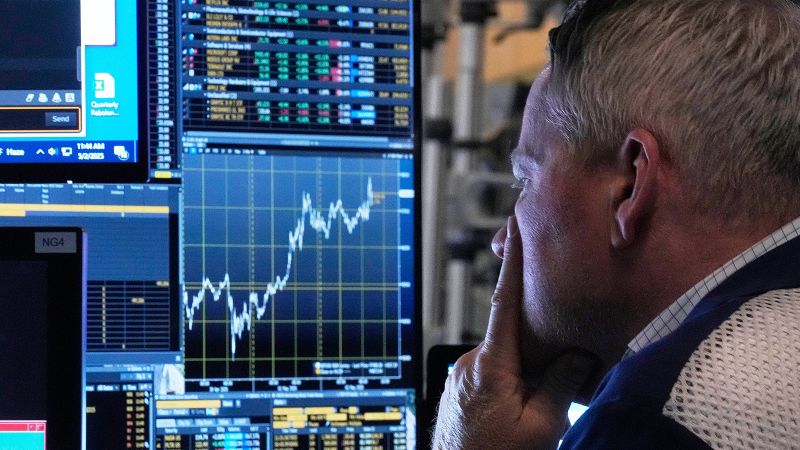
Trump’s tariff war roils typically quiet corner of global markets
CNN
US President Donald Trump’s efforts to “rebalance” global trade have spooked Wall Street, disquieted US Treasuries and sent investors rushing to buy gold. They have now also roiled a normally staid corner of financial markets, with major potential implications for the future of the US dollar and the global economy.
US President Donald Trump’s efforts to “rebalance” global trade have spooked Wall Street, disquieted US Treasuries and sent investors rushing to buy gold. They have now also roiled a normally staid corner of financial markets, with major potential implications for the future of the US dollar and the global economy. Since Friday, Taiwan’s currency has gained about 8% against the greenback, according to Refinitv data, an extraordinary amount over just two trading sessions because of speculation that the island has had to make trade-related concessions to the White House. And even though things are now calmer, Monday’s surge was the largest daily percentage gain in about four decades, according to Reuters, which was all the more surprising because the island’s central bank likes to keep things stable and quiet. The gyrations in Taiwan — and also in nearby Hong Kong, a city with a currency market that similarly tends to avoid the limelight — demonstrate how Trump’s trade war has already had far-reaching consequences. Yang Chin-long, governor of Taiwan’s central bank, was forced to convene a hastily arranged press conference late on Monday to shoot down rumors that the Trump administration had asked the island to strengthen its currency against the US dollar in exchange for tariff exemptions during ongoing trade talks. “Stock market commentators are urged not to comment … in a speculative manner to avoid affecting the order and stability of Taiwan’s foreign exchange market and even affecting the real economy,” he said in a statement.


Gerald Rodriguez, the general manager of an NPR affiliate in rural Colorado, expected federal funding for public media to shrink. He didn’t expect it to disappear almost overnight.

The much-touted new tax breaks for tips, overtime, seniors and car loan interest have a lot of income tax filers expecting a big bump in their refunds this year – or a big cut in their tax bill.

Looking out his shop window, across the street, just to the right, Paloma Clothing co-owner Mike Roach sees one of Portland, Oregon’s, most expensive gas stations.

Oil and liquefied natural gas tankers moving through the Strait of Hormuz carry around 20% of the world’s supply. But for countries on the Persian Gulf, the waterway is more than just an energy route – it’s a lifeline for more than 100 million people.

A California jury has largely sided with Twitter shareholders who accused billionaire Elon Musk of defrauding them by intentionally driving down the social media company’s stock ahead of his $44 billion acquisition in 2022.

The war with Iran is disrupting global oil flows, damaging energy infrastructure and raising fears of prolonged conflict. But gold, usually considered a safe haven during periods of economic uncertainty, has slumped.

US stocks and bonds fell, oil prices rose and gold had its worst week in four decades as the Iran war continues to ripple through financial markets.

The White House on Friday released its long-awaited national artificial intelligence legislative framework, a move to prevent states from enacting their own laws and enforce the Trump administration’s light-touch approach to AI regulation.

“Today is a difficult day,” CBS executives wrote to staff, explaining the cuts as a tough but necessary reallocation of newsroom resources.

President Donald Trump has repeatedly promised that Americans will get larger tax refunds this year thanks to his “big, beautiful bill.”

President Donald Trump has repeatedly promised that Americans will get larger tax refunds this year thanks to his “big, beautiful bill.”

Oil prices edged lower on Friday after a tumultuous day that saw the international benchmark surge above $119 a barrel as the Middle East conflict deepened energy supply fears.

The war in Iran has delivered what economists call a “black swan” event — an unforeseen shock so destructive, no one is immune to it.