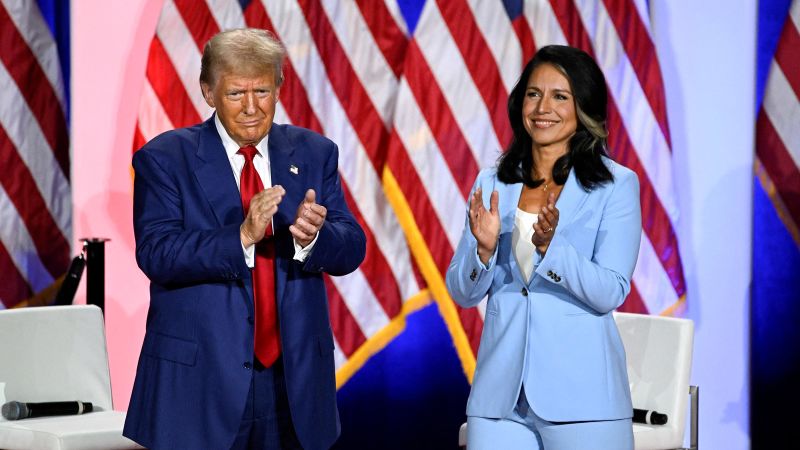
Trump’s pick for intel chief has deeply rooted distrust of agencies she would oversee
CNN
In 2020, the woman who has become Donald Trump’s pick to be the nation’s top spymaster met with one of the most infamous leakers of all time.
In 2020, the woman who has become Donald Trump’s pick to be the nation’s top spymaster met with one of the most infamous leakers of all time. Tulsi Gabbard, then in the midst of a failed bid for the Democratic nomination for president, met with Daniel Ellsberg, a military analyst who leaked the Pentagon Papers to The New York Times and The Washington Post in the 1970s and was charged with violations of the Espionage Act. He argued to her that it should be unconstitutional to charge officials who leak classified information to media outlets with espionage. Gabbard agreed, declaring the practice “insanity.” Later that year, she introduced a bill in the House called the “Protect Brave Whistleblowers Act,” designed to shield people like Ellsberg. She wrote two more bills that same week supporting Julian Assange and Edward Snowden, who were behind two of the biggest US national security leaks of the 21st Century. Trump’s selection of Gabbard to run the Office of the Director of National Intelligence has quickly drawn scrutiny because of her relative inexperience in the intelligence community and her public adoption of positions on Syria and the war in Ukraine that many national security officials see as Russian propaganda. But where she is perhaps most at odds with the agencies she may soon be tasked with leading is her distrust of broad government surveillance authorities and her support for those willing to expose some of the intelligence community’s most sensitive secrets. It’s also where she may come into conflict with Trump’s own past record — even as she appears to represent an evolution of the MAGA movement toward a more youthful, techno-libertarian vision of the anti-surveillance faction of the Republican Party. It was the first Trump administration, after all, that in 2019 took the unprecedented step of charging Assange, the founder of WikiLeaks, with Espionage Act violations for soliciting and publishing classified information.


Travelers have been dealing with worsening airport wait times as ICE agents deploy to more than a dozen airports. Follow for live news updates.

President Donald Trump voted in Tuesday’s state House special election by mail even as he suggested on Monday that “mail-in voting means mail-in cheating.”

CNN’s 5 Things AM brings you the news you need to know every morning.

The Supreme Court on Tuesday will consider the legality of a policy championed by President Donald Trump during his first term that prevented scores of migrants arriving at the southern border from starting the process of applying for asylum.

A young, well-liked facilities manager at the Kennedy Center has gone from being described as “in charge of HVAC and toilets” to head of the renowned arts institution.

Democrats in Florida are hoping to capitalize on the party’s recent special election overperformances and come out on top Tuesday in a special state House election for a Palm Beach district that includes President Donald Trump’s Mar-a-Lago residence.

The Supreme Court on Monday appeared ready to limit mail-in ballots, a move that would reinforce the justices’ pattern of shrinking voter protections and that has, at bottom, favored Republican interests and the Trump administration.

An Air Canada plane traveling from Montreal collided with an emergency vehicle on the runway at New York City’s LaGuardia Airport in the late hours of Sunday night, killing two pilots and injuring dozens of people.

Top Senate Republicans on Capitol Hill believe their party is unified behind a plan to reopen the Department of Homeland Security. Now, they need to sell the plan to Democrats.

Markwayne Mullin will serve as Donald Trump’s next Department of Homeland Security secretary, elevating the US senator to helm the agency at the center of the president’s controversial immigration enforcement effort and an ongoing shutdown.

President Donald Trump’s sudden turnabout and, according to him, rapidly advancing peace talks made for an abrupt shift in the administration’s approach to the Iran war.

The Supreme Court’s conservative majority appeared dubious of state laws that allow the counting of mail ballots that arrive at election offices after Election Day as justices heard oral arguments in a challenge to Mississippi’s five-day grace period for mail ballots.

The chief district judge in New Jersey appointed Robert Frazer, a career prosecutor, to serve as US attorney for the state, ending for now a dispute over the legality of the office’s leadership that threatened to derail criminal investigations.