Trump’s new stance toward Russia changes the calculus in Ukraine. Why now?
CNN
To appreciate the dramatic shift in President Donald Trump’s policy towards Ukraine, consider two scenes in the Oval Office, months apart:
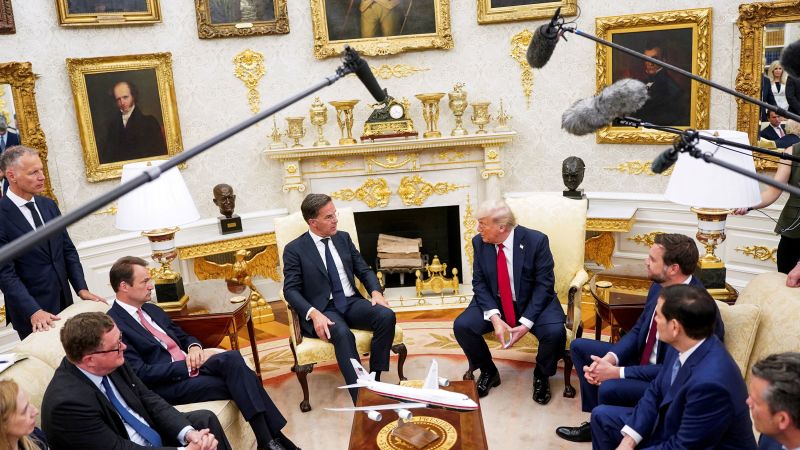
To appreciate the dramatic shift in President Donald Trump’s policy towards Ukraine, consider two scenes in the Oval Office, months apart: On February 28, Trump berated Ukrainian President Volodymyr Zelensky in front of the global news media, declaring that he has “no cards” and effectively no choice but to sue for peace with Russia and largely on Russia’s terms. Shortly after that meeting, the United States announced a temporary pause on all military and intelligence support for Ukraine. On July 14, Trump met with the secretary general of NATO, Mark Rutte, and announced significant new cards for Zelensky, in the form of billions of dollars in military equipment, including advanced anti-air systems, and new sanctions on Russia to go into effect 50 days from now if Russian President Vladimir Putin continues to prosecute the war. These scenes bookmark a chapter of ineffective American diplomacy and the beginning of a new and more promising one: diplomacy backed by the leverage ultimately required to stop a war that Putin has otherwise demonstrated he intends to continue indefinitely. Theodore Roosevelt once said, “Diplomacy is utterly useless, where there is no force behind it.” This is particularly true when it comes to diplomacy with Russia, a task I’ve confronted with some difficulty as an envoy for Presidents Obama and Trump. As a presidential envoy leading the campaign against the Islamic State in Iraq and Syria (ISIS), one of my jobs was to lead a diplomatic channel with Russia over its support of the Assad regime in Syria. The aim was primarily to keep Russian forces away from ours as we prosecuted the campaign against ISIS. The Russians wanted Syria to themselves, and they often sought to limit our maneuvering space.


An Air Canada plane traveling from Montreal collided with an emergency vehicle on the runway at New York City’s LaGuardia Airport in the late hours of Sunday night, killing two pilots and injuring dozens of people.

Top Senate Republicans on Capitol Hill believe their party is unified behind a plan to reopen the Department of Homeland Security. Now, they need to sell the plan to Democrats.

Markwayne Mullin will serve as Donald Trump’s next Department of Homeland Security secretary, elevating the US senator to helm the agency at the center of the president’s controversial immigration enforcement effort and an ongoing shutdown.

President Donald Trump’s sudden turnabout and, according to him, rapidly advancing peace talks made for an abrupt shift in the administration’s approach to the Iran war.

The Supreme Court’s conservative majority appeared dubious of state laws that allow the counting of mail ballots that arrive at election offices after Election Day as justices heard oral arguments in a challenge to Mississippi’s five-day grace period for mail ballots.

The chief district judge in New Jersey appointed Robert Frazer, a career prosecutor, to serve as US attorney for the state, ending for now a dispute over the legality of the office’s leadership that threatened to derail criminal investigations.

Tens of thousands of taxpayer dollars were spent on expenses for hair and makeup artists and a horse for the advertisement showcasing outgoing Department of Homeland Security Secretary Kristi Noem in front of Mount Rushmore, according to invoices seen by CNN.

President Donald Trump was presented Sunday with a potential off-ramp to the more than month-long Department of Homeland Security shutdown: fund every part of the department except enforcement operations by Immigration and Customs Enforcement, two sources familiar with the conversations told CNN.

Immigration and Customs Enforcement agents are heading to 13 airports today to help with crowd management as travelers at some airports wait in hours-long security lines amid the DHS shutdown. Follow here for the latest.

A consortium of the nation’s top architectural and historic preservation groups is targeting President Donald Trump’s plans to temporarily close and extensively renovate the Kennedy Center, filing a new lawsuit Monday that asks a federal judge to indefinitely halt the project.

ICE agents sent to airports as TSA callouts remain high; separately, two people have died after a plane collided with a fire truck at New York’s second biggest airport. Follow for live updates

Mike Pence used to dream of following two successful Donald Trump terms with his own turn in the White House.

An Air Canada plane was damaged after colliding with a vehicle on a runway at New York’s LaGuardia Airport Monday, according to video from the scene and air traffic control audio.