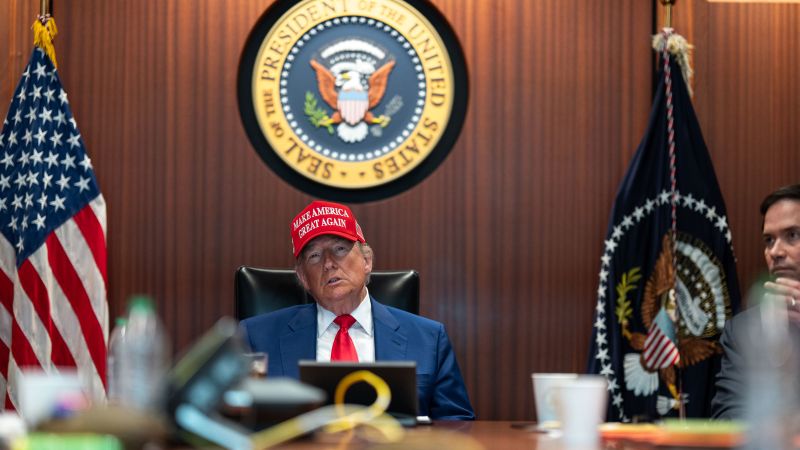
Trump’s bombings present major constitutional and legal questions. But it’s up to Congress to force the issue
CNN
President Donald Trump’s order to bomb Iran’s nuclear facilities presents a new test of the Constitution and the extent of presidential powers to conduct war despite a lack of congressional approval.
President Donald Trump’s order to bomb Iran’s nuclear facilities presents a new test of the Constitution and the extent of presidential powers to conduct war despite a lack of congressional approval. The administration is relying on the president’s authority under Article II of the Constitution, two senior administration officials told CNN, which says he has power to direct US military forces in engagements necessary to advance American national interests abroad. The White House counsel’s office and the Justice Department were both involved in the legal analysis for the strikes. The administration relied, in part, on memos about war powers written by the DOJ’s Office of Legal Counsel under previous administrations of both parties. “The president is clearly well within his Article II powers here,” one former senior US official told CNN. “End of story.” But that’s not a view held by many legal experts or universally endorsed by Democratic and Republican lawmakers, who point to the Constitution’s unambiguous statement that only Congress can declare war, the absence of a law akin to the Iraq War-era Authorization for Use of Military Force and — critically — a lack of an imminent threat to the United States. In 1973, responding to the disastrous war in Vietnam, Congress overrode President Richard Nixon’s veto to pass an important piece of legislation, the War Powers Resolution, that sought to rein in presidents regarding the use of military force. “This is a large enough scale action that I think it’s likely that it should be considered a war, and not merely a small, severely limited strike. Therefore, it requires congressional authorization,” said Ilya Somin, a law professor at George Mason University and a scholar at the Cato Institute, a libertarian think tank.


Donald Trump wants us to believe that a deal with Cuba is close at hand. After this past week, I am not so sure.

President Donald Trump has said ICE agents will head to US airports tomorrow amid a partial government shutdown. Follow for live updates

President Donald Trump said Sunday border czar Tom Homan will be in charge of deploying Immigration and Customs Enforcement agents to airports on Monday, with Homan telling CNN the agents will assist with security at entrances and exits to ease TSA workload amid a partial government shutdown.

Janet Mills and her allies are counting on a gender gap to narrow Platner’s wide lead ahead of the June 9 primary to decide who will face incumbent Republican Sen. Susan Collins. They are betting that the unfiltered style that has brought Platner widespread attention as someone who could help Democrats reach young men will backfire with women.

Why do people “pledge allegiance” to a “state” that is no longer a state? And what spurs someone to not just attack innocent people, but to then make a statement of loyalty while doing so?

A Supreme Court case examining state deadlines for election ballots sent in the mail is just the tip of the spear in President Donald Trump’s war on mail-in voting.

As a shrinking number of Transportation Security Administration agents work to keep hourslong security lines moving despite not being paid, President Donald Trump stepped into the fray Saturday, announcing he will send Immigration and Customs Enforcement officers to airports by Monday if Congress doesn’t agree to a plan to end the partial government shutdown.

Donald Trump wants us to believe that a deal with Cuba is close at hand. After this past week, I am not so sure.

The search for missing 84-year-old Nancy Guthrie, mother of “Today” show host Savannah Guthrie, has stretched into another anguished week, with mounting pressure on investigators and a family grappling with uncertainty.

Cuba’s Ministry of Energy announced Saturday evening that entire island has suffered another electrical blackout, leaving more than 10 million people without power.

Iran’s attempt to strike a US-UK base over 2,000 miles (over 3,000 kilometers) off its coast has renewed questions about Tehran’s military capabilities and how far its missiles can reach.

For years, President Donald Trump has offered crass and insensitive comments about people who died – especially his foes. That reached a new level on Saturday.

Robert Mueller, the former FBI director who led the historic probe into alleged collusion between Donald Trump’s 2016 campaign and the Russian government, has died. He was 81.