Trump’s aggressive moves on immigration protests put Democrats in a political bind
CNN
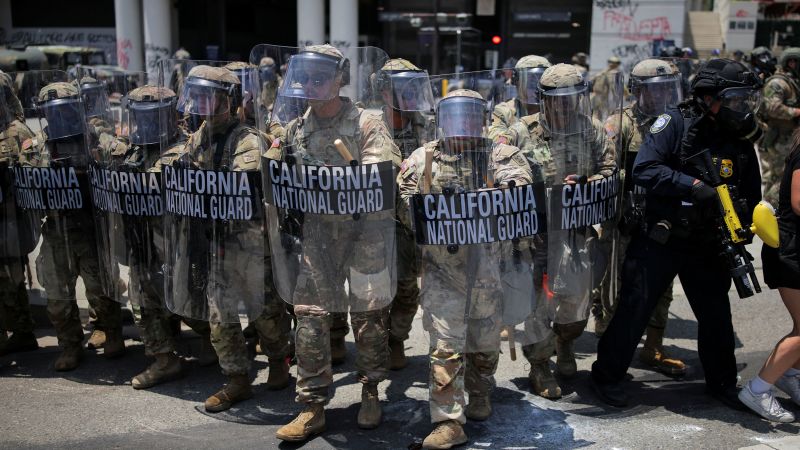
President Donald Trump’s deployment of military troops to California is forcing Democrats back onto politically perilous turf.
President Donald Trump’s deployment of military troops to California is forcing Democrats back onto politically perilous turf, as they look for ways to condemn his actions without being drawn into a broad debate over immigration or tying themselves to the chaotic scenes emerging from Los Angeles. Republicans are relishing a fight that directs attention away from their monthslong, intraparty debate over tax and spending legislation, and the messy political breakup of Trump and Elon Musk, and toward what they view as Democrats’ biggest vulnerabilities: immigration, law enforcement and public disorder. Pennsylvania Sen. John Fetterman warned his fellow Democrats about the images emerging from California, where protests erupted Friday after Immigration and Customs Enforcement raids and escalated into outbreaks of violence. Some protesters have thrown objects at law enforcement, looted businesses, blocked a major freeway and set self-driving cars ablaze — while police in riot gear fired rubber bullets to disperse crowds. While much of the protest activity has been peaceful, images of burning cars and chaos have been widespread across social media and traditional news coverage. “You can’t defend when people start setting things on fire or they start damaging buildings or going after members of law enforcement. That’s not free speech. That is not peaceful protest,” Fetterman said Tuesday. Fetterman, who was lieutenant governor of Pennsylvania during racial justice protests around the country in 2020, said Democrats “should have learned the lesson back in 2020. Absolutely, there was righteous outrage over what happened to George Floyd, but that never means that you can support or be quiet if there’s destruction or rioting and destroying and looting and those kinds of things.” He said he was “not judging any of my other colleagues in my party,” but warned: “You can’t be quiet on those things. You have to just call it really what it is.”


President Trump’s latest comments about the Iran war make him look out of the loop and unprepared.

Travelers are experiencing long security lines at a number of airports as TSA workers continue to work without pay. Follow for live updates.

A senior US intelligence official appointed by President Donald Trump abruptly announced he is stepping down from his post on Tuesday, citing misgivings about the administration’s war with Iran.

CNN’s 5 Things AM brings you the news you need to know every morning.

Polling suggests the idea of US troops on the ground in Iran is a complete nonstarter for Americans overall — and even a tough sell for the GOP base.

Facing deadly Iranian drone attacks across the Middle East, the US military has been rushing defensive systems into the region while adjusting to a threat that has come to dominates modern battlefields and carries echoes of a weapon that haunted service members during the 20 years of the war on terror.

In his early days in Congress, Markwayne Mullin tried pairing his suit jacket and tie with a pair of jeans on the House floor. Then-House Speaker John Boehner reprimanded the young Republican for breaking the dress code.

As President Donald Trump rachets up the pressure on Cuba’s communist-run government and threatens a US “takeover” of the island, he frequently repeats a central promise: that decades after they left, Cuban exiles will soon be able to return to their homeland.

The first two weeks of the Iran crisis have demonstrated military dominance by the US and Israel, with asymmetrical responses from Iran. How this plays out over the coming weeks will determine the outcome.

Utah mother Kouri Richins was found guilty of murder and all other charges in the 2022 death of her husband, Eric Richins, who died of a lethal dose of fentanyl.

The Virginia man accused of planting two pipe bombs in Washington, DC, the night before the 2021 US Capitol riot asked a federal judge on Monday to dismiss his case, arguing that President Donald Trump’s expansive pardon of January 6 rioters applies to him.

President Donald Trump has repeatedly taken aim at Democratic rival and possible 2028 presidential candidate Gavin Newsom. But lately, he’s become fixated on saying the California governor cannot be president due to his “learning disability.”

Cuba’s electrical grid suffered a total collapse on Monday, the country’s power operator said, marking the latest nationwide blackout in recent years, and the first since the US effectively shut off the flow of oil to the island of roughly 10 million people.