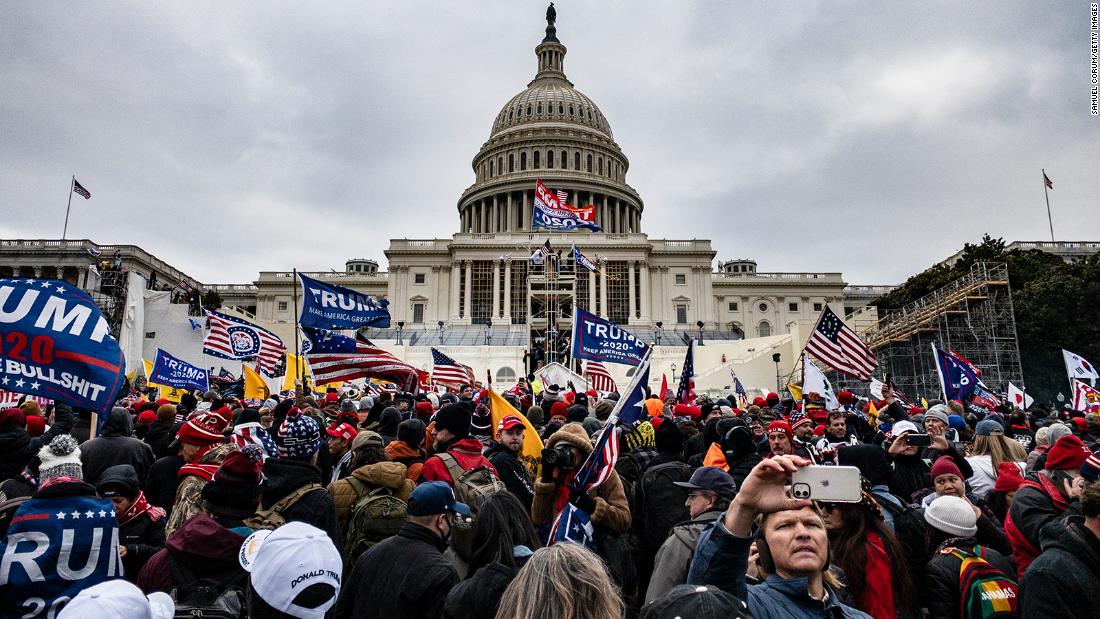
Trump escalates his January 6 cover-up as political comeback steps up a gear
CNN
Donald Trump is acting like an ex-President with a constitutional crime to hide as the cover-up of his assault on democracy gathers pace alongside his political comeback.
The twice-impeached 45th President's continuing influence on politics, popular culture and national life is broadening on multiple fronts and appears undimmed by his ban from social media platforms. His behavior is mirroring the conduct he showed in office: a driving desire to avoid accountability, a challenge to the US system of checks and balances, a willingness to exploit racial and cultural divides, and an eye for a political opening that could boost his own profile, like an apparent tele-rally on the eve of Virginia's gubernatorial election. The high-stakes election in a state Trump lost by 10 points last year will be closely watched as an indicator of the political environment heading into the 2022 midterms.
A just-revealed list of documents that Trump wishes to prevent the House select committee probing January 6 from seeing -- and over which President Joe Biden has refused to assert executive privilege -- in itself offers a darkly suggestive picture of Trump's activities leading up to the mob attack by his supporters on the US Capitol.


Haiti is about to get a new set of foreign boots on the ground. The goal sounds simple: fight the gangs that have brought life to a standstill.

Oklahoma’s governor picks energy executive Alan Armstrong to fill US Senate seat through end of year
Oklahoma’s governor on Tuesday appointed energy executive Alan Armstrong to serve in the US Senate through the end of the year and finish the term of Republican Markwayne Mullin, the new homeland security secretary.

Newly confirmed Homeland Security Secretary Markwayne Mullin told senators during his confirmation hearing that he wanted to keep the department out of the headlines. That won’t be easy.

A trader made nearly $1 million since 2024 from dozens of well-timed Polymarket bets that correctly predicted US and Israeli military actions against Iran, according to an analysis shared with CNN.

Travelers have been dealing with worsening airport wait times as ICE agents deploy to more than a dozen airports. Follow for live news updates.

President Donald Trump voted in Tuesday’s state House special election by mail even as he suggested on Monday that “mail-in voting means mail-in cheating.”

CNN’s 5 Things AM brings you the news you need to know every morning.

The Supreme Court on Tuesday will consider the legality of a policy championed by President Donald Trump during his first term that prevented scores of migrants arriving at the southern border from starting the process of applying for asylum.

A young, well-liked facilities manager at the Kennedy Center has gone from being described as “in charge of HVAC and toilets” to head of the renowned arts institution.

Democrats in Florida are hoping to capitalize on the party’s recent special election overperformances and come out on top Tuesday in a special state House election for a Palm Beach district that includes President Donald Trump’s Mar-a-Lago residence.

The Supreme Court on Monday appeared ready to limit mail-in ballots, a move that would reinforce the justices’ pattern of shrinking voter protections and that has, at bottom, favored Republican interests and the Trump administration.

An Air Canada plane traveling from Montreal collided with an emergency vehicle on the runway at New York City’s LaGuardia Airport in the late hours of Sunday night, killing two pilots and injuring dozens of people.

Top Senate Republicans on Capitol Hill believe their party is unified behind a plan to reopen the Department of Homeland Security. Now, they need to sell the plan to Democrats.