Trump asks Supreme Court to allow him to end birthright citizenship
CNN
President Donald Trump’s administration asked the Supreme Court in a series of emergency appeals Thursday to allow him to move forward with plans to end birthright citizenship, elevating a fringe legal theory that several lower courts have resoundingly rejected.
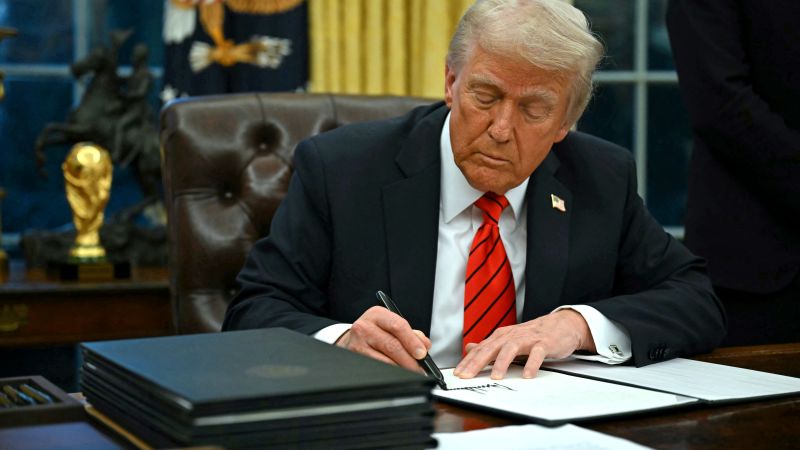
President Donald Trump’s administration asked the Supreme Court in a series of emergency appeals Thursday to allow him to move forward with plans to end birthright citizenship, elevating a fringe legal theory that several lower courts have resoundingly rejected. In a series of emergency appeals, the Trump administration argued that lower courts had gone too far in handing down nationwide injunctions blocking the controversial policy, and it asked the justices to limit the impact of those orders. Appeals courts have brushed aside the Trump administration’s request to pause lower court rulings that imposed nationwide injunctions on an executive order he signed on the first day of his second term. “Universal injunctions have reached epidemic proportions since the start of the current administration,” the Justice Department told the Supreme Court in its emergency appeals. “Those universal injunctions prohibit a Day 1 Executive Order from being enforced anywhere in the country, as to ‘hundreds of thousands’ of unspecified individuals who are ‘not before the court nor identified by the court.’” For more than 150 years, courts have understood the 14th Amendment’s text to guarantee citizenship to anyone “born or naturalized in the United States,” regardless of the immigration status of their parents. A landmark Supreme Court precedent from 1898 affirmed that reading of the law, and the modern court hasn’t signaled any desire to revisit that holding. But some conservatives have argued that those long-held views are wrong because the 14th Amendment includes a phrase that the benefit applies only to people who are “subject to the jurisdiction” of the United States. Immigrants in the country illegally, the theory goes, are subject to the jurisdiction of their native homeland.


President Donald Trump has said ICE agents will head to US airports tomorrow amid a partial government shutdown. Follow for live updates

Cuba is working to restore the electricity supply after another island-wide blackout left more than 10 million people without power.

President Donald Trump said Sunday border czar Tom Homan will be in charge of deploying Immigration and Customs Enforcement agents to airports on Monday, with Homan telling CNN the agents will help with security at entrances and exits to ease the Transportation Security Administration’s workload.

Donald Trump wants us to believe that a deal with Cuba is close at hand. After this past week, I am not so sure.

President Donald Trump has said ICE agents will head to US airports tomorrow amid a partial government shutdown. Follow for live updates

President Donald Trump said Sunday border czar Tom Homan will be in charge of deploying Immigration and Customs Enforcement agents to airports on Monday, with Homan telling CNN the agents will assist with security at entrances and exits to ease TSA workload amid a partial government shutdown.

Janet Mills and her allies are counting on a gender gap to narrow Platner’s wide lead ahead of the June 9 primary to decide who will face incumbent Republican Sen. Susan Collins. They are betting that the unfiltered style that has brought Platner widespread attention as someone who could help Democrats reach young men will backfire with women.

Why do people “pledge allegiance” to a “state” that is no longer a state? And what spurs someone to not just attack innocent people, but to then make a statement of loyalty while doing so?

A Supreme Court case examining state deadlines for election ballots sent in the mail is just the tip of the spear in President Donald Trump’s war on mail-in voting.

As a shrinking number of Transportation Security Administration agents work to keep hourslong security lines moving despite not being paid, President Donald Trump stepped into the fray Saturday, announcing he will send Immigration and Customs Enforcement officers to airports by Monday if Congress doesn’t agree to a plan to end the partial government shutdown.

Donald Trump wants us to believe that a deal with Cuba is close at hand. After this past week, I am not so sure.

The search for missing 84-year-old Nancy Guthrie, mother of “Today” show host Savannah Guthrie, has stretched into another anguished week, with mounting pressure on investigators and a family grappling with uncertainty.

Cuba’s Ministry of Energy announced Saturday evening that entire island has suffered another electrical blackout, leaving more than 10 million people without power.