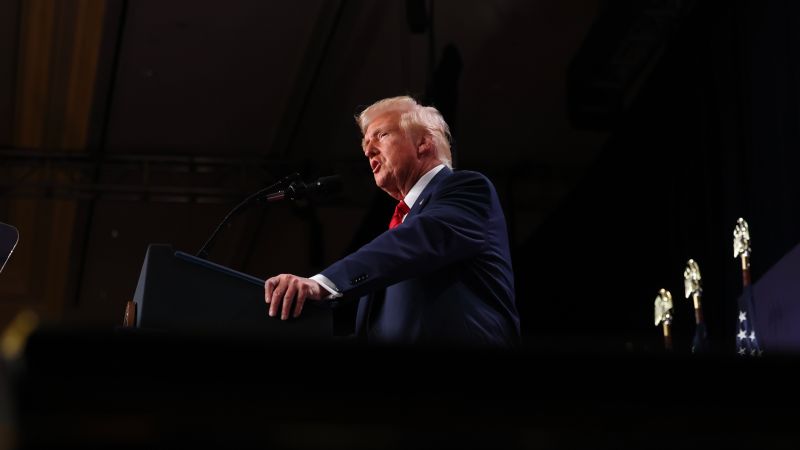
Trump and GOP are ‘overreading’ a landmark Supreme Court decision as they target DEI, legal experts argue
CNN
As part of a rapidly escalating war on corporate and government diversity, equity and inclusion programs, President Donald Trump’s administration and his allies are relying heavily on a two-year-old Supreme Court precedent that says virtually nothing about diversity in the workplace.
As part of a rapidly escalating war on corporate and government diversity, equity and inclusion programs, President Donald Trump’s administration and allies are relying heavily on a two-year-old Supreme Court precedent that says virtually nothing about diversity in the workplace. A series of lawsuits and threatening letters filed after Trump took office a month ago have cited the landmark 2023 decision that gutted affirmative action on college campuses — and have suggested that the ruling also requires companies to end their DEI programs. “The Supreme Court said it best: ‘Eliminating racial discrimination means eliminating all of it,’” Republican attorneys general from 19 states wrote to Costco recently, urging the retail giant to suspend its diversity efforts. “For the good of its employees, investors, and customers, Costco should ‘do the right thing’ by following the law and repealing its DEI policies.” But legal experts say that the notion that the Supreme Court’s 6-3 decision in Students for Fair Admissions v. Harvard spells out rules for the private sector is wishful thinking on the part of DEI critics. Critics of DEI are “kind of deliberately overreading the decision in order to engage in a lot of bluster and threats,” said David Glasgow, a New York University law professor and executive director of the Meltzer Center for Diversity, Inclusion, and Belonging. “The case didn’t say anything about private employment or DEI at all,” said Brent Siler, a labor lawyer at the Adams and Reese law firm. “DEI is not illegal, in and of itself, though some of it could be.”


Travelers have been dealing with worsening airport wait times as ICE agents deploy to more than a dozen airports. Follow for live news updates.

President Donald Trump voted in Tuesday’s state House special election by mail even as he suggested on Monday that “mail-in voting means mail-in cheating.”

CNN’s 5 Things AM brings you the news you need to know every morning.

The Supreme Court on Tuesday will consider the legality of a policy championed by President Donald Trump during his first term that prevented scores of migrants arriving at the southern border from starting the process of applying for asylum.

A young, well-liked facilities manager at the Kennedy Center has gone from being described as “in charge of HVAC and toilets” to head of the renowned arts institution.

Democrats in Florida are hoping to capitalize on the party’s recent special election overperformances and come out on top Tuesday in a special state House election for a Palm Beach district that includes President Donald Trump’s Mar-a-Lago residence.

The Supreme Court on Monday appeared ready to limit mail-in ballots, a move that would reinforce the justices’ pattern of shrinking voter protections and that has, at bottom, favored Republican interests and the Trump administration.

An Air Canada plane traveling from Montreal collided with an emergency vehicle on the runway at New York City’s LaGuardia Airport in the late hours of Sunday night, killing two pilots and injuring dozens of people.

Top Senate Republicans on Capitol Hill believe their party is unified behind a plan to reopen the Department of Homeland Security. Now, they need to sell the plan to Democrats.

Markwayne Mullin will serve as Donald Trump’s next Department of Homeland Security secretary, elevating the US senator to helm the agency at the center of the president’s controversial immigration enforcement effort and an ongoing shutdown.

President Donald Trump’s sudden turnabout and, according to him, rapidly advancing peace talks made for an abrupt shift in the administration’s approach to the Iran war.

The Supreme Court’s conservative majority appeared dubious of state laws that allow the counting of mail ballots that arrive at election offices after Election Day as justices heard oral arguments in a challenge to Mississippi’s five-day grace period for mail ballots.

The chief district judge in New Jersey appointed Robert Frazer, a career prosecutor, to serve as US attorney for the state, ending for now a dispute over the legality of the office’s leadership that threatened to derail criminal investigations.