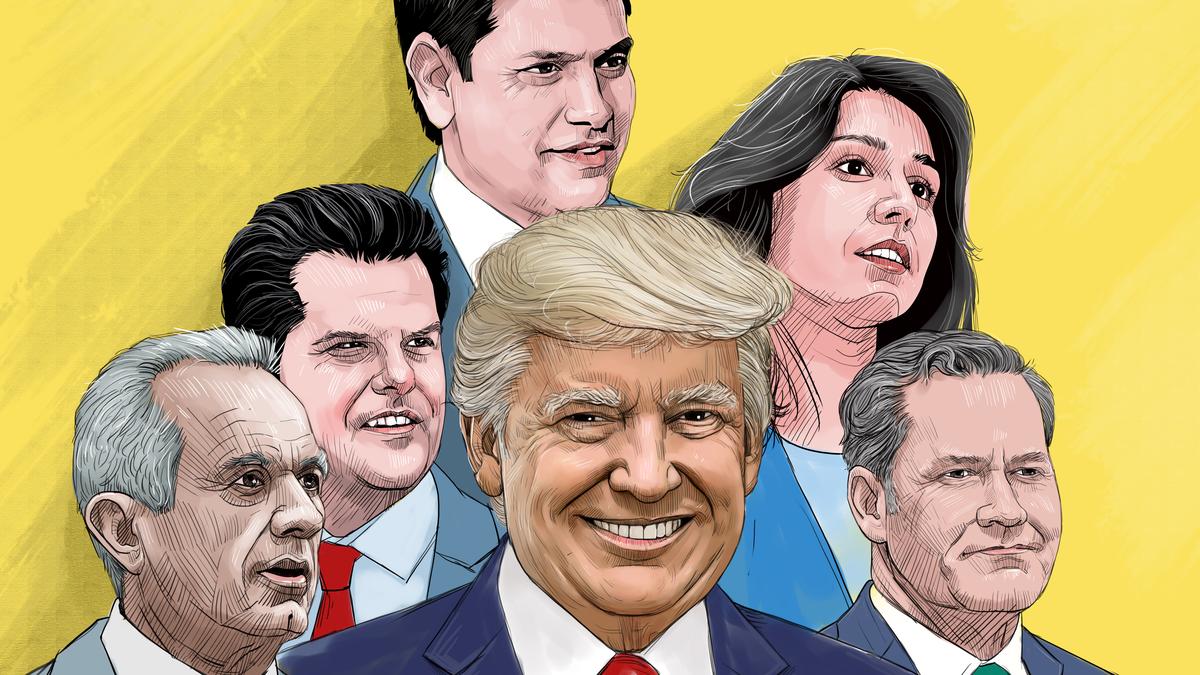
Trump 2.0 | Portentions of a second innings Premium
The Hindu
Donald Trump's second term as U.S. President promises major policy shifts and institutional transformations, impacting both domestic and foreign affairs.
U.S. President-elect Donald Trump is poised to kick off his second term at the White House, a four-year stint that will likely see major shifts in domestic and foreign policy and transform the functioning of a wide range of American public institutions. The fact that he defied the odds, as predicted by pollsters and some sections of the U.S. media, to sweep the seven swing States of the country in the 2024 election, win both the popular vote and the electoral college, and end the presidential run of Democrat candidate Kamala Harris speaks to the disenchantment of the electorate with the previous administration, the reasons for which are still being debated widely.
Yet, it also says something about the entity that is Donald Trump, a man who remains a saviour to some, an enigma to others, and a symbol of an abhorrent brand of politics to many, including, perhaps, the majority of the 73 million who voted for Ms. Harris. To understand what the next four years portend for the U.S. and for the world, it is instructive to peer through the haze of weaponised propaganda on all sides and disambiguate what Mr. Trump truly stands for.
Mr. Trump has worn many hats over the long arc of his 78 years, and as he dons the mantle of the oldest President to enter the Oval Office, the sheer dexterity with which he has moved across career ‘avatars’ — from inheritor of a real estate empire to a cult TV show personality and then the head of a sprawling conglomerate to ultimately being a two-term President — reflects on the deep changeability of his core, and the lack of a fixed view — his detractors would call them values — on his professional mission.
Born in Queens, New York, in 1946, as the son of a successful real estate developer, Mr. Trump studied at the New York Military Academy and the Wharton School of Finance and Commerce at the University of Pennsylvania. When he took control of the company of his father, Fred Trump, in 1971, he named it the Trump Organization, a corporate group that would go on to operate in a range of sectors, including commercial and residential buildings, resorts, hotels, golf courses, and casinos.
Among his several books was The Art of the Deal, published in 1987, which offers early hints about his belief that dealmaking is the true measure of success and the sole means to achieve it — a paradigm that runs contrary to the long-standing belief in, say, the U.S. State Department, that successful diplomacy entails “patiently building and deepening alliances and partnerships... playing a constructive role in regional institutions and investing time, at the highest levels, in regional summits”.
In a move that once again reflected what appeared to be Mr. Trump’s devotion to gimmickry and theatrics, at whose altar the loyalty of all his employees would be tested and judged, in 2004, he launched the hit reality television show The Apprentice. With his now famous dismissal line of “You’re Fired” going viral as a pop culture meme, the show solidified Mr. Trump’s credentials in the world of entertainment television, even if it prompted questions about his business ethics as they applied broadly across the Trump Organization. Especially by the time of his first presidential campaign in 2015, it became clear that no major U.S. company had filed for Chapter 11 bankruptcy protection more than Mr. Trump’s Atlantic City casino empire in the last 30 years — four distinct filings. In each of those cases, the implied corporate restructuring allowed Mr. Trump’s companies to stay afloat while shedding the unsustainable debt that it owed to banks, employees and suppliers.
With his record steeped in Wall Street shenanigans and proximity to power-broking at the highest echelons of the system, it came as a shock to many that Mr. Trump rose to meteoric heights in his campaign for the 2016 presidential election, all the while marketing himself as a man of the people, the saviour of blue-collar jobs in the Rust Belt, and as a political maverick far removed from Washington’s elite policymaking circles. Even his campaign slogan, ‘Make America Great Again’, was widely marketed to the benefit of the Trump campaign — reports suggest that, in a single year during 2024 alone, more than a million hats were sold at $40 per piece. However, on the eve of the 2016 election, major newspapers projected 90% odds that his rival, Democrat and former Secretary of State Hillary Clinton, would win the presidency — a failure by the U.S. mainstream media to recognise that Mr. Trump was in fact at the helm of a global nativist-populist movement that was poised to upturn the liberal economic consensus in the West and deglobalise its trade, investment and strategic cooperation paradigm by gradually eroding the rules-based international order.


Trump postpones military strikes on Iranian power plants for five days amid escalating tensions and ongoing diplomatic discussions.

Shorts News:Watch: NATO chief: 22-nation group forming to secure Strait of Hormuz

Saudi Aramco reduces crude supply to Asia for April, citing disruptions from the Iran-Israel conflict affecting trade routes.

Tencent launched a tool on Sunday to integrate its WeChat messaging platform with the OpenClaw agent

An Air Canada flight collided with a Port Authority vehicle at LaGuardia Airport, causing significant damage and police response.

Saudi Arabia and the UAE face missile attacks, with casualties reported and air defenses engaged amid escalating regional tensions.

Slovenia's parliamentary election results show a tight race between liberals and populists, signaling potential political instability ahead.

IEA chief warns of a potential energy crisis worse than the 1970s, with 11 million barrels lost daily amid regional conflicts.

Cuba begins restoring power after a nationwide grid collapse, affecting thousands amid an ongoing energy crisis and blackouts.

The Hindu LIVE updates on March 23 2026 on Iran-Israel war. Iran faces deadline of US President Donald Trump warning to open Strait of Hormuz

Brazil's Lula condemns renewed colonialism and U.S. interference in developing nations at a summit in Colombia.

Saudi Arabia expels Iranian military staff amid escalating tensions and ongoing missile attacks during the U.S.-Israeli war on Iran.

Russia claims control of Potapivka village in Ukraine's Sumy region amid ongoing military efforts to establish a buffer zone.