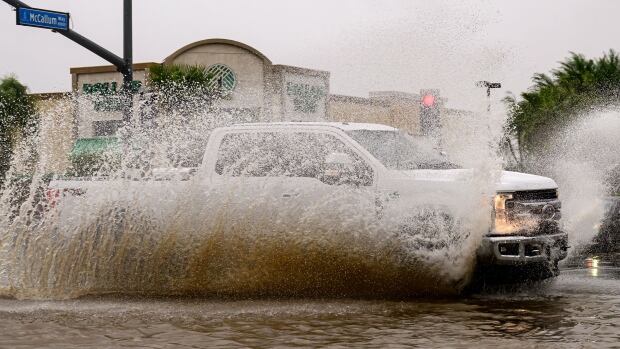
Tropical storm Hilary batters California, causes deadly flooding in Mexico
CBC
Deadly floodwaters inundated streets across Mexico's arid Baja California on Sunday as tropical storm Hilary moved ashore, carrying torrential rain into Southern California, with concerns mounting that flash floods could strike in places as far north as Idaho that rarely get such heavy rain.
Forecasters said Hilary was the first tropical storm to hit Southern California in 84 years, bringing the potential for flash floods, mudslides, isolated tornadoes, high winds and power outages.
Hilary made landfall along the Mexican coast in a sparsely populated area about 250 kilometres south of Ensenada, on a path to hit mudslide-prone Tijuana Sunday evening, threatening the improvised homes that cling to hillsides just south of the U.S. border.
At least 9 million people were under flash-flood warnings as heavy rain fell across normally sunny Southern California ahead of the brunt of the storm. Desert areas were especially susceptible along with hillsides with wildfire burn scars, forecasters warned.
Mud spilled onto highways, water overwhelmed drainage systems and tree branches fell in places from San Diego to Los Angeles. The weather service said tornadoes were possible Sunday afternoon in eastern San Diego County.
Southern California got another surprise in the afternoon as an earthquake with a preliminary magnitude of 5.1 hit near Ojai, about 130 kilometres northwest of downtown Los Angeles, according to the U.S. Geological Survey. It was felt widely and was followed by smaller aftershocks. There were no immediate reports of major damage or injury, according to a dispatcher with the Ventura County Sheriff's Office.
Hilary could wallop other western states with once-in-a-century rains, with a good chance of it becoming the wettest known tropical cyclone to douse Nevada, Oregon and Idaho. Hilary was expected to remain a tropical storm into central Nevada early Monday before dissipating.
By 2 p.m. PT, Hilary was 180 kilometres south-southeast of San Diego, the National Hurricane Center reported. The storm had maximum sustained winds of 95 km/h and was moving northwest at nearly 41 km/h.
Hilary is just the latest major climate disaster to wreak havoc across the U.S., Canada and Mexico. Hawaii's island of Maui is still reeling from a blaze that killed over 100 people and ravaged the historic town of Lahaina, making it the deadliest U.S. wildfire in more than a century. Firefighters in Canada are battling that nation's worst fire season on record.
The Mexican cities of Ensenada and Tijuana closed all beaches and opened a half-dozen shelters at sports complexes and government offices.
One person drowned Saturday in the Mexican town of Santa Rosalia when a vehicle was swept away in an overflowing stream. Rescue workers saved four other people, said Edith Aguilar Villavicencio, the mayor of Mulege township.
Mexican army troops fanned out across Mulege, where some of the worst damage occurred Saturday on the eastern side of the Baja Peninsula. Soldiers used bulldozers and dump trucks to help clear tons of boulders and earth clogging streets and roads that were turned into raging torrents a day earlier.
Power lines were toppled in many places, and emergency personnel were working to restore power and reach those cut off by the storm.
California Gov. Gavin Newsom declared a state of emergency. The Federal Emergency Management Agency said it has officials inside California's emergency preparedness office and teams on standby with food, water and other help.


U.S. President Donald Trump is urging other countries to help secure the Strait of Hormuz as Iran targets ships in the vital oil route, but so far there are few firm commitments.

Arab Gulf states reported new missile and drone attacks on Sunday after Iran threatened to widen its campaign as the war in the Middle East entered its third week.


The former secretary general of NATO says he doesn't think allies will be pulled further into the conflict in the Middle East, but he's concerned the ongoing war with Iran will benefit Russia's economy and take the world's attention away from the invasion of Ukraine.

As American and Israeli strikes pound Iran — while it attacks shipping and energy infrastructure across the Persian Gulf — U.S. President Donald Trump made a new threat to Tehran's leaders.

The armed man who rammed his vehicle into one of the largest Reform synagogues in the U.S. Thursday has been identified as a 41-year-old naturalized citizen born in Lebanon, according to federal officials.

With jagged cliffs rising from the Arabian Sea, the Strait of Hormuz is striking in its scenery — and these days, its emptiness. This resource superhighway, which normally hosts more than a hundred of the world’s largest oil and liquid natural gas (LNG) tankers every day, has seen no more than a handful all week.

The Canadian government said Tuesday it is alarmed by the escalation of violence and attacks in Lebanon, as the war in the Middle East expands.

In a resounding victory that is guaranteed to reshape Nepal's politics, rapper-turned-politician Balendra Shah appeared headed for a landslide win in the South Asian country's first polls since youth-led protests toppled the previous government last fall.

China’s latest blueprint for driving growth in its economy was largely written before the U.S. and Israel instigated the most far-reaching war in the Middle East in decades.

U.S. President Donald Trump's firing of Homeland Security Secretary Kristi Noem on Thursday overshadowed the announcement of his plans to nominate Republican Sen. Markwayne Mullin as her successor.

The truck carrying Nepali prime ministerial candidate Balendra Shah was swarmed by cheering supporters in the capital, Kathmandu, on Saturday, unable to inch forward as the former rapper, wearing sunglasses and a sleek black suit, danced on top of the roof.

Israel sent troops into southern Lebanon on Tuesday and warned residents of more than 80 villages to evacuate as the Iran-backed militant Hezbollah group said it was ready for an "open war" with Israel in the wake of the U.S.-Israeli war with Iran.