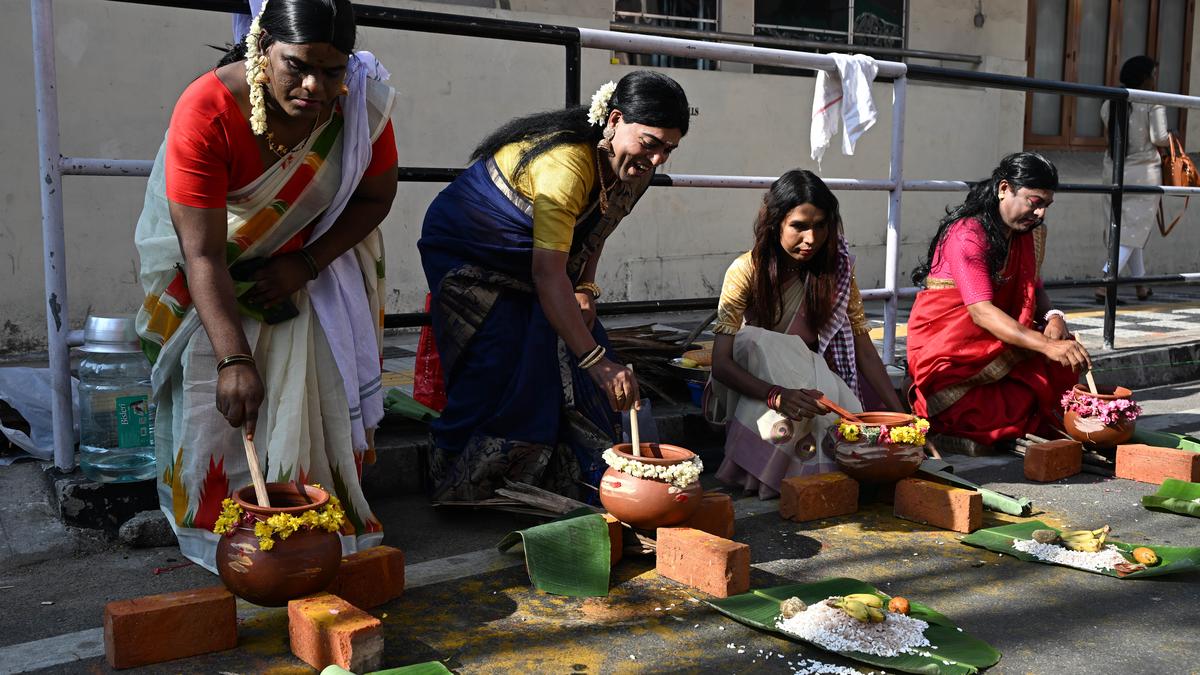
Transgender devotees carve unobtrusive niches for themselves to offer Pongala
The Hindu
Transgender devotees find solace in discreet Pongala alcoves, supported by community and government initiatives in Kerala.
Transgender people seem to create inconspicuous nooks to offer Pongala away from arguably probing and judgemental eyes on Thursday.
The Hindu stumbled upon such an unobtrusive alcove for transgender devotees near the Government Ayurveda College in the expansive festival area spread across 30 municipal wards in the Thiruvananthapuram Corporation limits.
The four-member group were largely incommunicado. They appearedvirtual recluses, possibly a fallout of the societal and familial discrimination they might have endured.
However, one of them, Kunjatta, agreed to speak to The Hindu. Kunjatta had arrived for the festival with four others. Kunjatta said the group supported each other and helped each other survive the harsh social and economic circumstances afflicting the community. Kunjatta says transgender people have turned out in strength to offer Pongala at different locations in the city, compared to past years. Theirs was just one among several other similar groupings.
Sheetal Shyam, a member of the State Transgender Justice Board under the Department of Social Justice, quoting a 2015 count, says that there were at least 4,000 transgender people in Kerala.
Sheetal says the numbers have possibly increased over the past 10 years. According to Sheetal, the Kerala government’s transgender empowerment schemes launched in 2017 by the first Pinarayi Vijayan government have tasted some success. “It is one reason why transgender people are broadcasting their distinctive identity in public venues and social life, including Pongala,” Sheetal adds.
Sheetal says the trend among transgender people was to migrate from rural localities to urban centres, where they arguably find less discrimination and more understanding. “Transgender people find Kochi and Thiruvananthapuram more welcoming than other urban centres. Several have migrated there to find jobs. Most transgender people prefer to live in groups after facing ostracisation in their families and other social groups,” Sheetal adds.


The government plans to amend the FCRA, introducing new regulations for NGO asset management and accountability for key functionaries.

The draft policy for “Responsible Digital Use Among Students”, released on Monday by the Department of Health and Family Welfare, has recommended that parents set structured routines with clear screen-time rules and prioritise privacy, safety, and open conversation with children on digital well-being.

Police Observer Sushant Kumar Saxena conducts surprise inspection at Shencottai police station, reviewing warrants and security arrangements ahead of elections.

Andhra Pradesh government to launch key projects in April, focusing on industrial growth and infrastructure development, says Nara Lokesh.

Lok Sabha refers the Corporate Laws (Amendment) Bill to a JPC amid opposition concerns over CSR provisions dilution.

SHG members in Kanniyakumari use snakes and ladders to raise election awareness and boost voter turnout.

Government accelerates consultations for early implementation of the Women’s Reservation Act to ensure women’s representation in 2029 elections.

CM A. Revanth Reddy distributes ₹1 crore insurance cheques to families of deceased Electricity department employees, enhancing financial security for workers.

The Bengaluru Traffic Police (BTP) registered 634 cases of drunk driving during a week-long special enforcement drive conducted across the city between March 16 and March 22.

GHMC intensifies action against property tax defaulters, seizing properties and offering a One Time Settlement scheme for payments.

CCB arrests three drug peddlers in Mangaluru, seizing ₹2.5 lakh worth of MDMA and other valuables.

TVK's 28 candidates in Puducherry include former BJP MLAs, a sitting Independent, and a retired police IG.

BRS submits notice on private member bill to Speaker