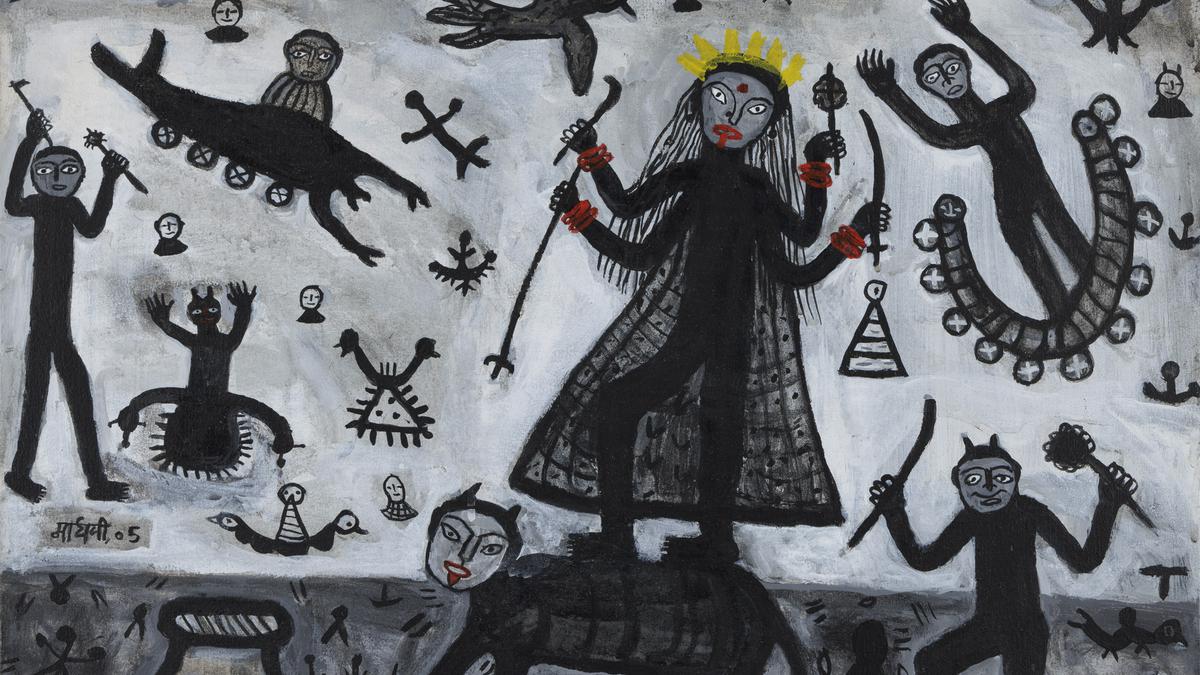
Tracking Kali | DAG’s group show explores 300 years of imagemaking
The Hindu
Curated by Gayatri Sinha, Kali: Reverence & Rebellion at DAG showcases the many avatars of the goddess — from fearsome asura slayer to a symbol of rebellion
One of the oldest stories about Kali that’s told in Bengali households harks back to when the male gods failed to control the mayhem unleashed by rampant asuras. The formidable goddess, in her rage-infused avatar, appeared to put a stop to the pandemonium. Her glorious arrival — wearing a garland of human heads, holding a blood-stained sickle in one hand and a freshly-severed demon head dripping with blood in another, surrounded by a cloud of loose black hair, her right foot resting atop the chest of a pacific Shiva — is an indelible one.
This Dakshinakali avatar is also one of the earliest representations of Kali in a painting, as described in the 5th century Puranic text, Devi Mahatmyam. And it is this image that sets the tone for DAG’s Kali: Reverence & Rebellion: her dark blue form, ornamented with gold, depicted with protruding bloody tongue and a halo that accentuates her divine status.
The group show spans about 300 years of imagemaking. “The principal challenge was to draw out a continuous history of the evolution of Kali’s image, and to relate it with social phenomena. I was keen to look at how the goddess has been appropriated by different groups of disenfranchised communities, and how her image — distorted as monstrous in colonial times — has been accommodative of all the different demands,” says curator Gayatri Sinha. “In this sense, Kali is not to be seen merely as a symbol of death, but as a beacon of hope because she has empowered groups demanding inclusion and authority.”
On a Saturday morning, I join a group of 40 on the second floor of DAG’s Delhi gallery, which is flooded with natural light, for a walkthrough with Sinha. Divided into sections, the exhibition traces Kali’s influence across the subcontinent, through miniatures, paintings by Indian and foreign artists, sculptures, breastplates and more. I spot a 19th century European rendition of the goddess that has a subdued colour palette, inspired by classical paintings from the continent. Kali is left unadorned, her wild hair tied at the back, and the obvious element of nudity cloaked with a garland of heads around her waist.
There are her benign incarnations that emerged during the 16th and 17th centuries — the generous mothers of the universe, Jagaddhatri and Tripura Sundari. The aspect of tantrism, which is often associated with the worship of Kali, is explored by Kashmiri artist Gulam Rasool Santosh in his geometrical acrylic on canvas compositions. Santosh was one of the central artists of Indian art’s Neo-Tantra movement, and the chakras in his work resemble the goddess’s tantric body, with an emphasis on her breasts.
A significant shift in the narrative appears when Kali is seen as a figure of rebellion. Right through the 20th century, the goddess is appropriated by different groups. In National Press Cawnpore’s version, one sees Subhash Chandra Bose — rendered in Chhinnamasta’s iconography — presenting his own head in one hand while wielding a sword in the other to urge people to participate in the fight for independence. In another image (a frontispiece of James Campbell Kerr’s 1917 report, Political Trouble in India), a bare-breasted Kali is seen wearing a garland of severed heads of Englishmen, a portrait intended to evoke revolutionary fervour and brand her as the leader of the Indian rebellion.
“Kali’s reverence extends into manifold Shakti peethas [seat of Shakti], as well as groups and communities,” says Sinha. The goddess identifies with the subaltern and protest movements strongly, and it’s a mutually progressive relationship. One of the best examples of this social dynamism is the Theyyam performance of Kerala’s Malabar coast — represented at DAG through a breastplate. The art form celebrates Bhadrakali as one who restores justice, who advocates for women’s dignity and the oppressed. Performed by Dalit men, it makes the deity a social equaliser.


Sean Penn skips the Oscars to meet Ukraine's Zelenskyy, who praises him as a "true friend" amid the war.

The teaser of Tamil star Suriya’s much-awaited film with director Venky Atluri, titled Vishwanath and Sons, was unveiled by the makers on Monday

A 'Golden' moment for a K-pop track at the Oscars.

Parvathi Nayar’s new exhibition, The Primordial, in Mumbai, traces oceans, pepper and climate change
Opened on March 12, the exhibition marks the artist’s first solo show in Mumbai in nearly two decades. Known for her intricate graphite drawings and multidisciplinary practice spanning installation, photography, video, and climate change, her artistic journey has long engaged with the themes of ecology, climate change and the natural world. In this ongoing exhibition, these strands converge through a series of works centred on water, salt, and pepper — materials that carry natural and historic weight across centuries.

Explore the highlights and key winners of the 98th Academy Awards, featuring memorable moments and historic achievements from Oscars 2026.

Spring season celebrated at Ramakrishna Mission Institute, Kolkata, with ‘Evening of Basant’

The Spirit of the Land, a solo show by artist Shivakumar Sunagar, is a vista of Nature-inspired emotions

Tal Fry is all set for an exciting new performance season

Netflix is making a bold move by snagging InterPositive, the AI filmmaking company founded by Ben Affleck, in a deal that could hit $600 million

Watch the eerie trailer for 'Hokum,' where Adam Scott faces a witch haunting in a mysterious Irish inn.

Oscars 2026 security heightened amid FBI warnings of a potential Iranian drone threat ahead of the Hollywood ceremony.

Directed by Rahul Pandey, the series also stars Naila Grewal, Nidhi Bisht, Anant Joshi, Anjum Batra and Kusha Kapila

A tribute to the versatile actor and comedian V.K. Ramasamy in his birth centenary year.