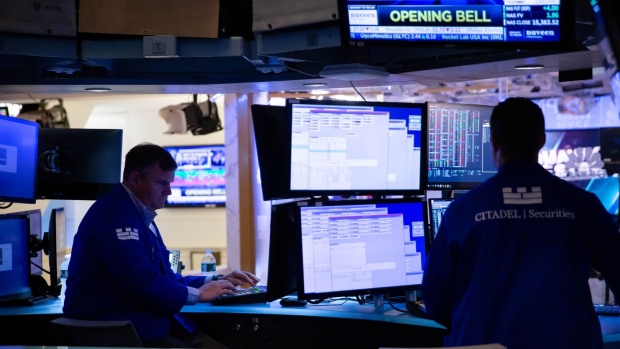
Too much market info is jamming up real-time trading models
BNN Bloomberg
Trying to use stock and bond signals to forecast the economy is never easy. With all the wild swings in markets these days, it risks becoming an exercise in the absurd.
Trying to use stock and bond signals to forecast the economy is never easy. With all the wild swings in markets these days, it risks becoming an exercise in the absurd.
Sometimes up, sometimes down, share prices and yield curves are bouncing around so much that discerning a macro message is borderline impossible. Two gains and three drops in the S&P 500 this week left it down 6 per cent on the year, but up 8 per cent from its low. Which message to heed? Bonds are equally indeterminate. The 2-year/10-year yield curve has inverted and un-inverted in the space of two weeks.
“The reality is signals in the marketplace right now have a lot of noise,” said Anik Sen, global head of equities at PineBridge Investments. “When you have a signal that is not particularly clear, that range of outcome is very wide.”
Research from Goldman Sachs Group Inc. suggests trying to discern a recession signal from stocks is generally futile. Mistakes are made, the study found, by people looking for indications that don’t exist. Equity markets behave the same 12 months before an economic downturn as they do any other time, for instance.
That’s bad news for investors who persist in searching for clues to help them navigate an expanding list of known unknowns, from the path of Federal Reserve monetary policy to war in Ukraine. All the uncertainty has prompted Victoria Fernandez and her team to shorten their investment horizon to deal with ever-shifting market narratives.


Prime Minister Mark Carney met with British Prime Minister Keir Starmer on Monday, and while both remarked the world has become a more challenging place since their first meeting a year ago, neither named a specific issue in their public remarks.

Japan plans to start releasing oil from its stockpiles on Monday to soften the shock from the U.S.-Israeli war on Iran, a stark reminder of the oil crisis half a century ago that prompted Tokyo to create reserves.

Warner Bros emerged as the biggest winner at the Academy Awards on Sunday, though the mood was clouded by its pending US$110 billion sale to Paramount Skydance, a deal reshaping Hollywood’s studio landscape.

Every day more than $4 billion worth of goods cross the United States’ borders with Canada and Mexico – U.S. auto parts headed for car factories in northern Mexico, cartons of Mexican avocados bound for California supermarkets, Canadian aluminum destined to become cans of Campbell Soup.

Prime Minister Mark Carney met Monday with Prime Minister Keir Starmer in London, and while both remarked the world has become a more challenging place since their first meeting a year ago, neither named a specific issue.

Conservative Leader Pierre Poilievre has unveiled a new auto plan that aims to secure tariff-free access to the U.S. market.

Prime Minister Mark Carney says that countries like Canada do not need to have oil reserves as a net exporter, after the energy minister announced Canada will contribute 23.6 million barrels to help stabilize international energy markets.

The U.S. military said all six airmen aboard a KC-135 refuelling aircraft that went down in Iraq are dead. Meanwhile, the American defence secretary says Iran's new supreme leader is "likely disfigured" and a large explosion rocked an area of Iran's capital.

Conservative Leader Pierre Poilievre is promising to release a new auto pact that he says will remove the GST on all Canadian-made automobiles and eliminate tariffs for the sale of Canadian vehicles to the United States.

Iran’s Supreme Leader Ayatollah Mojtaba Khamenei issued his first statement on the war on Thursday, saying Iran should close the Strait of Hormuz and keep attacking its Gulf Arab neighbors as leverage. Khamenei also called on people in Gulf countries to “shut down” U.S. bases, saying promised U.S. protection is “nothing more than a lie.”

Iran’s Supreme Leader Ayatollah Mojtaba Khamenei issued his first statement on the war on Thursday, saying Iran should close the Strait of Hormuz and keep attacking its Gulf Arab neighbors as leverage. Khamenei also called on people in Gulf countries to “shut down” U.S. bases, saying promised U.S. protection is “nothing more than a lie.”

Iran’s Supreme Leader Ayatollah Mojtaba Khamenei issued his first statement on the war on Thursday, saying that the leverage of closing the Strait of Hormuz should be used and that Iran will keep attacking its Gulf Arab neighbors. Khamenei also called on Gulf countries to “shut down” U.S. bases, saying promised U.S. protection is “nothing more than a lie.”

Iran’s Supreme Leader Ayatollah Mojtaba Khamenei says that the leverage of closing the Strait of Hormuz should be used and that Iran’s attacks on Gulf Arab neighbours will continue. His first statement since his appointment was read on state television Thursday by a news anchor.