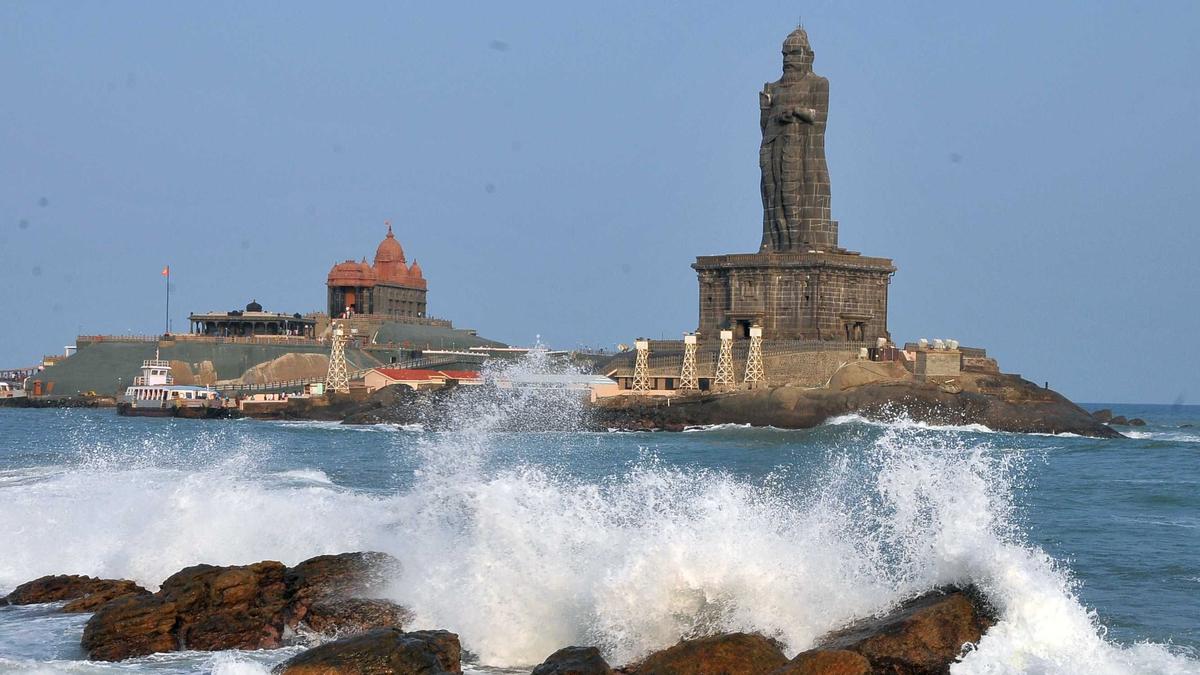
Tiruvalluvar’s statue owes its origin to DMK regime’s decision in 1975
The Hindu
The Tiruvalluvar statue in Kanniyakumari, which completed 25 years of its existence on Tuesday (December 31, 2024), owes its genesis to the decision of the DMK regime on the same day exactly 49 years ago.
The Tiruvalluvar statue in Kanniyakumari, which completed 25 years of its existence on Tuesday (December 31, 2024), owes its genesis to the decision of the DMK regime on the same day exactly 49 years ago.
In 1975, the State Cabinet, at its meeting chaired by the then Chief Minister M. Karunanidhi, cleared the proposal for installing a 33-foot granite statue atop Minor Rock, about 590 ft west of the imposing Vivekananda Rock Memorial, at the confluence of the three seas in the southern tip of the country.
It was Eknath Ranade who, as the president of the Vivekananda Kendra, had represented to the State government regarding the Tiruvalluvar statue, after which the authorities began taking up preliminary work in 1973.
The project cost, when cleared by the Cabinet, was a mere ₹10 lakh. To be mounted on a 42-ft pedestal, the statue would be installed on the Minor Rock, about 30 ft. above the sea level, according to a report of The Hindu on January 1, 1976.
At that time, the DMK regime’s pet project of Valluvar Kottam in Nungambakkam — a ₹99 lakh-monument for the Tamil bard in Chennai — was nearing completion. Sculptor S.K. Achar, who had already designed the Rock Memorial, was engaged for the Kottam work, which was inaugurated by Karunanidhi in September 1974. The architectural pattern of the 101-ft-high Kottam was modelled on the lines of the 96-ft-tall temple car (popularly called Aazhi Ther) of Thyagarajaswamy temple, Tiruvarur.
However, on January 31, 1976, Karunanidhi’s first tenure (since 1969) came to an end with the imposition of President’s rule in the State and the dissolution of the Assembly. On April 15, 1976, the then President Fakhruddin Ali Ahmed declared open the Kottam. The former Chief Minister had nursed a grievance till the end that he was not invited to the inauguration.
The next three years saw little activity with regard to the statue project. However, it was left to Karunanidhi’s successor and bête noire, M.G. Ramachandran, to revive the project. On April 15, 1979, the then Prime Minister Morarji Desai, who laid the foundation stone for the project, wished the statue had been erected earlier. Even at that time, the idea of building a bridge, connecting the Vivekananda Rock and the proposed Tiruvalluvar statue rock, was mooted.


Amit Shah reviews Manipur's security, urging the CM to tackle drug cartels and aid displaced communities after ethnic violence.

Kerala's fisherfolk urge political parties to address livelihood concerns, demanding fair pricing, rule enforcement, and better support during elections.

Moderate rainfall in Visakhapatnam brings relief but causes traffic disruptions and power outages across the city.

Shubman Gill’s Gujarat Titans banks on its tried-and-tested formula

Agriculture Ministry reviews unseasonal rains' impact, assesses farm losses, and discusses relief measures for affected farmers.

Premium petrol prices rise by ₹2 per litre, but government claims no impact on the common man amidst global oil tensions.

Kum. Veerabhadrappa’s acclaimed novel Aramane has been adapted into a television serial. Kannada channel DD Chandana (Doordarshan) has launched the serial with the same name. National Award-winning filmmaker Mansore is the director behind the project,

Diya Chitale and Manav Thakkar reach semifinals, while Yashaswini Ghorpade upsets top seed Sreeja Akula at National TT Championships.

DYFI criticizes A.P.'s job calendar for failing unemployed youth, demanding a revision to include 1 lakh posts and higher age limits.

‘Lethargic’ officials who left Chambal sanctuary to the mercy of sand miners will be held liable: SC
Supreme Court holds negligent officials accountable for enabling illegal sand mining in Chambal Sanctuary, emphasizing habitat protection laws.

Work on the Srisailam Left Bank Canal tunnel resumes after 13 months, with completion targeted by 2027-end, says Minister Reddy.

Ancient ‘Vanni’ tree at Sri Meenakshi Sundareswarar Temple tilts; steps on to restore it

Bengaluru Metro penalises 14 passengers for disrupting services with loud singing, following a viral clip of their antics.