Ticket to a nonsensical world? | Inside Toiletpaper’s largest show, ‘Run As Slow As You Can’, in Mumbai
The Hindu
Inside Toiletpaper and founders Maurizio Cattelan and Pierpaolo Ferrari’s investigation of “our hyper consumption of imagery”
The fourth floor of the Art House at the Nita Mukesh Ambani Cultural Centre is currently a red room. Not a torture chamber, not quite a villain’s lair, but a more Lynchian vision of an HQ or “control room” of Toiletpaper, this is the final chapter in the sprawling exhibit Run As Slow As You Can.
On either end of the control room are vitrines exhibiting the photography-only magazine’s long history in media. On the walls hang pithy quotes as neon signs such as “Tell the truth and run” and “I’m a drug you should try”. In the centre of the room are two officious-looking red tables and chairs. On the first sits an old TV, on which plays a video of a man quietly working in an artist’s studio. On the other is a DELL desktop and on its screen is a rooster’s head floating in outer space. “The Oracle” will answer any question you type into a floating text box, even to something as rhetorical as: “What will the world be like in 3023?” Pat comes the reply: “Like a surrealist dreamscape painted with shades of unknown.”
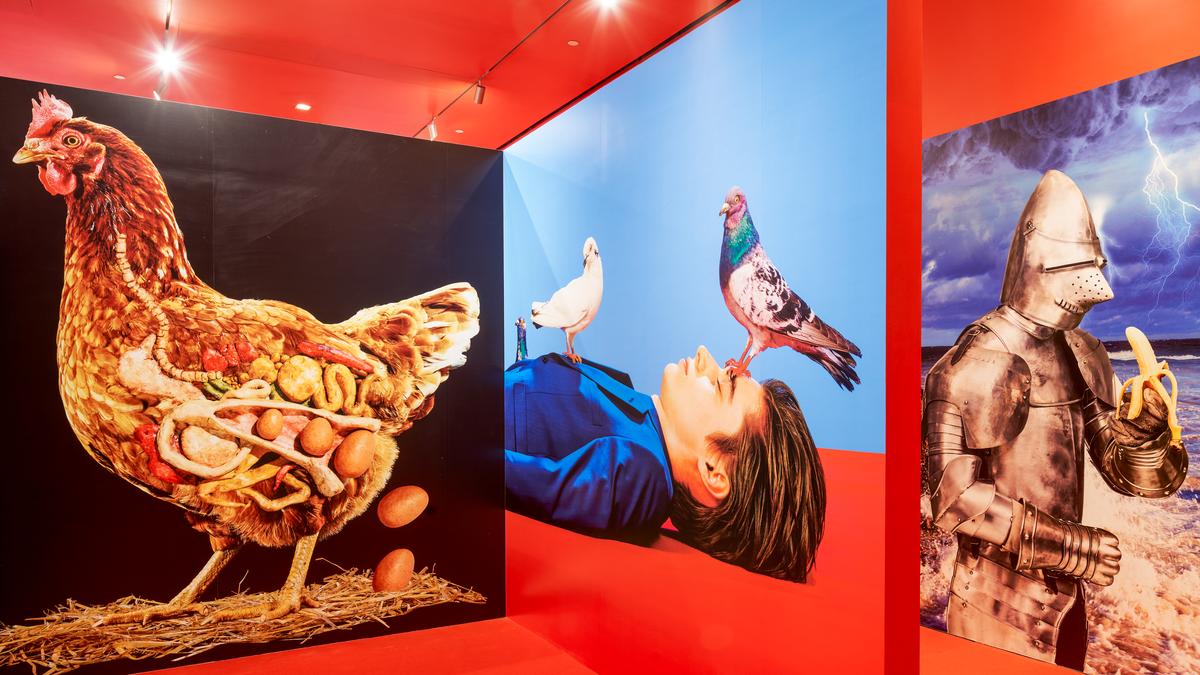
Run As Slow As You Can is Toiletpaper’s largest show since they debuted in 2010. Curated by Mafalda Millies and Roya Sachs, this is a wholesome tribute to the absurd, irreverent, playful universe that the world-famous Italian artist Maurizio Cattelan and renowned Italian fashion and design photographer Pierpaolo Ferrari have built over the last decade.
The show is divided into four chapters, beginning with ‘Take a Left, Right?’, a maze of sorts where your path is lined with blown-up imagery from Toiletpaper’s archives. Heavily mascaraed eyes, breakfast food nailed down to tables, cat heads for burger patties — as you puzzle your way out, you take the hint. This explosion of desire, irony and gluttony is not quite what the glossies advertised.
Ascending the stairwell covered in spaghetti wallpaper, you come upon the second gallery: ‘Is There A Room In The Sky?’ With mirrors on two ends, and every other surface painted a sky blue with white clouds, the air here is more rarefied. Large cut-outs of Toiletpaper images hang suspended from the ceiling: a globe with USA painted golden; a group of hands offering lipstick. It’s as if you’re in the window seat of an aeroplane flying through a funhouse.
For an experience built out of cardboard, paint and mirrors, these two chapters are immersive. “The word ‘immersive’ has become somewhat taboo in the art world today,” says Millies. “Art has become more commercial and accessible in many ways, and immersive art has in some ways helped do this, albeit the often misuse of the word.”
All sense of reality continues to evaporate in Chapter 3: ‘A House Is a Building That People Live In’. Opposite the Taj Mahal plastered on one tall wall, stands a spaghetti covered Fiat, and next to it an arched doorway to a luxurious home stands open. Giant roses bloom and trumpets and trombones boom on the walls. An old Philips RL 191 radio plays an old Kishore Kumar song.


Review meeting held in Dharmapuri with election observers and nodal officers to discuss upcoming Assembly elections.

Execution of development projects, infrastructure augmentation to occupy centre stage in electioneering

Telangana Cabinet approves Hate Speech and Parents Support Bills, ensuring accountability for neglecting elderly and curbing hate-driven offences.

EU and Australia finalize a free trade agreement and establish a new defense partnership to enhance economic and military cooperation.

U.S.-Israeli war on Iran LIVE: Iran faces deadline of US President Donald Trump warning to open Strait of Hormuz. Follow The Hindu for more LIVE updates on March 23 2026 on Iran-Israel war.

KPCC chief Sunny Joseph emphasizes UDF's focus on Sabarimala and corruption while expressing confidence in winning Kerala's upcoming Assembly elections.

A military plane crash in Colombia leaves 125 aboard, with at least 48 survivors rescued amid ongoing recovery efforts.

‘Symposium’, a new platform to promote lifelong learning and counter misinformation among youth, was launched in Hyderabad.

By using TB as an entry point, integrated healthcare delivery can optimise and improve public health efficiency

Residents of Chettichavadi express concerns over deteriorating groundwater quality due to long-standing garbage dumping issues in Salem West.

Community Health Officers in Vijayawada protest for reduced workload and continued incentives amid growing dissatisfaction over salary changes.

Telangana faces 13,929 healthcare vacancies, primarily in doctors and nurses, as recruitment efforts aim to address the shortage.

For most patients with TB who are severely underweight, nutritional support is an essential and not optional part of treatment