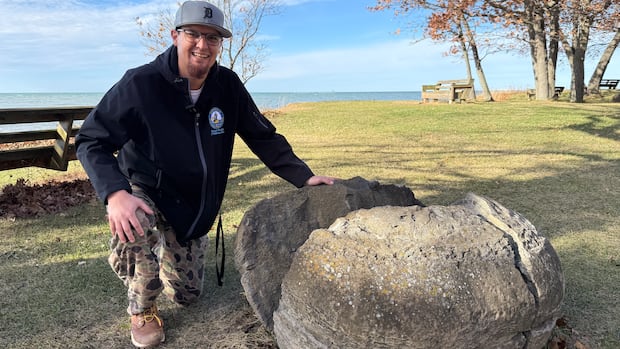
Thunderbird eggs returned to their 'nest' at Kettle and Stony Point First Nation
CBC
Two ancient stone spheres were returned to their home at Kettle and Stony Point First Nation on the shores of Lake Huron last Tuesday.
The boulders are called kettles because their shape and size is similar to a cooking pot and are found in the community about 220 kilometres southwest of Toronto.
They have cultural significance to the Anishinaabek. Knowledge keepers describe Kettle Point beach as the nesting place of the Thunderbird: powerful spirits that offer protection and bring healing rains to communities in exchange for safekeeping of their sacred places. The kettles are the eggs.
The point is believed to be the source of power that fades from the stones if they are removed.
Christy Bressette, member of Kettle and Stony Point and vice-provost for Indigenous initiatives at Western University in London, Ont., was integral in having the kettles that had been in the university's possession returned.
“Getting sacred items back home, beings such as the Thunderbird eggs, is critically important to the community and a really great place to start," said Bressette.
"Our work is not done."
Bressette said sharing Indigenous knowledge offers "sustainable solutions" and benefits everyone, not just Indigenous communities.
"This work is supporting a much larger endeavour where we not only reconcile with each other, but also reconcile with the earth,” she said.
The kettles were welcomed home with a pipe ceremony and an honour song.
Bernard George, who spoke during the rematriation ceremony, said it was an important day because the Thunderbird is sacred to the Anishnabek people. It's on their nation’s flag and in their stories and traditions.
He said elders told him growing up that the Thunderbird comes during storms to warn people to pay attention, and when the kettles crack, he said, their spirit is released.
Jordan George, Kettle and Stony Point's language revitalization and communications co-ordinator, was on the rematriation working group and said he felt "full" after they were given back.
"But I also know that this is the first step on the journey to repatriating and caring for the thousands of other stones that were taken from our shores," he said.


Toronto resident Winhan Wong's lung cancer journey began in 2016, with a nagging cough that just wouldn't go away.

Last month, Assembly of First Nations National Chief Cindy Woodhouse Nepinak pointed out on social media that history was made this year because there are a record 164 female chiefs serving across the country.

Most of humanity has a great propensity to think in the short-term, but generally, long-term considerations — air pollution, deforestation and emissions, for example — just aren't our thing.

As the COVID-19 pandemic began to unfold in early April 2020, Kolter Bouchard was just weeks into fatherhood when he noticed a lump on his neck.

Advocates and health care providers say they remain concerned about First Nations kids seeking services under Jordan's Principle even after the Canadian government’s recent promise of $1.55 billion in funding.

Contrary to science fiction, black holes are not portals to other dimensions or cosmic vacuum cleaners that swallow up everything around them.

An attempt to preserve files documenting some of the worst harms caused by Indian Residential Schools could soon head to Parliament.

A new survey suggests about three million Canadian adults are currently taking GLP-1 drugs such as Ozempic or Mounjaro and that many more would like to, but cost is a barrier.

For years, people living in Canada’s north have reported an increasing numbers of polar bears on shore, venturing into communities and encountering humans.

When Maureen Hayes first tested her Ottawa home for radon a little over a year ago, the initial reading was far below Canada's current threshold to take action.

Debate over legislation to update animal testing rules will resume next month, with one lawyer fearing it will end important research into cardio-vascular disease without proper debate.

Sam Pratt was around 13 when he first saw people talking about "looksmaxxing" on YouTube.

A group advocating on behalf of Indigenous people who cross the Canada-U.S. border says it’s disappointed by new travel advice from the federal government.