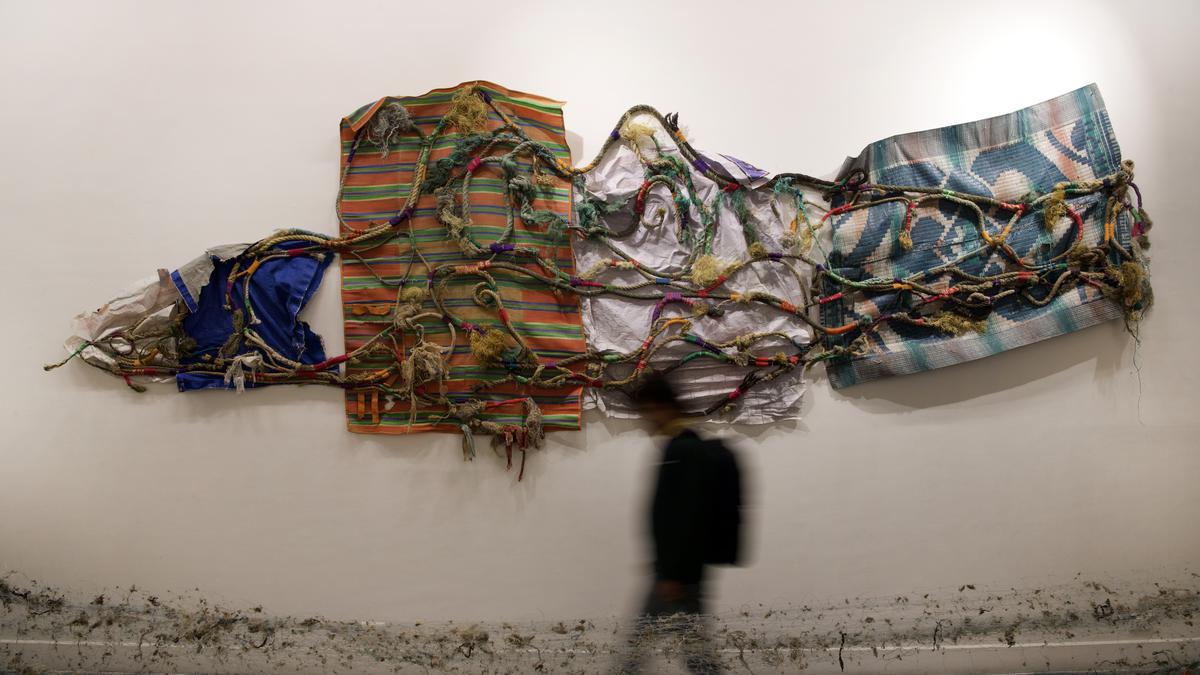
Thukral & Tagra’s ‘Sustaina India’ trains the spotlight on climate change
The Hindu
Can art do more than build awareness around climate change? Delhi exhibition Sustaina India would like to find out
British Columbia in Canada is home to temperate coastal rainforests, some of the oldest growths of their kind on the planet. When Manjot Kaur, a contemporary artist who spends her time between Chandigarh and Vancouver, began to make excursions there some years ago, she was struck anew by the greenery.
“I was born in Ludhiana, a very industrial, urban town in Punjab,” says Kaur, one of three selected fellows at Sustaina India, a unique new art exhibition with a focus on raising climate awareness, at Bikaner House in New Delhi. “I lived in Vancouver for two years, and as soon as I started to venture into the forest, I realised that it was not just trees. We are in symbiosis with them, there is reciprocity.”
Kaur’s observations have manifested in The Parliament of Forests, a video installation that seeks to highlight the idea of nature having rights of its own. “The goal of this project is to think about personhood for forests,” says the artist, who is inspired by the work of French philosopher Bruno Latour, American feminist academic Donna Harroway, and American eco-feminist Carolyn Merchant, among others.
Sustaina India’s first art exhibition is the result of 18 months of conversations between the Council on Energy, Environment and Water (CEEW), a New Delhi-based think tank, and the multi-disciplinary artists Jiten Thukral and Sumir Tagra. Born from the alarming research-based observation that eight out of 10 Indians now reside in districts vulnerable to extreme climate events, CEEW sought to fill the blank spaces between policy, awareness and on-ground implementation through artistic practice.
For this, they reached out to Thukral & Tagra who have, since the pandemic, been putting together climate change-oriented Game Plays — like board games, says Tagra “but another take on how to engage with people and communities, without any tech involved”.
In another room of Bikaner House, stands a part-mud, part-cement wall — artist Debasmita Ghosh’s Living With The Land, an art installation that tracks the after-effects of switching from mud to industrial material for building houses in the Kondh community of Orissa.
Ghosh, who first ventured into this tribe’s hamlet in 2018, knew there was not going to be any solutions or answers to the questions she was asking the community. “What we wanted to show was the process and the journey that the women of the community are taking: the impact, the transitions, their feelings about it — how this impacted different aspects of their lives.”


The teaser of Tamil star Suriya’s much-awaited film with director Venky Atluri, titled Vishwanath and Sons, was unveiled by the makers on Monday

A 'Golden' moment for a K-pop track at the Oscars.

Parvathi Nayar’s new exhibition, The Primordial, in Mumbai, traces oceans, pepper and climate change
Opened on March 12, the exhibition marks the artist’s first solo show in Mumbai in nearly two decades. Known for her intricate graphite drawings and multidisciplinary practice spanning installation, photography, video, and climate change, her artistic journey has long engaged with the themes of ecology, climate change and the natural world. In this ongoing exhibition, these strands converge through a series of works centred on water, salt, and pepper — materials that carry natural and historic weight across centuries.

Explore the highlights and key winners of the 98th Academy Awards, featuring memorable moments and historic achievements from Oscars 2026.

Spring season celebrated at Ramakrishna Mission Institute, Kolkata, with ‘Evening of Basant’

The Spirit of the Land, a solo show by artist Shivakumar Sunagar, is a vista of Nature-inspired emotions

Tal Fry is all set for an exciting new performance season

Netflix is making a bold move by snagging InterPositive, the AI filmmaking company founded by Ben Affleck, in a deal that could hit $600 million

Watch the eerie trailer for 'Hokum,' where Adam Scott faces a witch haunting in a mysterious Irish inn.

Oscars 2026 security heightened amid FBI warnings of a potential Iranian drone threat ahead of the Hollywood ceremony.

Directed by Rahul Pandey, the series also stars Naila Grewal, Nidhi Bisht, Anant Joshi, Anjum Batra and Kusha Kapila

A tribute to the versatile actor and comedian V.K. Ramasamy in his birth centenary year.

‘One Piece’ Season 2 review: As the Straw Hats enter the Grand Line, Netflix’s live-action adaptation finds its sea legs with bigger islands, stranger villains and the same stretch-happy sense of boundless adventure