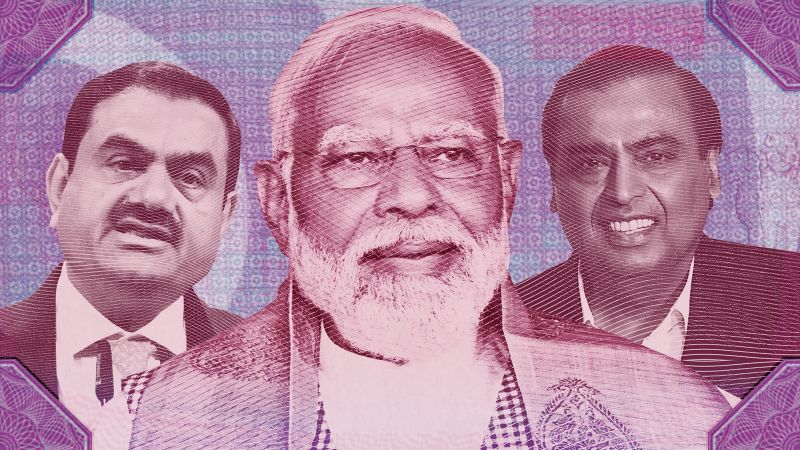
Three men behind India’s bid to become an economic superpower
CNN
Narendra Modi, Mukesh Ambani and Gautam Adani are playing a fundamental role in shaping the kind of economic superpower India will become in the coming decades.
In March, a quiet coastal town in the western Indian state of Gujarat could have given both Davos and Coachella a run for their money. That’s when billionaires and movie stars from around the world jetted to Jamnagar, overwhelming its small airport with private planes and chartered flights. They were all there to party with Asia’s richest man, Mukesh Ambani. The 67-year old chairman of India’s most valuable private company Reliance Industries had thrown a lavish pre-wedding bash for his son, welcoming around 1,200 guests from Silicon Valley, Bollywood and beyond. Mark Zuckerberg, Bill Gates and Ivanka Trump were among the many high-profile celebrities in attendance. The three-day celebration, which saw performances by popstar Rihanna and magician David Blaine, transfixed India and further underscored Ambani’s growing global clout. But Ambani was not the only Indian businessman at the bash whose staggering influence and riches are reshaping the world’s most populous country. Fellow billionaire Gautam Adani, founder of the Adani group, was also invited. The infrastructure tycoon has stunned the world with his supercharged rise in the last decade. In 2022, he briefly ousted Jeff Bezos as the world’s second-wealthiest person.


Maria Corina Machado, the Venezuelan opposition leader and 2025 Nobel Peace Prize winner, arrives in Washington this week for high-stakes talks with US President Donald Trump on the future of Venezuela following the ouster of Nicolás Maduro. The meeting comes after Trump surprised many by allowing Maduro’s vice president, Delcy Rodríguez, to assume control, dashing opposition hopes for a new democratic era.

A judge decided not to issue a temporary restraining order after Minnesota and the Twin Cities sued federal officials, claiming their immigration enforcement operation involves warrantless arrests and excessive force.

After an Immigration and Customs Enforcement (ICE) agent shot and killed Renee Nicole Good in Minneapolis one week ago, reactions on social media and among politicians and political influencers rapidly polarized.

Most Americans see an immigration officer’s fatal shooting of Minneapolis resident Renee Good as an inappropriate use of force, a new CNN poll conducted by SSRS finds. Roughly half view it as a sign of broader issues with the way US Immigration and Customs Enforcement is operating, with less than one-third saying that ICE operations have made cities safer.

The United States is indefinitely suspending immigrant visa processing from 75 countries in another expansion of the Trump administration’s crackdown on immigration.

The US announced the start of the next phase of the Gaza ceasefire plan on Wednesday as a new committee was formed to run the battered enclave.

Michigan Democratic Sen. Elissa Slotkin said Wednesday that US Attorney Jeanine Pirro wants a formal interview with her following her involvement in a controversial video urging service members and intelligence officials to disobey illegal orders.

Venezuelan opposition leader María Corina Machado, the 2025 Nobel Peace Prize winner, is scheduled to meet with US President Donald Trump on Thursday, a senior White House official told CNN. CNN’s Stefano Pozzebon reports from Bogota.

Top Trump administration officials met Tuesday to further refine a set of options for the president to take action against Iran amid its deadly crackdown on protesters.

The decision that may make it easier for other candidates to challenge voting laws – even if they ultimately win their election.

The Pentagon is working to surge dozens of military lawyers to Minneapolis to assist in federal prosecutions amid an immigration enforcement crackdown there, according to two officials familiar with the matter and a written request that has circulated inside the Defense Department.

The au pair who was having an extra-marital affair with Brendan Banfield when he allegedly killed his wife and another man in February 2023 is set to resume her pivotal testimony in Banfield’s double-murder trial Wednesday morning.

President Donald Trump unveiled in rapid succession last week a series of proposals aimed at reducing Americans’ cost of living, focused on housing and credit card debt.