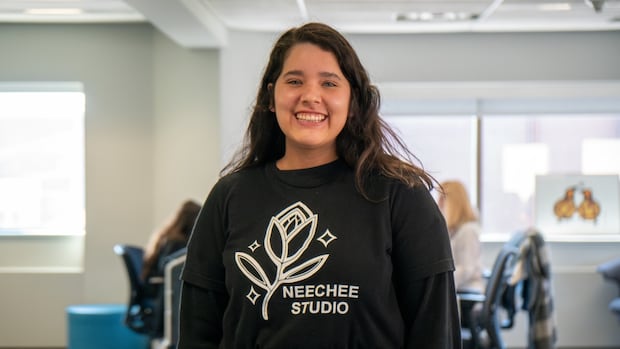
This co-valedictorian gave her speech in Anishnaabemowin
CBC
It was an historic moment at the Bora Laskin Law School graduation earlier this spring. Co-valedictorian Cassandra Spade gave her speech in Anishnaabemowin.
Cassandra is from Mishkeegogamang First Nation but also spent a lot of her time growing up in Couchiching First Nation and she has big plans as she moves forward in her law career.
She spoke with Mary-Jean Cormier, the host of Superior Morning, about those plans and what it was like giving her speech in Anishnaabemowin.
This interview has been edited for length and clarity.
Mary-Jean Cormier: Can you tell me what it was like to be up on stage speaking Anishnaabemowin?
Cassandra Spade: I cried walking up to the stage. I was trying to hold myself together during the speech. Throughout the speech, you can hear pauses where I'm very much overcome with emotion, and it's because it's such an unimaginable thing to think that a valedictorian address would be given in an Indigenous language and especially at a law school.
So, it was really special to me, but it also felt like all of the language teachers and the people who supported my language learning were in that room with me. So, it was very, very special.
MC: What did you say?
CS: I opened by saying that this is perhaps the first time at a Canadian law school where this address is given in an Indigenous language, specifically Anishinaabe.
But I also said that this moment didn't happen by myself alone. There are a lot of people who have nurtured me and loved me and taken care of me to get me to this point and who taught me the Anishinaabe language.
LISTEN | Cassandra Spade speaks Superior Morning host Mary-Jean Cormier:
So, I'm not a first language speaker. I learned as an adult and I'm specifically talking about one elder from Lac Seul First Nation. She specifically told me when I first started learning that if you take care of the Anishinaabe language it will take care of you. I didn't really know what it meant at the time, but throughout law school I learned that our language holds all of our law, and by learning my language and taking care of it and practising it, I was really reinforcing our laws and learning and kind of preserving them. So it was really special to learn that in law school.
MC: Speaking of law school, beyond the language piece, what did it mean for you to graduate from law school?
CS: I've obtained a law degree, which is really special. I'm the first one in my family to go to law school and to graduate, and it makes me reflect on all of the people in my family who are so talented and skilled and are able to give to the community in so many different ways. So, I think about all of the things that my family has taught me specifically about kindness or thinking about other people or listening to other stories.


A national organization is seeking people with experience in Canada's forestry sector as they put together a working group that will examine ways to improve forest recovery following wildfires.

Ella Heyder is bracing for a breakup, even though she already moved out decades ago.

Shawne Hopkins never saw it coming.

Politicians return to Queen’s Park Monday for a shortened spring session, as Premier Doug Ford prepares to unveil his eight budget amid heightened global economic uncertainty.

Despite a recent announcement that a water supply pipeline will be build in Oneida Nation of the Thames, some members of the community say that's no excuse for taking water for granted.

As scandal has swirled around former prince Andrew Mountbatten-Windsor, questions and curiosity have also focused on his ex-wife, Sarah Ferguson, and their daughters, Princesses Beatrice and Eugenie.

Friday may have been the first day of spring, but winter storms are not over yet for Newfoundland.

While we officially welcomed spring last week, an incoming system will be a reminder that snow is still very much part of the new season, especially early on.

The future of a national historic site in Fredericton is up for discussion at meetings across New Brunswick in the next few weeks as the Anglican diocese considers what to do about costly repairs needed at Christ Church Cathedral.

Amanda Lathlin, the first First Nations woman to be elected to the legislative assembly in Manitoba's history, has died, the provincial NDP said on Saturday.

CBC's road trip series Land of Living Stories explores inspiring stories of community spirit from across Saskatchewan. In our latest visit, CBC-Radio Canada hit the road to La Ronge. This is the fifth of a multi-part series from that community.

Dozens of people filled Regina's Fresh and Sweet cafe on Saturday to paint, collage and craft their concerns about artificial intelligence by making zines — a type of self-published small booklet, typically created by hand.

Wildfire season has officially started in Alberta. As the snow starts to melt, people are starting to wonder: Will I have to evacuate this year?