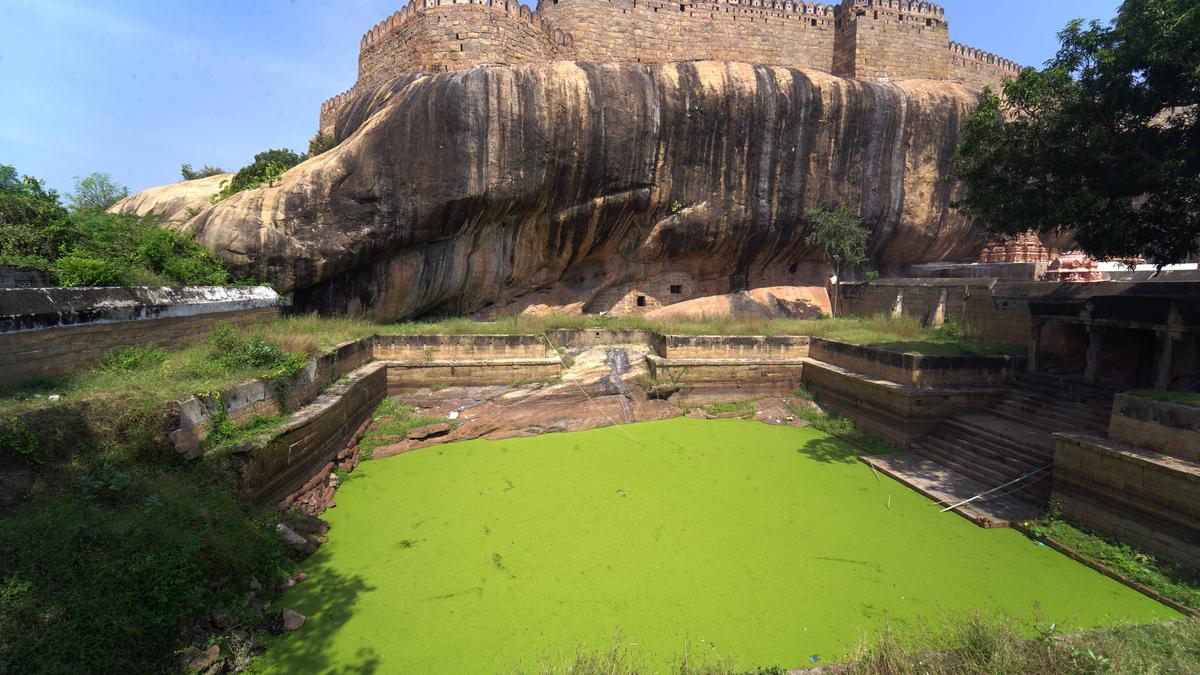
Thirumayam fort bears a testimony to the bond between Sethupathis and Thondaimans
The Hindu
Discover the history and secrets of the Thirumayam fort, a testament to the bond between two dynasties.
The story goes that sometime in the 1680s, a messenger had brought news to Kilavan Sethupathi, the Ramanathapuram king, of a tiger creating panic in villages in and around Thirumayam. A sharpshooter, the king reached Thirumayam, the northernmost boundary of his kingdom. To keep an eye on the marauding invaders from the northern part of Tamil Nadu, Sethupathi had built a fort on the hillock there.
During this hunting expedition, Sethupathi, who according to historian Rober Sewell was the first truly sovereign king of the Sethupathi dynasty, may have rested at the fort, where there were barracks for his soldiers and a rock-cut cell with a Shiva lingam inside. Had he walked on the ramparts of the seven-ringed fort wall, he would have seen in the distance the Vellar, a non-perennial river, snaking through thick vegetation and forming a boundary for his kingdom. It was there in the thickly forested area that the tiger was holed up.
History does not tell whether Sethupathi killed the tiger, but an oft-repeated romantic folklore says it was on the banks of the river that he set his sights on Kathayi Nachiar, the sister of Ragunatha Raya Tondaman, the chieftain of the neighbouring Pudukkottai. What is recorded is the marriage of Sethupathi and Nachiar. Mee. Manoharan, in his book Kilavan Sethupathi, writes that in the 17th Century, the Thondaimans were the local chieftains who ruled in and around Pudukkottai. They were known for their skills in training elephants for warfare and this would have buttressed the army of the Sethupathis.
Earlier, Sethupathi had deputed a local chief, Pallavarayan, to oversee the Thirumayam region. Around 1686, whispers in the palace corridor brought to him the news of a revolt by Pallavarayan. To gain more power, Pallavarayan had been toying with the idea of joining forces with the Bhonsles, the Thanjavur rulers. Sethupathi ousted Pallavarayan and made his brother-in-law Ragunatha Raya Thondaiman the new ruler of Pudukkottai and gave him the Thirumayam fort.
By the early 18th Century, the British had emerged as a mighty force in Tamil Nadu. During this period, Hyder Ali, aided by the French, was manoeuvring to capture Pudukkottai.
J. Raja Mohamad, former curator, Pudukkottai Government Museum, says that to survive, the kings were forced to side with the British or the French. For some time, the Thondaimans had followed an independent foreign policy but when besieged by Hyder Ali’s forces, they sided with the British and also helped the Nawab of Arcot against Hyder Ali. With British arrival, the Thirumayam fort became a highly guarded garrison. The fort’s magazine room was filled with artillery; cannons were placed on the bastions; and the embrasures in the wall were parked with projectiles.
The fort stands as a testimony to the bond between two dynasties — the Sethupathis and the Thondaimans. But the fort held secrets within its outer boundary walls that date not only before the Keezhadi civilization but also much earlier than the Indus Valley Civilisation, says Mr. Mohamad. During the prehistoric time, this region was interspersed with hillocks. The Vallar flowed quietly during the monsoon and bands of nomadic hunter-gatherers settled here in the Neolithic period and began their first forays into agriculture.


Delhi Home Minister Ashish Sood condemns violence during demolition near Faiz-e-Elahi mosque, ensuring legal action against offenders.

Whistleblower Sangeeta Chendvankar joins NCP ahead of Maharashtra civic polls, previously exposed Badlapur sexual assault case.

All-India Tiger Estimation-2026 begins in Erode's Thanthai Periyar Wildlife Sanctuary, focusing on tigers and other wildlife.

Form district-level panels to end ‘orderly’ system in Police dept.: Madras HC to T.N. Home Secretary
Madras HC orders Tamil Nadu Home Secretary to form district-level panels to end misuse of police personnel for personal tasks.

Realsee at CES 2026: Showcasing Spatial Digitization Solutions

V.D. Satheesan critiques CPI(M) for echoing Hindutva rhetoric, claiming it undermines Kerala's secular fabric and minority support.

Tamil Nadu's Transport department to deploy over 22,700 buses from Chennai for Pongal, ensuring smooth travel across the State.

Chilly weather returns to Telangana, with Asifabad recording a low of 6.3℃ as temperatures drop across 11 districts.

Bharatanatyam dancer Christopher Gurusamy presented his solo production 'Ananda' at the Kalavaahini festival in December 2025.

Delhi Court orders removal of posts linking BJP leader Dushyant Gautam to Ankita Bhandari's murder case to prevent defamation.

Former TDB president A. Padmakumar denied bail again in Sabarimala gold theft case due to potential evidence tampering concerns.

Bengaluru techie loses ₹1.1 lakh to traffic fine link fraud; police investigate rising scam incidents.

Amazon’s cloud unit has partnered with German automotive hardware supplier Aumovio to support the commercial rollout of self-driving vehicles