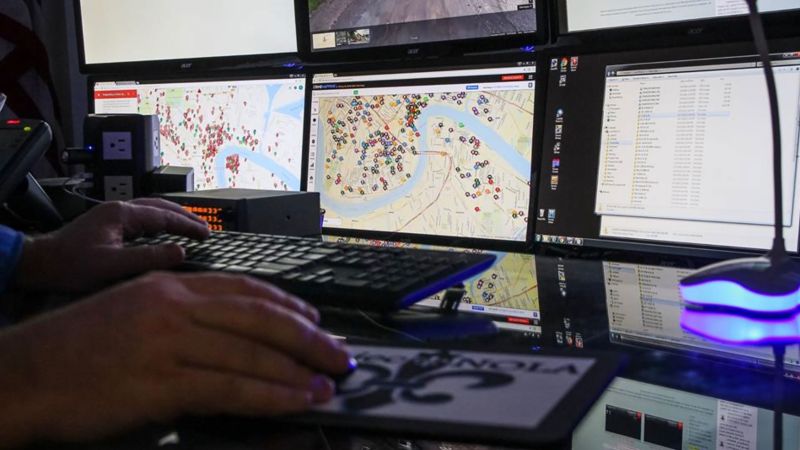
They’ll be watching Bourbon Street on Mardi Gras (and every other day)
CNN
In cities across the United States someone or something is almost always watching you. On Tuesday, as Mardi Gras revelers flock to New Orleans to celebrate the end of Carnival, it will be no different.
In cities across the United States someone or something is almost always watching you. On Tuesday, as Mardi Gras revelers flock to New Orleans to celebrate the end of Carnival, it will be no different. Surveillance cameras are crucial for deterring and solving crimes, finding missing people and fighting terrorism in cities across the US, but a unique web of eyes is observing Bourbon Street. Spawned in the aftermath of a natural disaster, Project NOLA, a community-based network in New Orleans and beyond is using its web of 10,000 security cameras to offer high-definition surveillance to dozens of law enforcement agencies serving communities from coast to coast. What sets the nonprofit’s model apart is that their cameras are positioned on private homes and businesses and can be outfitted with facial recognition, license plate reading and clothing recognition software. Some studies have shown that areas covered by surveillance cameras generally see significant crime reductions, but critics worry advanced facial recognition software violates the public’s right to privacy, and disproportionately targets people of color. Mere hours into the new year, the team at Project NOLA was focused on a shooting in Adams County, Mississippi – one of many cities and towns across the country where Project NOLA operates – when the phone rang.


ICE agents sent to airports as TSA callouts remain high; separately, two people have died after a plane collided with a fire truck at New York’s second biggest airport. Follow for live updates

Mike Pence used to dream of following two successful Donald Trump terms with his own turn in the White House.

An Air Canada plane was damaged after colliding with a vehicle on a runway at New York’s LaGuardia Airport Monday, according to video from the scene and air traffic control audio.

A statue of Christopher Columbus has been erected outside of an ornate federal office building on the White House grounds — the latest sign of the Trump administration’s efforts to reshape cultural and historical representations across the nation’s capital.

Kentucky Gov. Andy Beshear, speaking in JD Vance’s home state of Ohio on Saturday, tore into the vice president, questioning his Appalachian roots and telling voters they “deserve better.”

President Donald Trump has said ICE agents will head to US airports tomorrow amid a partial government shutdown. Follow for live updates

Cuba is working to restore the electricity supply after another island-wide blackout left more than 10 million people without power.

President Donald Trump said Sunday border czar Tom Homan will be in charge of deploying Immigration and Customs Enforcement agents to airports on Monday, with Homan telling CNN the agents will help with security at entrances and exits to ease the Transportation Security Administration’s workload.

Donald Trump wants us to believe that a deal with Cuba is close at hand. After this past week, I am not so sure.

President Donald Trump has said ICE agents will head to US airports tomorrow amid a partial government shutdown. Follow for live updates

President Donald Trump said Sunday border czar Tom Homan will be in charge of deploying Immigration and Customs Enforcement agents to airports on Monday, with Homan telling CNN the agents will assist with security at entrances and exits to ease TSA workload amid a partial government shutdown.

Janet Mills and her allies are counting on a gender gap to narrow Platner’s wide lead ahead of the June 9 primary to decide who will face incumbent Republican Sen. Susan Collins. They are betting that the unfiltered style that has brought Platner widespread attention as someone who could help Democrats reach young men will backfire with women.

Why do people “pledge allegiance” to a “state” that is no longer a state? And what spurs someone to not just attack innocent people, but to then make a statement of loyalty while doing so?