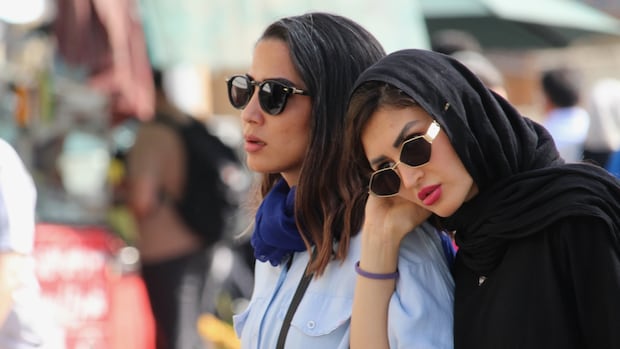
These women are defying Iran's hijab laws — despite fear of reprisal
CBC
The face of Tehran has been undergoing an extraordinary transformation in recent months, some neighbourhoods seeming to channel Beirut as much as the capital of the Islamic Republic where headscarves — or hijabs — have been mandatory for women for 45 years.
Less than three years after the brutal crackdown on the protests that followed the death of Mahsa Amini in police custody for an alleged dress code violation, a growing number of women are daring to bare their heads in public.
They're not a majority, but on any given day in north Tehran's popular Tajrish Square, you'll find a mixture of women with and without headscarves. Some don't even wear them around their necks anymore, where they could be pulled up quickly if the decision to go bare-headed is challenged.
"We young people have decided to live the way we like," said Laylah, a 30-year-old self-employed woman out shopping with her mother. The authorities "need to understand that we want to be free, comfortable and liberated."
Like all the women interviewed in this story who were not wearing a headscarf, Laylah did not provide her last name for fear of repercussions for defying her country's hijab laws.
Some analysts believe the Woman, Life, Freedom protest movement sparked by Amini's death in 2022 is here to stay. That the number of women — young and old — defying the hijab law is so great the regime will be unable to reverse it.
Others say Iran's ruling clerics are allowing what's happening to continue because it suits their purposes at this time, noting that stories like this one, which highlight the seemingly dramatic change on the streets, actually distract from the draconian and often sinister ways the state continues to punish women who disobey.
"I think that the authorities, frankly, are getting more clever about how they carry out their reprisals," said Nassim Papayianni, a senior Iran campaigner with Amnesty International based in London.
The white vans used by Iran's controversial morality police are still visible on the streets of Tehran. But on a recent — and rare — reporting trip to the city, our crew didn't witness police make any arrests or bully those women not wearing the hijab.
"What they're doing is just trying to adapt in a system that they think won't draw as much international attention," Papayianni said.
"I think they know if they arrest women's rights defenders or women and girls for defying compulsory veiling that there will be a lot of international attention on that."
The methods regularly used by authorities to enforce a dress code in place since just after the 1979 Islamic Revolution range from financial penalties to lashings or jail terms.
And just because women are choosing to defy the law doesn't mean they are not afraid of repercussions.
"I am afraid; I have concerns," said Saha, a 33-year-old human resources worker wearing her long curly hair uncovered while out in public. "But I'm doing this because I want [any future child of mine] not to have the same fear as I do," she said, speaking in Farsi.


U.S. President Donald Trump is urging other countries to help secure the Strait of Hormuz as Iran targets ships in the vital oil route, but so far there are few firm commitments.

Arab Gulf states reported new missile and drone attacks on Sunday after Iran threatened to widen its campaign as the war in the Middle East entered its third week.


The former secretary general of NATO says he doesn't think allies will be pulled further into the conflict in the Middle East, but he's concerned the ongoing war with Iran will benefit Russia's economy and take the world's attention away from the invasion of Ukraine.

As American and Israeli strikes pound Iran — while it attacks shipping and energy infrastructure across the Persian Gulf — U.S. President Donald Trump made a new threat to Tehran's leaders.

The armed man who rammed his vehicle into one of the largest Reform synagogues in the U.S. Thursday has been identified as a 41-year-old naturalized citizen born in Lebanon, according to federal officials.

With jagged cliffs rising from the Arabian Sea, the Strait of Hormuz is striking in its scenery — and these days, its emptiness. This resource superhighway, which normally hosts more than a hundred of the world’s largest oil and liquid natural gas (LNG) tankers every day, has seen no more than a handful all week.

The Canadian government said Tuesday it is alarmed by the escalation of violence and attacks in Lebanon, as the war in the Middle East expands.

In a resounding victory that is guaranteed to reshape Nepal's politics, rapper-turned-politician Balendra Shah appeared headed for a landslide win in the South Asian country's first polls since youth-led protests toppled the previous government last fall.

China’s latest blueprint for driving growth in its economy was largely written before the U.S. and Israel instigated the most far-reaching war in the Middle East in decades.

U.S. President Donald Trump's firing of Homeland Security Secretary Kristi Noem on Thursday overshadowed the announcement of his plans to nominate Republican Sen. Markwayne Mullin as her successor.

The truck carrying Nepali prime ministerial candidate Balendra Shah was swarmed by cheering supporters in the capital, Kathmandu, on Saturday, unable to inch forward as the former rapper, wearing sunglasses and a sleek black suit, danced on top of the roof.

Israel sent troops into southern Lebanon on Tuesday and warned residents of more than 80 villages to evacuate as the Iran-backed militant Hezbollah group said it was ready for an "open war" with Israel in the wake of the U.S.-Israeli war with Iran.