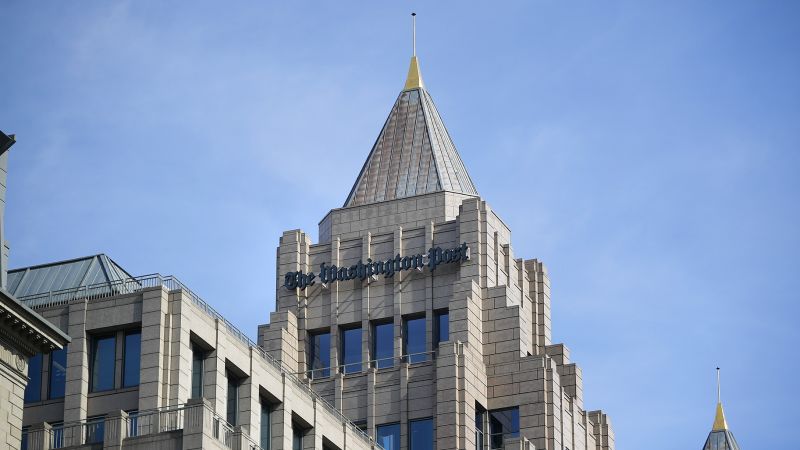
The Washington Post publisher disclosed the paper lost $77 million last year. Here’s his plan to turn it around
CNN
On Wednesday, Will Lewis, publisher and chief executive, outlined to staffers his vision for shepherding the iconic newspaper into a financially prosperous future.
Editor’s Note: A version of this article first appeared in the “Reliable Sources” newsletter. Sign up for the daily digest chronicling the evolving media landscape here. On Wednesday, Will Lewis, the newly minted publisher and chief executive of The Washington Post, strode on stage before gathered staffers at the company’s D.C. headquarters to outline his vision for shepherding the iconic newspaper into a financially prosperous future. Dressed in a navy blue blazer and button down shirt, along with his trademark sneakers (the Brit is known to be partial to the casual footwear), Lewis first delivered the cold hard reality to his assembled workforce. He candidly explained the depths of The Post’s recent financial woes, revealing that it had lost $77 million over the last year and seen a dramatic 50% drop in audience since the highs of 2020. “To speak candidly,” Lewis told staffers at the top of the 90-minute meeting, “we are in a hole, and we have been for some time.” But Lewis said he has a plan to rescue the renowned newspaper that has broken some of the biggest stories of our time and turned its most influential journalists into household names. That plan, officially dubbed the “build it” phase of the turnaround project (which follows the “say it” and “fix it” phases), was defined by a pyramid shared with staffers in a Powerpoint presentation. The pyramid, aimed at helping employees visualize new business opportunities, showed the traditional subscription membership stacked along with new subscription and payment offerings for readers.


Artificial intelligence could widen the problem of income inequality, said BlackRock CEO Larry Fink in his annual letter to shareholders.

Stocks soared and oil prices fell after President Donald Trump on Monday said the United States would postpone further strikes on Iran’s energy infrastructure, pending the outcome of negotiations.

The national average price for a gallon of regular unleaded gasoline is on the verge of hitting $4 for the first time since 2022.

Oil prices rose Monday after the United States and Iran threatened fresh attacks on energy facilities in the Middle East, including power plants, signaling that the conflict may yet escalate.

The war in Iran is pushing up prices for already-strained farmers, with higher costs for fertilizer and energy on top of last year’s tariffs. And the increasing pressure on American agriculture could lead to even bigger price tags at the grocery store.

If you only watched Fox News over the weekend, you didn’t hear about President Donald Trump’s widely condemned reaction to Robert Mueller’s death.

Oil prices rose Sunday after President Donald Trump threatened to “obliterate” Iran’s power plants if the Strait of Hormuz is not reopened by Monday evening.

Defense Secretary Pete Hegseth has been taking steps to thwart news coverage of the Pentagon for more than a year. Now he has finally met some resistance.

Defense Secretary Pete Hegseth has been taking steps to thwart news coverage of the Pentagon for more than a year. Now he has finally met some resistance.

Gerald Rodriguez, the general manager of an NPR affiliate in rural Colorado, expected federal funding for public media to shrink. He didn’t expect it to disappear almost overnight.

The much-touted new tax breaks for tips, overtime, seniors and car loan interest have a lot of income tax filers expecting a big bump in their refunds this year – or a big cut in their tax bill.

Looking out his shop window, across the street, just to the right, Paloma Clothing co-owner Mike Roach sees one of Portland, Oregon’s, most expensive gas stations.

Oil and liquefied natural gas tankers moving through the Strait of Hormuz carry around 20% of the world’s supply. But for countries on the Persian Gulf, the waterway is more than just an energy route – it’s a lifeline for more than 100 million people.