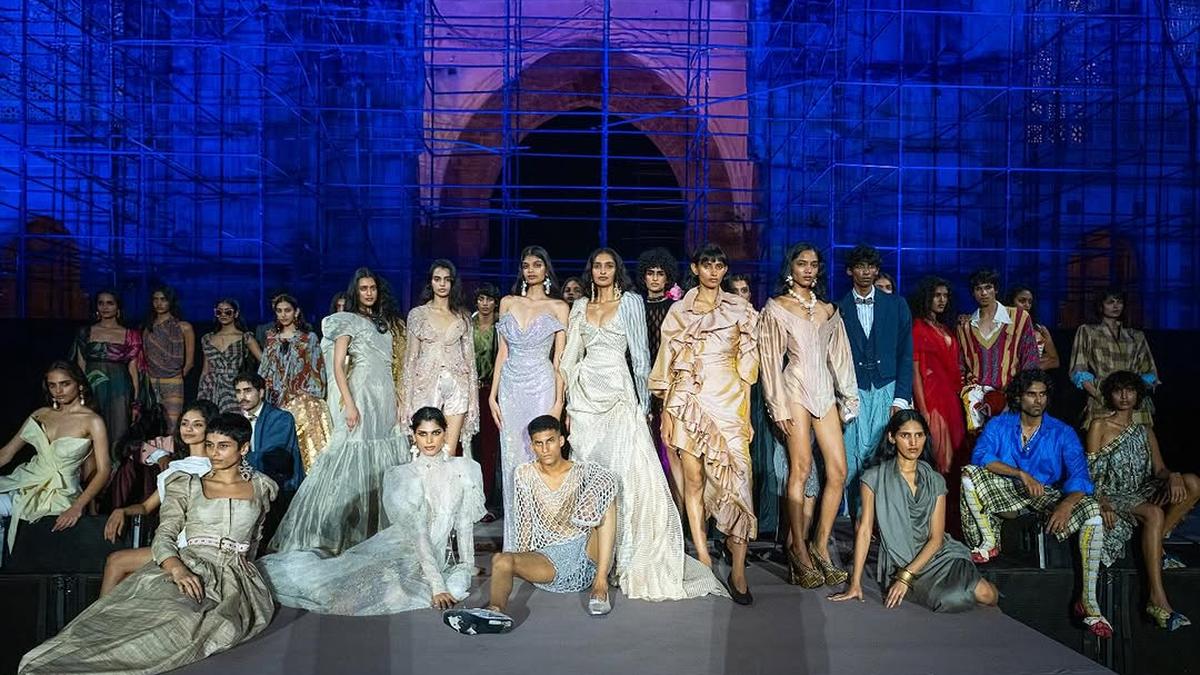
The Vivienne Westwood fashion show in Mumbai did not bring the punk
The Hindu
Vivienne Westwood's Mumbai show, a nod to Indian heritage, lacked the rebellious edge that defined her iconic collections.
The late Dame Vivienne Westwood, the British designer who dragged punk and new-wave fashion into the mainstream in the 1970s, once quipped, “Popular culture is a contradiction in terms. If it’s popular, it’s not culture.” Her disdain for conformity and her love for rebellion were the hallmarks of a career that redefined style as a form of dissent. “Democratic envy,” as she termed it, made people dress alike simply to belong. She preferred dressing for herself — even if no one else approved.
That ethos lingered in the air at Vivienne Westwood’s recent show in Mumbai, staged against the dramatic backdrop of the Gateway of India. The venue — last seen hosting Dior’s pre-Fall showcase in 2023 — came with weighty expectations. Where Dior offered polished precision, Westwood delivered something else entirely: looser, moodier, and far less structured.
Secrecy surrounded the event. There was no pre-show buzz and invites were last-minute invites. A passing drizzle left the air sultry and thick with tension.
The collection, which featured a few archival pieces, was born of a collaboration with Vivz Fashion School in Pune and Aaranya, an initiative led by Priyadarshini Scindia, of the erstwhile royal family of Gwalior. Aaranya’s mission: to preserve traditional crafts, especially Chanderi, famous in Madhya Pradesh, through modern design interventions. Also in the mix was khadi, supplied by the Khadi and Village Industries Commission (KVIC), a statutory body established by the Government of India in 1957. Together, these collaborations were meant to champion craft preservation, sustainability, and cultural exchange.
According to Carlo D’Amario, CEO of Vivienne Westwood, the show’s inception began with his visit to India last year, hosted by Priyadarshini. The trip rekindled memories of his travels through Goa in the 1970s, and coincided with his growing interest in India’s burgeoning luxury market — currently valued at $8 billion and projected to reach $14 billion by 2032.
In a poetic twist, the Gateway of India itself features jaali work sourced from Gwalior, linking the royal collaborator to the setting.
The idea for the show reportedly crystallised during Carlo’s keynote at Vivz last year. “He fell in love with India — its textiles, its stories,” recalls Vivek Pawar, the school’s founder-director. But translating that love into garments was not straightforward. Getting khadi and Chanderi to the Westwood studio in Italy meant navigating red tape. “The fabric had to have structure,” Vivek explains. “It wasn’t just about heritage; it needed to hold up on the runway.”


T. Jeevan Reddy resigns from Congress after 42 years, criticizing party leadership and the influence of defectors.

Kanniyakumari Collector inspects vulnerable and sensitive polling stations

Westbrook: Opening Doors to your Child’s Best Start

The Mangaluru Chapter of the Indian National Trust for Art and Cultural Heritage (INTACH) organised a special lecture in memory of Rashtrakavi Manjeshwara Govinda Pai on Monday.

Hyderabad's Buddhavanam will host the World Buddhist Peace Conference 2026, attracting delegates from 22 countries to promote peace.

The Mysuru City Corporation (MCC) has set an ambitious revenue target for 2026-27, projecting significant increases in property tax, trade licences, and non-tax revenues, while setting aside substantial funds for infrastructure, digitisation, and urban development.

NCSC reviews the reservation policy at Kalpakkam's atomic energy units, ensuring effective implementation and addressing concerns with officials.

Shivamogga Deputy Commissioner Prabhulinga Kavalikatti stated that the philosophy of the 12th-century Vachanas has served as a daily guiding principle in his role as an officer.

CM Siddaramaiah says he presented the State Budget at an "auspicious" time, owing to pressure from family and officials.

India's first open-source psychiatric disorders database, CALM-Brain, launched in Bengaluru, aims to enhance understanding and treatment of mental health issues.

Political parties in Tamil Nadu ramp up their election strategies in high-tech war rooms, focusing on youth engagement and real-time responses.

‘Follower’ dives into the heated border dispute between Karnataka and Maharashtra in Belagavi while tackling the messy world of social media and its impact on friendships

India's NavIC satellite system faces setbacks, limiting its security capabilities amid concerns of reliance on foreign navigation systems