The Trump turmoil in bond markets
The Hindu
Trump's interference with the Federal Reserve deepens global financial market uncertainty, impacting bond yields and currency values.
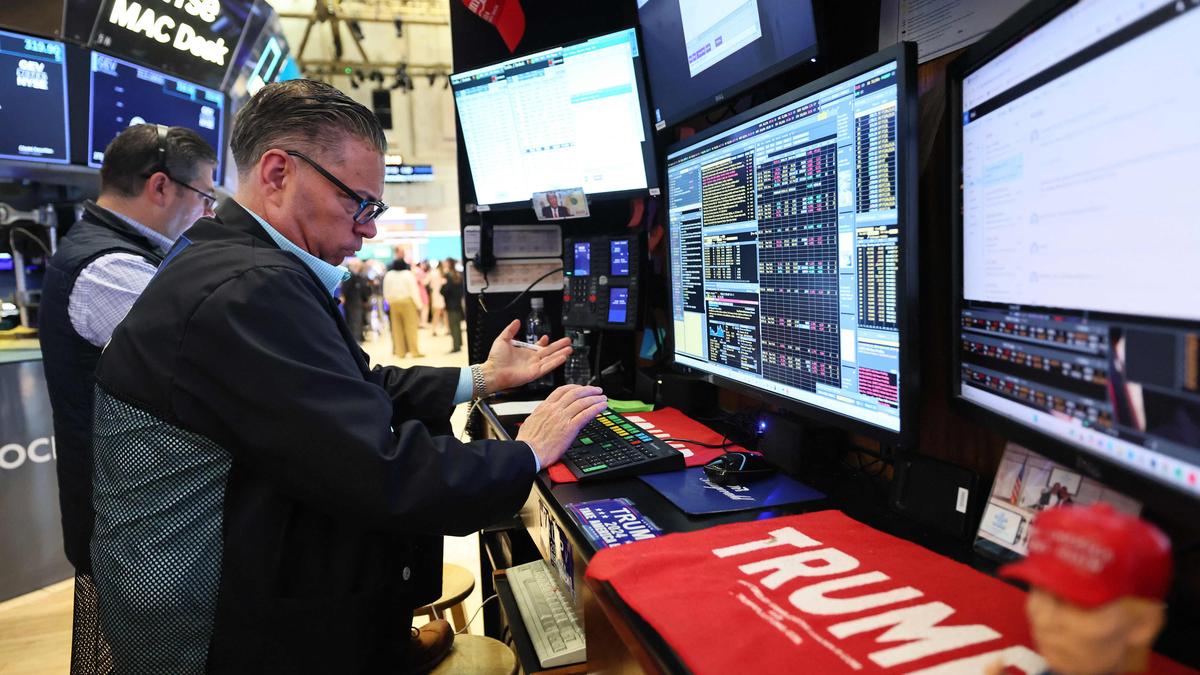
Not content with rewriting the rules of international trade, U.S. President Donald Trump has sought to upend a vital cornerstone of the U.S. financial architecture: the independence of the Central Bank. Mr. Trump has deemed the chair of the Federal Reserve, Jerome Powell, a “loser” for refusing to lower interest rates. Though he has walked back his threat of firing Mr. Powell, the U.S. President’s interference has deepened uncertainty in global financial markets.
The dollar and stock markets have registered further falls following Mr. Trump’s latest declarations. The rise in bond yields and the fall in the dollar are indicative of the fact that global investors are reducing their holdings of American assets due to fears about inflation. Mr. Trump’s conflict with Mr. Powell will only heighten those fears and bring about further turmoil.
A bond is a financial instrument that promises a fixed amount — called the face value — to the holder at the end of a certain time period. This is unlike an equity instrument, which promises unlimited gains — or losses — and has no fixed time period for which the gain must be realised. Bonds are therefore safer instruments than equity stocks, and are used by investors to hedge risks, or as a safe store of value.
The price at which bonds are bought and sold in the market is less than the face value. The return to a bond-holder from holding the bond to maturity — that is, the end of the given time period — is called the yield. Thus, if a bond with a face value of ₹100 is brought at a price of ₹90, the yield to the holder will be 11.11%. With a given face value, the price of the bond is inversely proportional to the yield. If the market price of bonds rise, it means that investors are willing to accept lower yields, and vice-versa.
A major threat to bond-holders is inflation. In the above example, imagine that inflation is 12%. An investor will receive a yield of 11.11% on holding the bond, but an inflation rate of 12% will completely wipe out his/her gains. Furthermore, if inflation is perceived to increase in the future, the Central Bank will raise interest rates to combat inflation. The risk-free interest rate announced by the Central Bank acts as a standard for all interest rates in the economy. The yields on long-term bonds is determined by the risk-free interest rate plus a certain premium desired by investors to park their money in bonds for so long. If investors perceive inflation to be high in the future, they know that a Central Bank dedicated to combating inflation will raise rates in the future. These perceptions will impact the market immediately, as investors bid down the price of bonds, raising yields. This affects investment, since the ripple effects will ensure all interest rates will rise to match the higher yields of government bonds.
The other risk to bond holders is currency value. Imagine a U.S. investor investing in an Indian bond. In our above example, imagine the dollar to be worth ₹90. By investing one dollar, and holding the bond to maturity, the American investor receives $1.11, thus making a gain of 11.11%. However, if the rupee depreciates after her investment, with the dollar now being equal to ₹100 rupees, the bond-holder invests one dollar only to receive one dollar in return, effectively making no returns. International bondholders require two things — stable inflation and a stable currency. Dollar-denominated bonds are thus the ideal instrument for wealth-holders looking to add stability to their portfolio.
Despite his many assertions to the contrary, the short-run impact of tariffs will bring inflationary pressures to bear on the U.S. economy, likely bringing about a rise in interest rates by the Central Bank. Foreseeing this, investors have started selling bonds in open markets, leading to falling bond prices and rising yields. These rising yields indicate the pessimistic outlook held by global investors who seek higher returns to offset the inflationary impact of Mr. Trump’s tariffs.


The Thane police have arrested two co-founders of cryptocurrency exchange platform CoinDCX in connection with an alleged fraud of Rs 71.6 lakh, officials said

Meta Chief Executive Mark Zuckerberg is building a CEO agent to help him do his job, the Wall Street Journal reported

Insurance penetration and density are often misunderstood and do not reveal how many families are insured or whether they would be financially secure if the main earning member were to die. The real issue is not reach but adequacy, as households may have life insurance but not enough cover to replace lost income, leaving them financially vulnerable.

Five top firms lose ₹1 lakh crore in market value, with HDFC Bank experiencing the largest decline of ₹56,124.48 crore.

L&T confirms 95% of its West Asia project sites are safe, while addressing logistics challenges amid ongoing regional conflicts.

Mines Ministry to auction 19 critical mineral blocks on March 23, expanding strategic resources for clean energy and technology sectors.

Mines Ministry to auction 19 critical mineral blocks on March 23, expanding strategic resources for clean energy and technology sectors.

Five top firms lose ₹1 lakh crore in market value, with HDFC Bank experiencing the largest decline of ₹56,124.48 crore.

HDFC Bank terminates three senior officials over client onboarding issues at its DIFC branch amid ethical concerns following chairman's resignation.

Air India CEO warns of potential flight cuts and reduced travel demand due to rising fuel costs amid ongoing Gulf conflict.

Options are widely used by retail traders to speculate on the value of the stock for immediate gains and such behaviour in large scale can distort the market

India achieves 1 billion tonne coal production for the second consecutive year, ensuring stable energy supply and economic growth.

Generic drugmakers in India launch affordable Semaglutide versions, targeting a $1 billion diabetes and weight loss market.