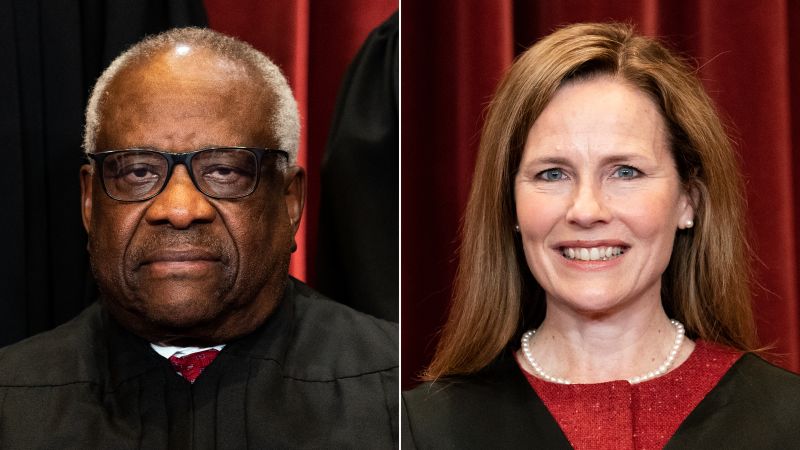
The Supreme Court’s approach on ‘history and tradition’ is irking Amy Coney Barrett
CNN
On a Supreme Court where the conservative supermajority increasingly leans on history as a guide, a dispute may be simmering over how many modern cases can be resolved by looking to the nation’s past.
On a Supreme Court where the conservative supermajority increasingly leans on history as a guide, a dispute may be simmering over how many modern cases can be resolved by looking to the nation’s past. Though Justice Clarence Thomas’ decision in a major trademark case last week was unanimous, it prompted a sharp debate led by Justice Amy Coney Barrett over the use of history to decide the case. Barrett, the newest conservative on the court, accused Thomas, the most senior associate justice, of a “laser-like focus on the history” that “misses the forest for the trees.” The back-and-forth could signal a recalibration by some members of the court of how and when to apply originalism, the dominant legal doctrine among the court’s conservatives that demands the Constitution be interpreted based on its original meaning. Even a slight change could have enormous consequences for the court’s blockbuster cases, including a pending case that is likely to focus heavily on history to decide whether Americans who are the subject of domestic violence retraining orders can be barred from owning guns. “Barrett’s critique of originalism definitely signals what seems to be a growing rift among the originalists on the court about the proper way to use history,” said Tom Wolf, a constitutional law expert with the liberal-leaning Brennan Center for Justice at New York University’s law school.


Newly confirmed Homeland Security Secretary Markwayne Mullin told senators during his confirmation hearing that he wanted to keep the department out of the headlines. That won’t be easy.

A trader made nearly $1 million since 2024 from dozens of well-timed Polymarket bets that correctly predicted US and Israeli military actions against Iran, according to an analysis shared with CNN.

Travelers have been dealing with worsening airport wait times as ICE agents deploy to more than a dozen airports. Follow for live news updates.

President Donald Trump voted in Tuesday’s state House special election by mail even as he suggested on Monday that “mail-in voting means mail-in cheating.”

CNN’s 5 Things AM brings you the news you need to know every morning.

The Supreme Court on Tuesday will consider the legality of a policy championed by President Donald Trump during his first term that prevented scores of migrants arriving at the southern border from starting the process of applying for asylum.

A young, well-liked facilities manager at the Kennedy Center has gone from being described as “in charge of HVAC and toilets” to head of the renowned arts institution.

Democrats in Florida are hoping to capitalize on the party’s recent special election overperformances and come out on top Tuesday in a special state House election for a Palm Beach district that includes President Donald Trump’s Mar-a-Lago residence.

The Supreme Court on Monday appeared ready to limit mail-in ballots, a move that would reinforce the justices’ pattern of shrinking voter protections and that has, at bottom, favored Republican interests and the Trump administration.

An Air Canada plane traveling from Montreal collided with an emergency vehicle on the runway at New York City’s LaGuardia Airport in the late hours of Sunday night, killing two pilots and injuring dozens of people.

Top Senate Republicans on Capitol Hill believe their party is unified behind a plan to reopen the Department of Homeland Security. Now, they need to sell the plan to Democrats.

Markwayne Mullin will serve as Donald Trump’s next Department of Homeland Security secretary, elevating the US senator to helm the agency at the center of the president’s controversial immigration enforcement effort and an ongoing shutdown.

President Donald Trump’s sudden turnabout and, according to him, rapidly advancing peace talks made for an abrupt shift in the administration’s approach to the Iran war.