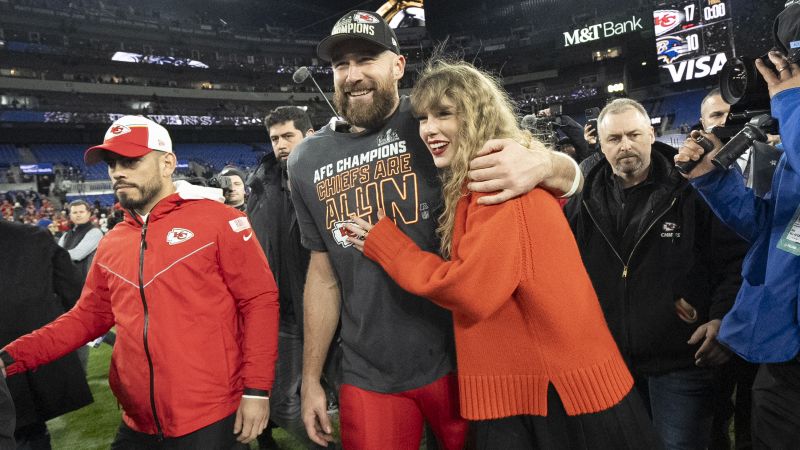
The Super Bowl is really an American holiday. So welcome to the party, Cousin Taylor
CNN
In these divided, often fractious times, the Super Bowl remains the one thing that we, America, still do as a family.
Media people can be forgiven for turning the coming weekend into “Taylor Swift’s Super Bowl LVIII,” seizing upon the shiniest of objects to enhance traffic among those who aren’t particularly invested in the game itself. Yet of all TV events, the Super Bowl has long since perfected the art of attracting an audience that isn’t necessarily there for the football, but rather to simply participate in the communal nature and spectacle. Whatever incremental audience and additional popularity Swift’s relationship with the Kansas City Chiefs’ Travis Kelce brought to the NFL season, what commissioner Roger Goodell called “the Taylor Swift effect” should be less pronounced at the Super Bowl, which has already evolved into the equivalent of an unofficial national holiday in the US, celebrating the nation’s collective love of sports, marketing and family, with a heavy side dish, usually, of old-fashioned patriotism. Long before DVRs and digital teasers, casual audiences tuned in to see the commercials, which took on an extra air of significance as cultural touchstones. A few relatively early legends in that category – Apple’s “1984” ad, broadcast 40 years ago, comes to mind – established that these ads could be not just product pitches but mini-masterpieces, little works of art that could spur thought as well as chuckles. Music, too, has become an integral part of the game, and another bridge in appealing to those who don’t know the intricacies of when to blitz and might not otherwise feel particularly compelled to move away from the table with the mini-hamburgers and seven-layer dip. Give much of the credit for that to the then-renegade Fox network and its sketch comedy “In Living Color,” which in 1992 counterprogrammed the halftime show and siphoned away a huge chunk of the audience. The next year, the NFL recruited Michael Jackson to blow the doors off with a live performance, and the notion of halftime consisting of nothing more than the studio crew of football analysts debating Xs and Os disappeared forever. As one of the most powerful forces in sports and media, and by far TV’s main attraction, the NFL has thus refined its approach throughout the years. Along the way that has meant overcoming multiple setbacks, from politics to a pandemic to concerns about the debilitating injuries and lingering health effects that playing the sport inflicts on its players.
