The secularism of Indian science Premium
The Hindu
Science in India has historically been accommodative of the country’s diverse religiosity
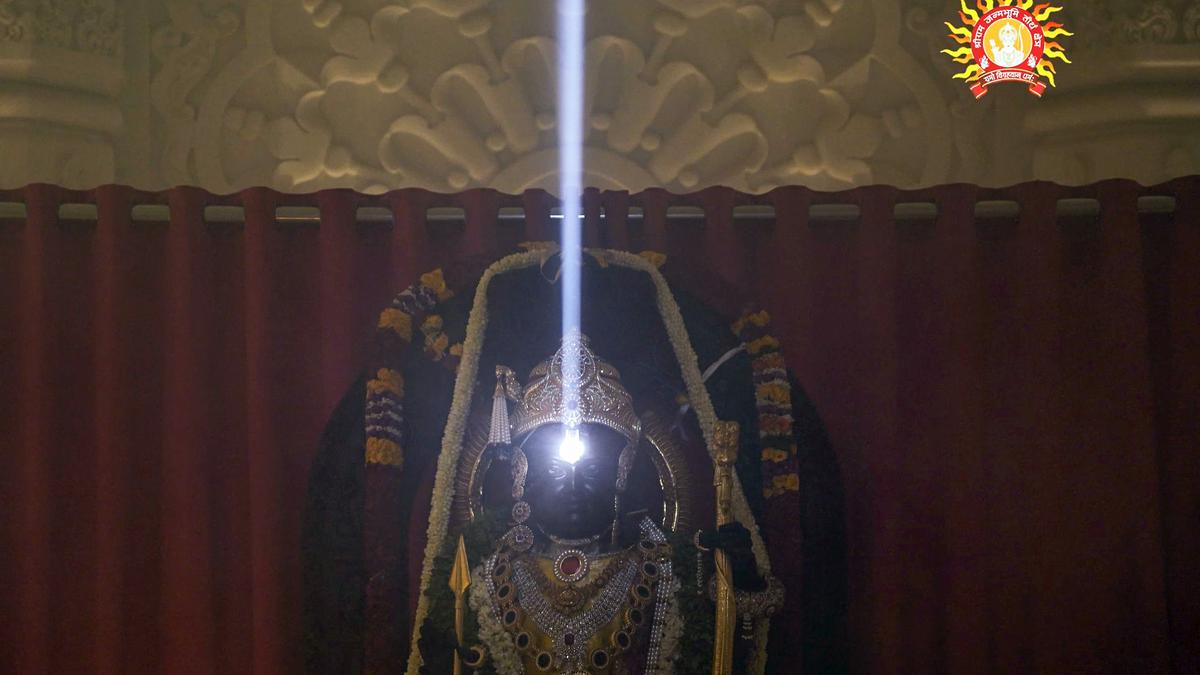
Last month, a sunbeam reignited a debate on the role of science and religion in Indian society. The Secretary of the Department of Science and Technology (DST), Abhay Karandikar, posted on X on April 17 (Ram Navami) that the Indian Institute of Astrophysics (IIA) had played a “crucial role” in the ‘surya tilak’ project in the Ram Mandir in Ayodhya. The ‘surya tilak’ was a beam of sunlight focused precisely on the forehead of Ram Lalla. The IIA, experts in designing mirrors and lenses to capture light from celestial bodies and galaxies in their telescopes, helped design a system of lenses and mirrors that manipulated the light into falling on the desired spot, he said. The IIA calculations will also account for the differing dates of Ram Navami every year, as the date is determined by the lunisolar calendar, and ensure a precise ‘surya tilak’, he added.
Some scientists were perturbed by this. Their first objection was that a college-level student could have designed this system and therefore there was no need to involve India’s leading astrophysicists and astronomers.
The more serious gripe was that involving the IIA, an autonomous body under the DST, in a religious ceremony impugned on the Constitution’s commitment to ‘scientific temper.’ While a Nehruvian coinage, the idea of scientific temper stretches back to the reformist ideas of Raja Ram Mohan Roy, P.C. Ray, and later, in independent India, to Satish Dhawan, Abdur Rahman, and P.M. Bhargava — all scientists and technology heads of some of India’s preeminent scientific institutions. This principle underlines a general commitment to rational investigation and evidence-based thinking, but from Ram Mohan Roy’s era to the present, it surfaces in the Indian public discourse particularly when science rubs up against religious practice. In the last two decades, proposals to introduce Vedic astrology in the college curricula and suggestions that ancient Indians flew airplanes, for example, have fomented discussions on scientific temper.
What is curious about the recent turn of events is that the IIA was not the only scientific institution involved in Ayodhya. The Central Building Research Institute (CBRI), a laboratory under the Council of Scientific and Industrial Research (CSIR), another state-funded research institution, was closely involved in aspects relating to the structural integrity of the temple. In fact, it was the CBRI that set up the ‘surya tilak’ system. However, there have been no objections regarding its participation. The inference, then, is that either the CBRI’s expertise doesn’t encompass the ‘scientific’ or that it is the association of astronomers and astrophysicists with a religious event that is problematic. As temples of yore, too, incorporated ingenious design practices to manipulate sunlight, craftsmanship and engineering have always been viewed as independent of religion.
Astronomy, astrophysics, and space shuttles are linked to the movements of the planetary bodies and are thus linked to the European origin story of the ‘scientific revolution’. The Roman Catholic dogma of geocentricism was dislodged by the sun-centric re-imagination of the universe by Copernicus and Galileo; this led to the gestation of modern science. However, this radicalism of European science is alien to the Indian context, which has historically been accommodative of India’s diverse religiosity.
The most salient example of this was an attempt by a scientific committee constituted by Jawaharlal Nehru and led by the eminent astrophysicist Meghnad Saha, to put India’s 30-odd local calendars (panchangas) on a more scientific footing. The Calendar Reform Committee, as it was called, undertook a detailed analysis of not only the time-keeping mechanics of Indian calendars but also dove deep into the history of calendars of nearly every civilization. The Indian National Calendar, a product of the committee’s report in 1956, corrected the anomalies by adding leap years, ensuring months had only 30 or 31 days, and defining Indian Standard Time. Despite being enforced by an Act of Parliament, only the last of these has been adopted into everyday life. Today, except for government gazettes, there is no trace of this Gregorian-scale innovation, and a plethora of religious and secular ‘new years’ still proliferate. The Calendar, while attempting to correct tradition, took pains to retain Indianness. As per this Calendar, the present is Vaisakha 1946. The makers specified that it would be useful for astrologers to calculate religious festivals.
Had the DST only turned to the Positional Astronomy Centre (PAC), a department of the India Meteorological Department and set up as a consequence of the Calendar committee report, it wouldn’t have needed the IIA. The PAC annually releases a document that lists the public holidays, dates of a galaxy of festivals, the position of the sun and moon and key planets through the year to help both astronomers and astrologers.


Explore North East India with South Star Rail's three unique 14-day train tour packages from Mangaluru, starting April 25.

A woman and her son sustained burn injuries in a gas cylinder fire in Bagalkot, Karnataka, and were hospitalised.

Directed by Nicholas Kharkongor, the show also stars Angira Dhar, and Ranveer Brar in pivotal roles

T.N. CM Stalin blames Centre's delimitation focus for diverting attention from the cooking gas shortage crisis.

UDF plans to challenge Kerala BJP chief Rajeev Chandrasekhar over alleged asset concealment and criticizes CPI(M) for corruption.

Telangana's Civil Supplies Commissioner assures no fuel shortage, with 20,000 kilolitres of petrol available

Delhi Assembly faces second bomb threat in two days amid Budget session; security measures intensified, but no suspicious items found.

Protect your eyes this summer with simple habits like wearing sunglasses, staying hydrated, and maintaining proper hygiene.

Hyderabad Collector assures no fuel shortage, urges public to ignore rumors and avoid panic buying.

Learn how elderly and disabled voters can easily cast their ballots from home in the 2026 Assembly Elections.

Parliament Budget Session LIVE: Track updates on the Parliament Budget Session as the Transgender Bill moves to the Rajya Sabha. Follow The Hindu for the latest updates on the Budget Session on March 25, 2026.

Congress leaders in Kerala accuse LDF and NDA of a secret deal to undermine their influence in the upcoming Assembly elections.

Agnikul Cosmos successfully test-fires a revolutionary 3D printed booster engine, enhancing launch efficiency and scalability in space transportation.