The right to work deleted
The Hindu
right to work mgnrega scheme deletion workers name
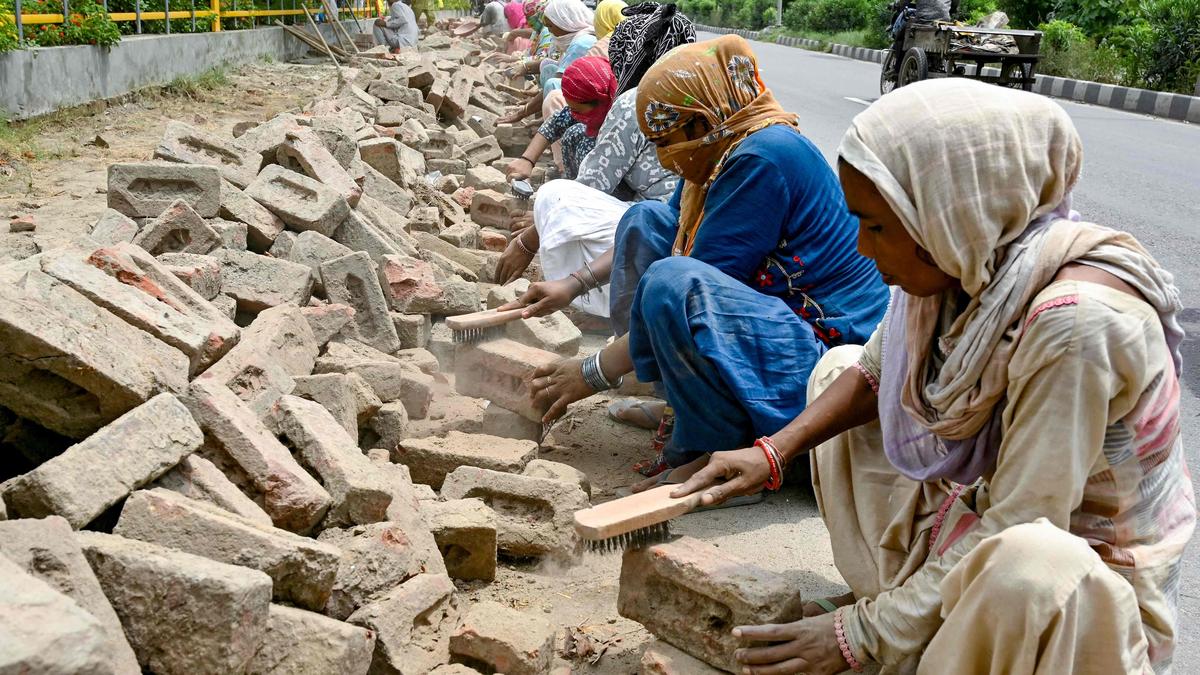
Central to the Mahatma Gandhi National Rural Employment Guarantee Act (MGNREGA) is the legal right to work for 100 days per year per rural household. Each household gets a unique job card containing the list of all its registered adults. One cannot work in MGNREGA without a job card. Addition of new members to job cards happens upon furnishing appropriate documents establishing adulthood.
Schedule II, Paragraph 23 of the Act outlines the procedure for deletions of workers from job cards — “If the Gram panchayat is satisfied at anytime that a person has registered with it by furnishing false information, it may direct the Programme Officer to direct his name to be struck off from the register and direct the applicant to return the job card:” Regarding due process, it says that a deleted worker, if alive, must be “given an opportunity of being heard in the presence of two independent persons.”
Implementation guidelines for MGNREGA are available in Master Circulars which are released either annually or once in two years by the Ministry of Rural Development (MoRD). The Master Circular from 2021-22 specifies clear protocols for worker deletions as follows. A job card can only be deleted under the following situations: (a) when a household permanently migrates, (b) the job card is found to be a duplicate, (c) it was issued based on forged documents.
Additionally, if a Gram Panchayat is reclassified as a Municipal Corporation, all job cards in that panchayat are deleted. In line with the Act, the circular emphasises due process, requiring independent verification by the Programme Officer before any deletions. Moreover, all deletions must be documented, reported to the Gram Sabha/Ward Sabha, and updated in the MGNREGA Management Information System (MIS). The MIS is the digital architecture of MGNREGA. Beyond the listed reasons, the MGNREGA MIS has dropdowns in its menu with 12 reasons for deletions of workers and job cards. Some of which are “Duplicate Applicant”, “Fake Applicant“, “Not willing to work” etc.
In 2021-22, 1.49 crore workers were deleted, which surged to 5.53 crore in 2022-23 resulting in a 247% increase in deletions in 2022-23. In the last four years, names of 10.43 crore MGNREGA workers across India have been deleted.
The surge of deletions in 2022-23 coincided with the period when the Union Government issued several circulars making Aadhaar-based payment systems (ABPS) mandatory in MGNREGA. For ABPS to work, as a first step, every worker’s Aadhaar number had to be seeded with her job card. Senior officials rely on the percentage of workers whose Aadhaar has been seeded with their respective job cards as a metric of compliance. Strict diktats were issued to field officials to increase this percentage.
In response to questions in the Lok Sabha on February 6, 2024, regarding worker deletions in MGNREGA, the Minister of State for Rural Development, Sadhvi Niranjan Jyoti, in a written reply stated: “Updation and deletion of job cards is a regular exercise conducted by the States and Union Territories under MGNREGS. These actions are undertaken to maintain accuracy and transparency.” However, a paper published in the Economic and Political Weekly by Chakradhar Buddha and Laavanya Tamang establishes how field officials resorted to deleting job cards without verification in a rush to increase ABPS compliance percentage. Deleting workers is akin to reducing the denominator to make the fraction bigger.


Police Observer Sushant Kumar Saxena conducts surprise inspection at Shencottai police station, reviewing warrants and security arrangements ahead of elections.

Andhra Pradesh government to launch key projects in April, focusing on industrial growth and infrastructure development, says Nara Lokesh.

Lok Sabha refers the Corporate Laws (Amendment) Bill to a JPC amid opposition concerns over CSR provisions dilution.

SHG members in Kanniyakumari use snakes and ladders to raise election awareness and boost voter turnout.

Government accelerates consultations for early implementation of the Women’s Reservation Act to ensure women’s representation in 2029 elections.

CM A. Revanth Reddy distributes ₹1 crore insurance cheques to families of deceased Electricity department employees, enhancing financial security for workers.

The Bengaluru Traffic Police (BTP) registered 634 cases of drunk driving during a week-long special enforcement drive conducted across the city between March 16 and March 22.

GHMC intensifies action against property tax defaulters, seizing properties and offering a One Time Settlement scheme for payments.

CCB arrests three drug peddlers in Mangaluru, seizing ₹2.5 lakh worth of MDMA and other valuables.

TVK's 28 candidates in Puducherry include former BJP MLAs, a sitting Independent, and a retired police IG.

BRS submits notice on private member bill to Speaker

CPI-M accepts DMK's five-seat offer for Tamil Nadu Assembly elections, prioritizing INDIA bloc unity over seat demands.

Ricky Rai, son of former underworld operative Muthappa Rai, on Monday appeared before the Bengaluru Traffic Police for questioning in connection with a case involving a Lamborghini performing dangerous stunts at Anil Kumble Circle on March 21.