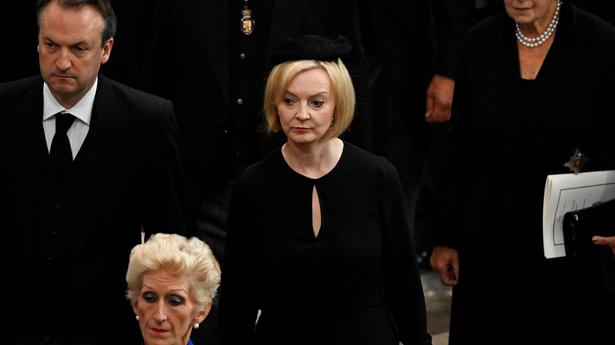
The Queen has been laid to rest, now U.K. has to confront its challenges
The Hindu
New British PM Liz Truss has a full ‘to-do’ list, particularly on the economy front
‘Business as usual’ in the U.K. came to standstill on September 8, after the death of Queen Elizabeth II. The Queen’s passing has, by and large, rallied people of different political ideologies together and brought to the fore a degree of unity and patriotism. A 10-day mourning period ended on Monday as the country’s best known resident was laid to rest, but as the dust settles, the U.K. is going to have to be confronted, once again, with its many serious challenges.
The country’s new Prime Minister, Liz Truss, has a full ‘to-do’ list, particularly on the economy front. There is a cost of living crisis in the U.K. driven by high energy costs, which are contributing to high inflation. The pound has fallen to 37-year record low against the dollar, partly due to events outside the U.K.’s control, but partly because of internal forces. The U.K. has low worker productivity and business investment levels relative to other advanced economies. A new report released on Tuesday indicated that despite a cut in corporation tax by 11 percentage points, to 19% in2017, the U.K. had a private investment to GDP ratio of 9.8% in 2020 — the lowest in the G7 economies.
Also read | Britain cleans up and looks to future after Queen Elizabeth II’s funeral
All eyes are on a ‘mini-budget’ that will be released on Friday, and include a reversal of taxes, including the corporation tax, previous cuts to which have not spurred business investment. Ms. Truss has suggested that she is moving towards a version of ‘trickle-down economics’ with tax cuts benefiting wealthier individuals, who paid more into the system, benefiting more from the cuts than those less well-off. She is convinced of her plan and said, this week, that she was prepared to be unpopular to ensure that Britain weathers this “very, very difficult storm”.
Minutes before she received news of the Queen’s ill health in Parliament on September 8, the Prime Minister had announced a plan to tackle energy costs, estimated to cost £150 billion. Last month the Bank of England had said the U.K. could enter into a 15-month recession starting in the last quarter of this year. The impact of Ms Truss’s energy plan on this and inflation — which came in at just under 10% in August.
Although Ms. Truss herself voted for the U.K. to remain in the EU, whether she can deliver on the trade deals — one of the post-Brexit freedoms which were touted by the campaign to leave the EU — will be watched. The U.K. has had some measure of success with this — it has crafted deals with Australia and Japan for instance, but the majority of agreements have been extensions of the terms of deals that the EU had with third countries.
In New York this week for the UN General Assembly (UNGA) debate, Ms. Truss was forced to admit that a U.S.-U.K. trade deal, possibly the prize among trade deals, was not coming anytime soon. The U.S. accounts for nearly 17% of U.K. trade, according to British government data.


A large explosion at Valero refinery in Port Arthur, Texas, prompts shelter-in-place order for nearby residents, no injuries reported.

Kim Jong Un vows to solidify North Korea's nuclear status and labels South Korea as its "most hostile" adversary.

U.S.-Israel war on Iran LIVE: Follow The Hindu for updates on the West Asia conflict on March 24, 2026

Trump claims “very good” talks with Iran, despite Tehran’s denial, as U.S. negotiators plan potential meetings in Pakistan.

Netanyahu discusses U.S.-Israeli military gains with Trump, emphasizing commitment to protect Israel's interests amid ongoing conflicts.

Pakistan reaffirms commitment to combat terrorism as Afghan ceasefire approaches end amid rising tensions and recent casualties.

Trump postpones military strikes on Iranian power plants for five days amid escalating tensions and ongoing diplomatic discussions.

Shorts News:Watch: NATO chief: 22-nation group forming to secure Strait of Hormuz

Saudi Aramco reduces crude supply to Asia for April, citing disruptions from the Iran-Israel conflict affecting trade routes.

Tencent launched a tool on Sunday to integrate its WeChat messaging platform with the OpenClaw agent

An Air Canada flight collided with a Port Authority vehicle at LaGuardia Airport, causing significant damage and police response.

Saudi Arabia and the UAE face missile attacks, with casualties reported and air defenses engaged amid escalating regional tensions.

Slovenia's parliamentary election results show a tight race between liberals and populists, signaling potential political instability ahead.