The pillars that travelled from Madras to Pondicherry and back Premium
The Hindu
Explore the journey of 32 historic pillars between Madras and Pondicherry, reflecting colonial architecture and cultural history.
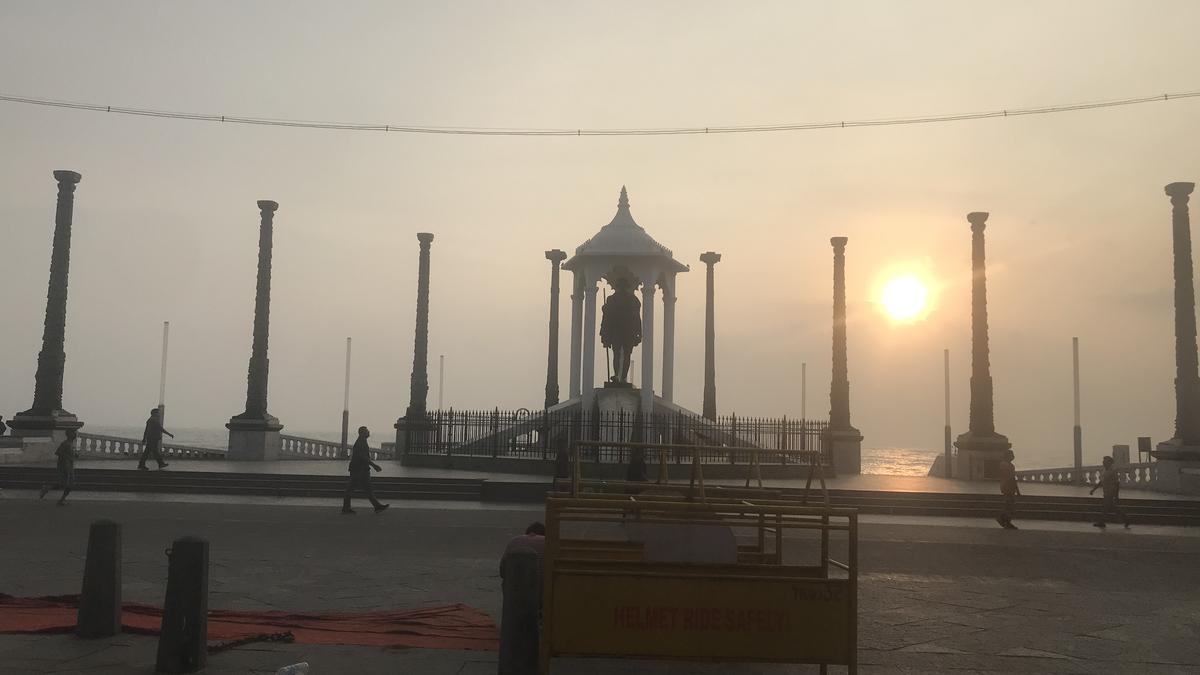
Wandering around the promenade at Pondicherry on a rainswept morning last week, I stopped by the Gandhi statue, which is a fairly pedestrian work of art when compared to D.P. Roy Choudhuri’s magnificent piece that adorns the Marina in Madras. But as always, what caught my attention was the set of eight pillars that stand around the statue. These, and a few more that stand in neighbouring Ayi Mandapam/Bharati Park, were all once at the Venkataramanaswami Temple at Senji and then brought here by the French to adorn their beachfront. What is forgotten is that once, there was a colonnade of 32 pillars here that the French brought in from Madras in 1746. The British took them back to Madras following their siege of Pondicherry in 1762.
These pillars, all of Pallavaram gneiss, were owing to Governor George Morton Pitt, who, during his tenure in the 1730s, had them put up in four rows from the sea to the entrance of Fort St. George. Though meant to be an ornamental and ceremonial arcade to beautify the city (shades of Singara Chennai here), the passage became the city’s first commodities exchange, with trade happening in the spaces between the pillars. A row of shops came up on one side, and these, along with the colonnade itself, can be seen in a picture by William Daniells in 1793.
The statues, once upon a time, were at the Venkataramanaswami Temple at Senji. They were brought here by the French to adorn the beachfront | Photo Credit: Sriram V.
Between their erection and that picture, much had happened. Firstly, the Board of Directors in England were not happy with the expense incurred of 1,600 pagodas, much of which was taken from the Town Conicopoly’s duties (read civic taxes). They felt that the money could have been put to better use than such “showy things”. But between the letter intimating them of the project (January 1732) and the reply (November 1732), much of the work was completed anyway and so, nothing could be done to reverse the expense.
In 1746, as mentioned earlier, the French took them away and had them erected at their beach, only to have the British bring them back in 1762 and put them up exactly as they were, facing the sea in Madras, which is how William Daniells saw them. By this time, the exchange had shifted, to what is now the Fort Museum and so, the pillars had to be put to some other use. Early in the 19th century, the spaces between the pillars were walled in and the building that emerged was known as the Pillar Godown. With business houses rapidly moving out of the Fort to First Line Beach/North Beach Road (Rajaji Salai) from the early 1800s, the godown was put to Governmental use.
It was for a few years the Record Room and therefore, a precursor to the present Tamil Nadu Archives in Egmore. Then it became the Government Press. This, presumably, was in 1831 when the Government of Madras established a press of its own and which we know functioned from the ground floor of the “offices at Fort St. George” until 1888, when it was shifted to the old Mint building in George Town where it still functions from. Post 1888, we do not know as to what purpose the Pillar Godown served but it came to be known as Old Banqueting Hall, which was a misnomer.


Discover how to turn creative passion into a sustainable business by mastering finance, IP, and strategic growth.

Arjun Krish and Ria Dinesh win Best Telefilm at Kerala State Television Awards for their impactful short film, F for Freedom.

redBus data reveals a significant 76% rise in solo women travelers from Karnataka since 2019, highlighting increasing independence in travel.

Air India and AI Express will operate 44 flights to West Asia amid Dubai airport restrictions on foreign carriers.

Maharashtra Assembly passes the Freedom of Religion Bill, imposing strict penalties for unlawful conversions, ensuring protection for vulnerable individuals.

Trump claims he can do “anything” with Cuba amid U.S.-Cuba talks, escalating tensions over political intervention and economic crises.

Amrutanjan owes ₹9.74 crore in rental arrears for Mylapore Kapaleeswarar Temple land, despite lacking a landlord-tenant relationship.

BJP intensifies campaign in Palakkad for the 2026 Assembly elections, targeting UDF amid scandal surrounding MLA Mamkootathil.

Jeevan Reddy leads a rally for maize farmers in Jagtial amid speculation of leaving Congress for BRS.

BJP and AINRC likely to maintain 2021 seat-sharing formula for Puducherry's 2026 Assembly elections, confirms party president.

BJP reveals 144 candidates for Bengal Assembly polls, featuring Suvendu Adhikari contesting against Mamata Banerjee in Bhabanipur.

Anna University partners with Ramco Systems to create an advanced ERP lab for enhanced industrial engineering education.

NDA announces candidates for 12 Kozhikode seats in Kerala Assembly polls 2026 as UDF and LDF ramp up campaigning.