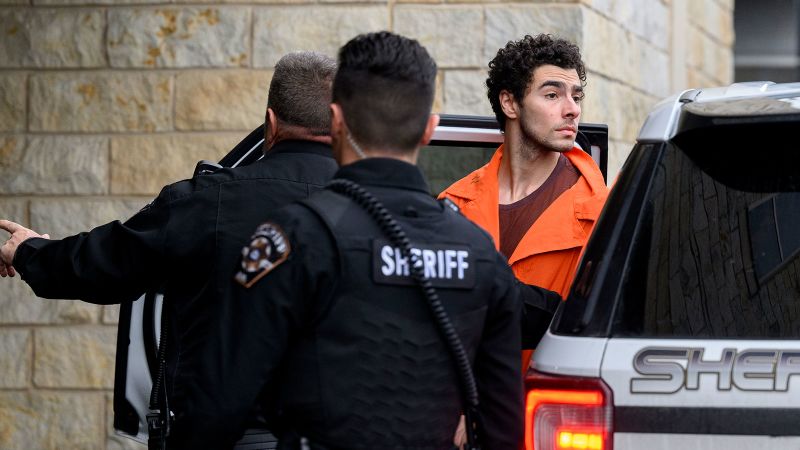
The next steps in Luigi Mangione’s case and why his most serious charge is only second-degree murder
CNN
The most serious charge against healthcare CEO killing suspect Luigi Mangione is murder in the second-degree in New York, but the murder charge could be upgraded if prosecutors find evidence to prove he had an intent to commit terrorism by targeting other executives.
The most serious charge against the suspect accused of killing the UnitedHealthcare CEO in broad daylight last week on a Manhattan sidewalk is murder in the second-degree, but that charge could be upgraded if prosecutors find evidence to prove he had an intent to commit terrorism by targeting other executives, according to legal analysts. Investigators say they have mounting evidence against Luigi Mangione, 26, connecting him to the assassination of Brian Thompson on December 4. The 3D-printed gun and fake ID found on him when he was arrested in Pennsylvania on Monday matches three shell casings found at the crime scene, and his fingerprints match those investigators found on items near the scene, according to New York Police Department Commissioner Jessica Tisch. Mangione was also carrying a document, which has been described as a “manifesto” that did not include specific threats but indicated “ill will towards corporate America,” said NYPD Chief of Detectives Joseph Kenny. Mangione was denied bail on Tuesday and is fighting his extradition to New York, where he faces five charges, including second-degree murder, in Thompson’s killing. He also faces gun charges in Pennsylvania related to the firearm police say they found on him when he was arrested. Under New York state law, a first-degree murder charge only applies to a narrow list of aggravating circumstances — for example, when the victim is a judge, police officer, first responder, or when the killing involves a murder-for-hire or intent to commit terrorism, several legal experts told CNN. In Mangione’s case, he could be charged with first-degree murder if the investigation uncovers evidence showing he had a plan to commit terrorism, such as plotting the killing of other health insurance executives, said David Shapiro, a lecturer at the John Jay College of Criminal Justice. If convicted of second-degree murder, Mangione faces at least 15 years to life in prison, while a first-degree murder charge carries a minimum of 20 years to life in prison.


A consortium of the nation’s top architectural and historic preservation groups is targeting President Donald Trump’s plans to temporarily close and extensively renovate the Kennedy Center, filing a new lawsuit Monday that asks a federal judge to indefinitely halt the project.

ICE agents sent to airports as TSA callouts remain high; separately, two people have died after a plane collided with a fire truck at New York’s second biggest airport. Follow for live updates

Mike Pence used to dream of following two successful Donald Trump terms with his own turn in the White House.

An Air Canada plane was damaged after colliding with a vehicle on a runway at New York’s LaGuardia Airport Monday, according to video from the scene and air traffic control audio.

A statue of Christopher Columbus has been erected outside of an ornate federal office building on the White House grounds — the latest sign of the Trump administration’s efforts to reshape cultural and historical representations across the nation’s capital.

Kentucky Gov. Andy Beshear, speaking in JD Vance’s home state of Ohio on Saturday, tore into the vice president, questioning his Appalachian roots and telling voters they “deserve better.”

President Donald Trump has said ICE agents will head to US airports tomorrow amid a partial government shutdown. Follow for live updates

Cuba is working to restore the electricity supply after another island-wide blackout left more than 10 million people without power.

President Donald Trump said Sunday border czar Tom Homan will be in charge of deploying Immigration and Customs Enforcement agents to airports on Monday, with Homan telling CNN the agents will help with security at entrances and exits to ease the Transportation Security Administration’s workload.

Donald Trump wants us to believe that a deal with Cuba is close at hand. After this past week, I am not so sure.

President Donald Trump has said ICE agents will head to US airports tomorrow amid a partial government shutdown. Follow for live updates

President Donald Trump said Sunday border czar Tom Homan will be in charge of deploying Immigration and Customs Enforcement agents to airports on Monday, with Homan telling CNN the agents will assist with security at entrances and exits to ease TSA workload amid a partial government shutdown.

Janet Mills and her allies are counting on a gender gap to narrow Platner’s wide lead ahead of the June 9 primary to decide who will face incumbent Republican Sen. Susan Collins. They are betting that the unfiltered style that has brought Platner widespread attention as someone who could help Democrats reach young men will backfire with women.