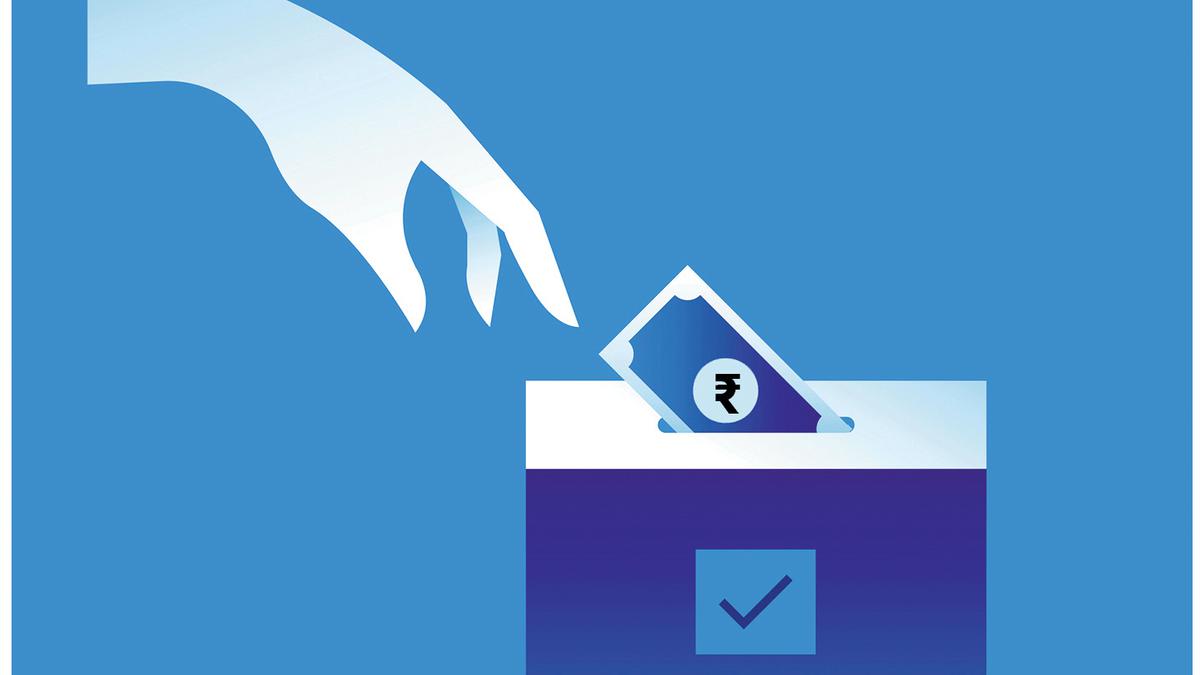
The need to disclose political donations
The Hindu
Electoral bonds challenge in Supreme Court is crucial for democracy and rule of law in India. Most countries require full disclosure of political donations and have laws to regulate limits on contributions and campaign spending. We need a separate legislation to mandate public disclosure of donors to political parties, set limits on funding and expenditure, and enforce the law for a healthy democracy.
With the hearings in the Supreme Court on the electoral bonds challenge having concluded, it is a good time to discuss how important the outcome of this challenge will be to democracy and rule of law in India. Political parties in any country play an indispensable role in the democratic process. They form the government and have the responsibility under our constitution of holding the government to account. It is thus essential that the parties are adequately funded in a manner which enjoys public confidence.
The amendments made to the Representation of the People Act 1951 and other laws which provide for electoral bonds, provide complete anonymity to political donors. The requirement all over the world on this issue on the other hand has been the diametrical opposite — requirement of full disclosure on donations to political parties, either by individuals or corporations.
As far back in 1910, the United States of America enacted the Publicity Act, which not only made all funding of political parties and candidates to be disclosed, it also imposed limits on political contributions. There were also other laws which regulated these limits, and imposed limits on campaign spending. These conditions were challenged and the U.S. Supreme Court in Buckley versus Valeo in 1976, not only upheld the public disclosure requirements of funding of political parties, but also upheld the limits on contributions to be received, as being constitutional. It held that to the extent that large contributions are given to secure a political quid pro quo from current and potential office holders, the integrity of the system of representative democracy is undermined. The danger, is not of actual quid pro quo arrangements but of the appearance of corruption and the opportunities for abuse inherent with large financial contributions, even when the identities of the contributors and their contributions are fully disclosed. The mere impression of misuse may be sufficient to erode confidence in the political system and democracy.
In 2014, the European Union enacted a Regulation of the European Parliament and of the Council on the funding of European political parties and European political foundations. Under this Regulation, there were limits set on the value of donations that parties and foundations may accept per year and per donor. While donations from natural persons under a certain value can be anonymised, all donations exceeding that value have to be disclosed. Large donations above a certain value require not just disclosure but immediate reporting to the authority. Further, political parties are also required to file annual financial statements of their revenue and expenditure, their list of donors and corresponding donations.
In the U.K., under the Political Parties, Elections and Referendums Act 2000, there are restrictions on the donations and loans a political party can accept, and requirements for the declaration of the source of the donations.
There are thus two distinct requirements that most legal regulations have for funding of political parties — complete disclosure of donors above certain minimal amounts and limits or caps on donations.
We need public disclosure of funding because political parties are the pillars of representative democracy and transparent accounts are the key to preserving citizens’ trust in parties and politicians, maintaining the rule of law and removing corruption in the electoral and political process. Limits on donations are imposed because unchecked large donations to political parties and their allies have the effect of bringing democracy into disrepute. The outcome of elections should not depend on which party has more money to campaign and woo, or buy voters. The separation of wealth from power is a basic condition of a democratic system.


Blasts and sirens sounded in Jerusalem as Israel warned of incoming Iranian missile threats amid escalating tensions.

275 former judges and officials criticize USCIRF's report on religious freedom, calling it biased and lacking credible evidence.

Jharkhand Police request Indian Army's help to safely defuse an active WWII-era bomb found near Subarnarekha river.

Tamil Nadu Assembly election: VCK under compulsion to consider local candidates, says Thirumavalavan
VCK leader Thirumavalavan emphasizes the need for local candidates amid concerns over past electoral losses due to outsiders.

Explore Tamil Nadu's upcoming four-cornered election contest, featuring key players DMK, AIADMK, TVK, and Naam Tamizhar Katchi.

I and EPS were appointed CMs, Stalin elected by people, says O. Panneerselvam

The ₹88.41 crore AMRUT scheme aims to eliminate Kavali's water scarcity, transforming the town’s infrastructure and services.

A 4.1 magnitude earthquake struck Sikkim's Mangan district; no casualties or property damage reported.

Telangana government updates building rules, increasing TDR usage, allowing more floors, and easing setback regulations for developers.

The escalating Israel-Iran conflict over the South Pars gas field threatens global energy security and impacts India's energy imports.

Delhi's weather forecast: clear skies, maximum temperature around 30°C, and moderate air quality with an AQI of 154.

Union Minister Kiren Rijiju meets Tamil Nadu Bishops and pastors to discuss minority welfare and counter anti-BJP narratives.

Japan may consider minesweeping in the Strait of Hormuz post-ceasefire, says Foreign Minister Motegi, amid ongoing regional tensions.