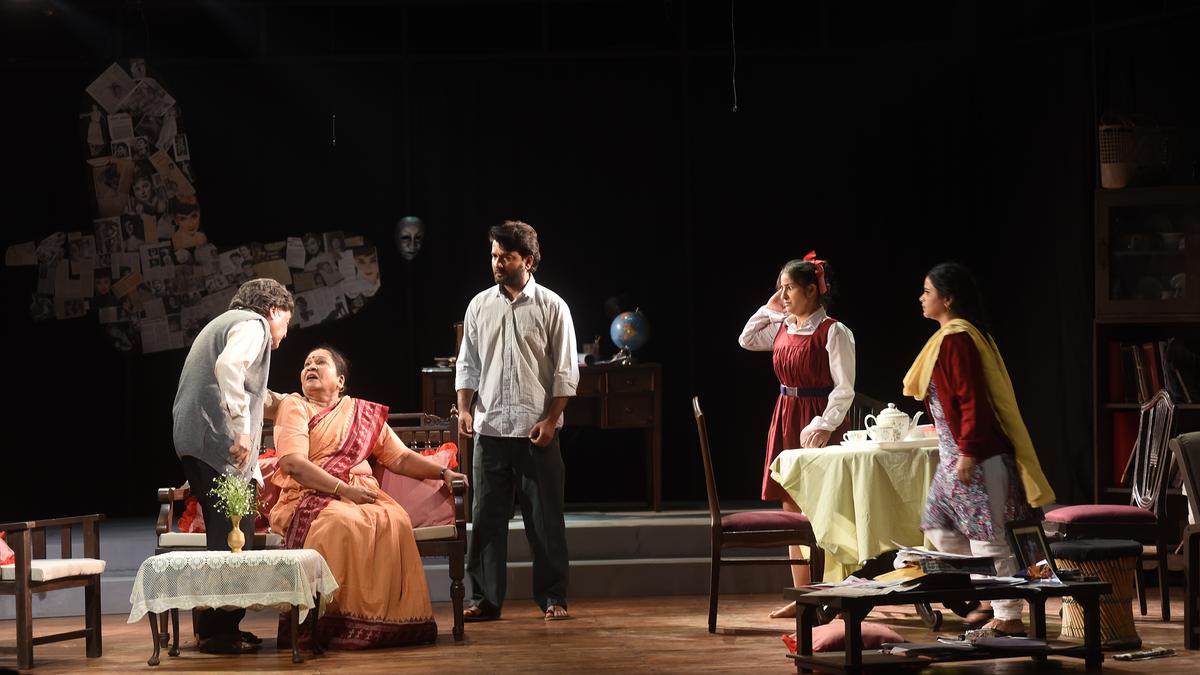
The National School of Drama Repertory revives Mohan Rakesh’s iconic play Aadhe Adhure
The Hindu
The National School of Drama Repertory revives Mohan Rakesh’s iconic play Aadhe Adhure
Not many have mapped the inner lives of middle-class India as Mohan Rakesh has. One of the foremost proponents of the Nayi Kahani (new story)movement that swept the Hindi literature scene in the 1950s and 1960s, Rakesh explored the moral architecture of the burgeoning middle class when a feudal India was gingerly pacing towards modernity after Independence.
This week, the National School of Drama Repertory paid a fitting tribute to Rakesh in his centenary year by staging his iconic play Aadhe Adhure with the same lead cast, Pratima Kannan and Ravi Khanvilkar. The duo performed it three decades ago under the direction of Tripurari Sharma.
Like most of Rakesh’s works, Aadhe Adhure juxtaposes the shapeshifting rigidity of a patriarchal society with the aspirations and desires of a working woman.
A product of his times, Rakesh drew from personal experiences, and also put his female protagonist Savitri under scrutiny. Unlike her mythical namesake, she is not ready to sacrifice herself for a husband who takes out his professional frustrations by finding faults in her character. As Pratima says, some “relationships become a habit” you can’t do without. First staged by theatre stalwarts Om Shivpuri and Sudha Shivpuri, the play has, over the years, opened up space for deeper conversations about gender and social constraints.
Some progressive writers and feminist voices feel that, in the end, the play reinforces the male agenda to cage women. Others find its portrayal of a woman’s struggle, caught between traditional roles and personal aspirations, relatable. It is this in-betweenness of emotional takeaways that keeps the play and its characters relevant more than five decades after it was penned.
It is so tightly woven, says seasoned theatre critic Diwan Singh Bajeli, that directors don’t take the liberty to tweak it. “The dialogues are constructed in a way if you take away a pause or a comma, the context will change.”
Pratima recalls that when Tripurari Sharma had given Savitri a little more nuance in expression, “it created a flutter because, the audience used to take a slightly negative image of the character with them”.


The vehicle towing drive will soon resume in the city to ease traffic congestion. The Bengaluru Traffic Police (BTP), in coordination with the Greater Bengaluru Authority (GBA), is set to relaunch the vehicle towing drive across the city shortly to tackle traffic congestion and illegal parking.

Panic buying, not shortage, is leading to long queues at Hyderabad petrol pumps.

District Collector urges collective action against TB during World TB Day rally, highlighting screening efforts and patient support initiatives.

DMK finalises seat-sharing for the 2026 Tamil Nadu Assembly elections, contesting 175 seats with allies DMDK and VCK.

Collector V. Saravanan and Police Commissioner Kamini promote voter awareness through outreach programs and traditional events in Tiruchi.

Mysuru DC stresses precautionary measures to reduce road accidents, urging officials to identify and address high-risk areas.

Growing influence of Artificial Intelligence highlighted

Telangana MP urges quick approval and funding for Musi River and 7,444 km sewerage projects during AMRUT review meeting.

Former Udupi MLA K. Raghupathi Bhat, who had launched an indefinite dharna in front of the Udupi Urban Development Authority (UUDA) office on Monday against the Authority’s alleged illegal refusal to grant single site approval for 1.1 acres of his land at Badanidiyur, ended his dharna on Tuesday.

Rahul Gandhi criticizes Modi for referencing COVID-19 during the West Asia crisis, claiming it reflects a compromised foreign policy.

Ongole GGH hosts TB awareness program, emphasizing prevention and treatment on World Tuberculosis Day.

Delhi court summons gangster Lawrence Bishnoi and two others in an extortion call case after previous discharge.

TNNLU student A. Rishi Kumar stands firm against pressure to remove his critical blog on the Supreme Court, gaining widespread support.