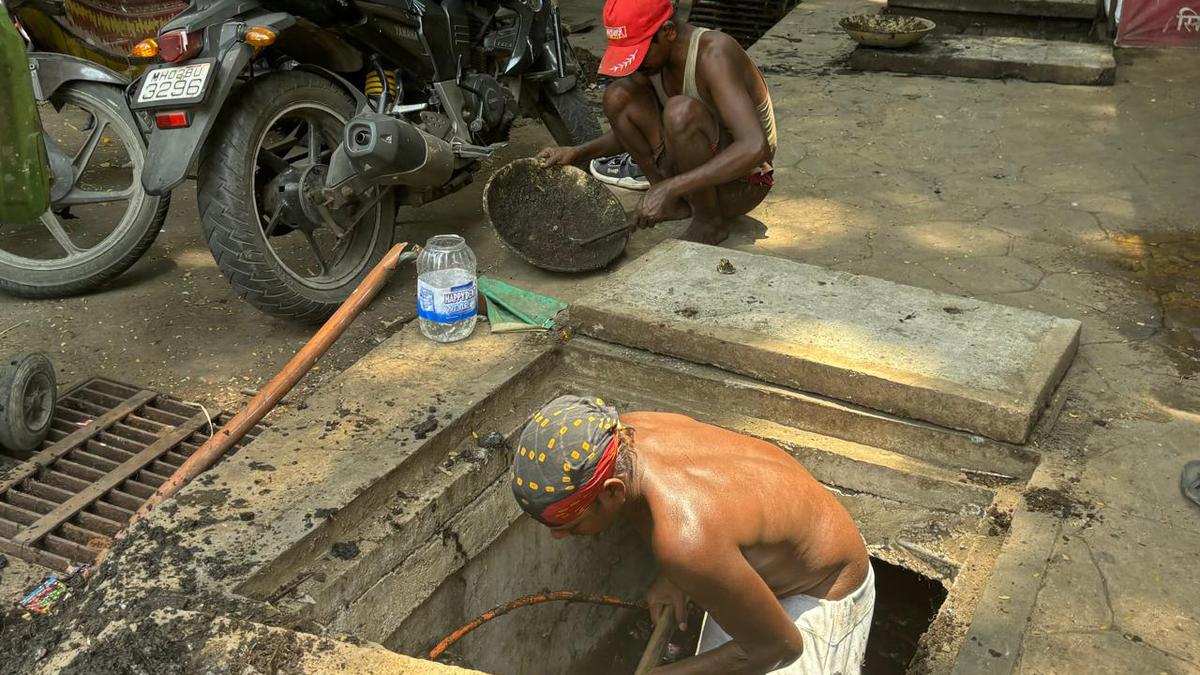
The invisible lives of sanitation workers who clean Mumbai’s drains to keep it from drowning
The Hindu
A look into the lives of sanitation workers, who often do manual scavenging work to clean Mumbai’s stormwater drains ahead of the monsoon
Shankara Colony, a slum in Mumbai’s Ghatkopar, serves as a temporary home to thousands of seasonal sanitation workers who travel from remote areas of Maharashtra to take part in the yearly ritual of desilting the stormwater drains before the dreaded monsoon arrives.
Squatting on the footpath adjacent to the slum, Laxman Kale, 55, says they do whatever is asked of them. “We do all that we are told to do. That could be cleaning drains, getting into nullahs, climbing down manholes — whatever the job requires.”
The cleaning of the 2,200-km-long drain network, which consists of both major and minor nullahs, was recommended by the Madhav Chitale committee after the calamitous 2005 Mumbai floods and falls under the ambit of the Brihanmumbai Municipal Corporation (BMC). It involves the removal of mud deposits carried by nullahs, and waterbodies like the Mithi river, which flows through Mumbai’s suburbs.
This year, the BMC has allocated ₹243 crore and appointed 31 agencies to oversee the desilting process. But the real work, typically done from March to May by 4,000-odd sanitation workers who are hired by the agencies through contractors, can be potentially fatal.
“The migrants are asked to get into drains where sewer water is present. They clean it with their bare hands, but all of this goes unnoticed, because manual scavenging in stormwater drains is not recognised,” says Shubham Kothari, member of Mumbai-based NGO Loktantrik Kamgar Union.
He explains that the city has failed to separate its sewers from stormwater drains, which, as per Section 239 of the Mumbai Municipal Corporation Act, 1888, should not be connected in the first place. This causes the waste from public toilets and septic tanks to be discharged into the main drain, leaving the workers to deal with toilet sludge.
“The government calls the migrants ‘seasonal sanitation workers’ to get around the ban on manual scavenging, and when deaths happen, the government never acknowledges them,” Mr. Kothari says, adding that the workers’ issues remain largely unaddressed due to the transitory nature of the job.


The government plans to amend the FCRA, introducing new regulations for NGO asset management and accountability for key functionaries.

The draft policy for “Responsible Digital Use Among Students”, released on Monday by the Department of Health and Family Welfare, has recommended that parents set structured routines with clear screen-time rules and prioritise privacy, safety, and open conversation with children on digital well-being.

Police Observer Sushant Kumar Saxena conducts surprise inspection at Shencottai police station, reviewing warrants and security arrangements ahead of elections.

Andhra Pradesh government to launch key projects in April, focusing on industrial growth and infrastructure development, says Nara Lokesh.

Lok Sabha refers the Corporate Laws (Amendment) Bill to a JPC amid opposition concerns over CSR provisions dilution.

SHG members in Kanniyakumari use snakes and ladders to raise election awareness and boost voter turnout.

Government accelerates consultations for early implementation of the Women’s Reservation Act to ensure women’s representation in 2029 elections.

CM A. Revanth Reddy distributes ₹1 crore insurance cheques to families of deceased Electricity department employees, enhancing financial security for workers.

The Bengaluru Traffic Police (BTP) registered 634 cases of drunk driving during a week-long special enforcement drive conducted across the city between March 16 and March 22.

GHMC intensifies action against property tax defaulters, seizing properties and offering a One Time Settlement scheme for payments.

CCB arrests three drug peddlers in Mangaluru, seizing ₹2.5 lakh worth of MDMA and other valuables.

TVK's 28 candidates in Puducherry include former BJP MLAs, a sitting Independent, and a retired police IG.

BRS submits notice on private member bill to Speaker