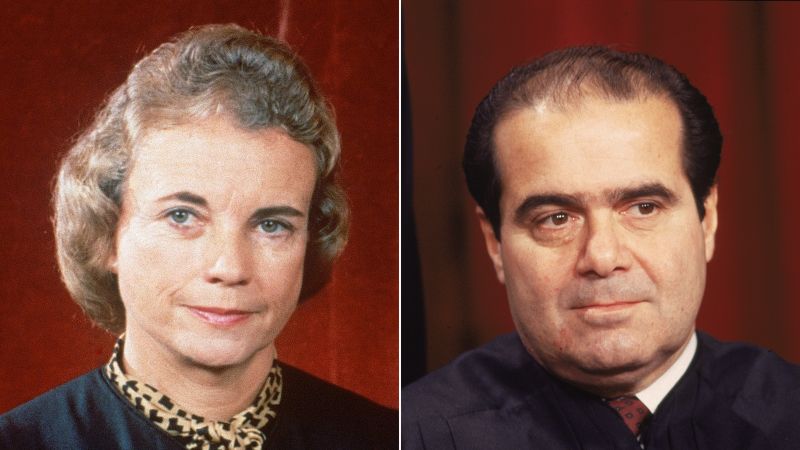
The inside story of how Sandra Day O’Connor rebuffed pressure from Scalia and others to overturn Roe v. Wade
CNN
During much of the 1980s, Justice Sandra O’Connor, the first woman on the Supreme Court, cast a consistent vote against abortion rights. That changed in 1989.
During much of the 1980s, Justice Sandra O’Connor, the first woman on the Supreme Court, cast a consistent vote against abortion rights. But in 1989, things changed. A new conservative majority was in place and appeared to have the votes to eviscerate Roe v. Wade, for the first time since the 1973 landmark made abortion legal nationwide. O’Connor struggled with the new dynamic. Some of her ambivalence emerged in her opinions, but newly available correspondence and handwritten notes of secret deliberations reviewed by CNN flesh out her budding resistance. They show her evolution in a Missouri abortion case, as she faced pressure to cast the decisive vote that would have reversed Roe and instead set a path that preserved abortion rights for another three decades. The O’Connor archive demonstrates how the nine Supreme Court justices, both then and now, negotiate behind the scenes through memos, personal entreaties, and various means of persuasion — some more successful than others. At times, the papers show, pressure on individual justices can have the opposite of the intended effect. The documents also underscore the difference on abortion rights between the court of that era and the contemporary far-right bench, which in 2022 jettisoned Roe and nearly a half century of reproductive rights. Pressing for reversal of Roe and pushing hard on O’Connor were Justice Antonin Scalia, relatively new to the bench but already known for a forceful, if sometimes bullying, presence; and Chief Justice William Rehnquist, one of the original two dissenters in Roe.


Cuba is working to restore the electricity supply after another island-wide blackout left more than 10 million people without power.

President Donald Trump said Sunday border czar Tom Homan will be in charge of deploying Immigration and Customs Enforcement agents to airports on Monday, with Homan telling CNN the agents will help with security at entrances and exits to ease the Transportation Security Administration’s workload.

Donald Trump wants us to believe that a deal with Cuba is close at hand. After this past week, I am not so sure.

President Donald Trump has said ICE agents will head to US airports tomorrow amid a partial government shutdown. Follow for live updates

President Donald Trump said Sunday border czar Tom Homan will be in charge of deploying Immigration and Customs Enforcement agents to airports on Monday, with Homan telling CNN the agents will assist with security at entrances and exits to ease TSA workload amid a partial government shutdown.

Janet Mills and her allies are counting on a gender gap to narrow Platner’s wide lead ahead of the June 9 primary to decide who will face incumbent Republican Sen. Susan Collins. They are betting that the unfiltered style that has brought Platner widespread attention as someone who could help Democrats reach young men will backfire with women.

Why do people “pledge allegiance” to a “state” that is no longer a state? And what spurs someone to not just attack innocent people, but to then make a statement of loyalty while doing so?

A Supreme Court case examining state deadlines for election ballots sent in the mail is just the tip of the spear in President Donald Trump’s war on mail-in voting.

As a shrinking number of Transportation Security Administration agents work to keep hourslong security lines moving despite not being paid, President Donald Trump stepped into the fray Saturday, announcing he will send Immigration and Customs Enforcement officers to airports by Monday if Congress doesn’t agree to a plan to end the partial government shutdown.

Donald Trump wants us to believe that a deal with Cuba is close at hand. After this past week, I am not so sure.

The search for missing 84-year-old Nancy Guthrie, mother of “Today” show host Savannah Guthrie, has stretched into another anguished week, with mounting pressure on investigators and a family grappling with uncertainty.

Cuba’s Ministry of Energy announced Saturday evening that entire island has suffered another electrical blackout, leaving more than 10 million people without power.

Iran’s attempt to strike a US-UK base over 2,000 miles (over 3,000 kilometers) off its coast has renewed questions about Tehran’s military capabilities and how far its missiles can reach.