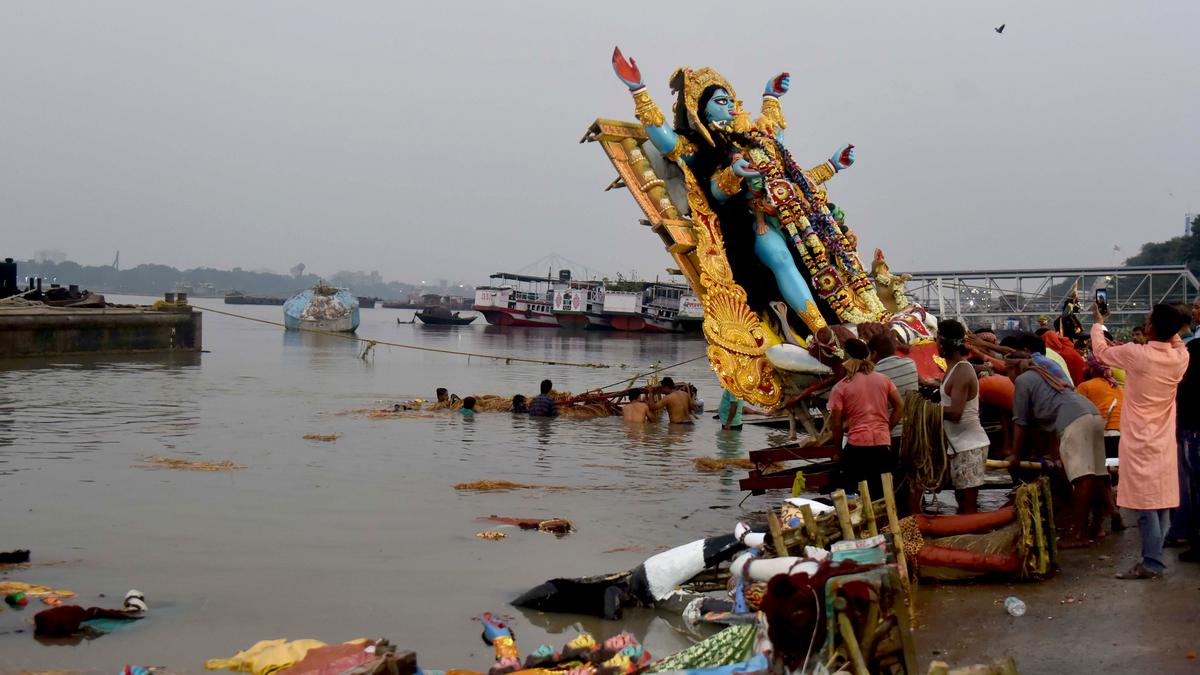
The foul aftermath of the festivities
The Hindu
Kolkata's festive season sees pollution rise with Durga Puja immersions, green crackers, and lax enforcement of environmental laws.
Every festive season, between September and November, the air in Kolkata turns heavy with the emotion of bidding farewell to the goddesses and the rising pollution. At its peak, 4,000 Durga pujas across the city immerse their idols in the Hooghly river, and ‘green crackers’ — only 30% less polluting than traditional ones according to the National Environmental Engineering Research Institute — light up the skies.
Despite the immediate removal of idols at a few ghats, water and air pollution escalates in West Bengal’s capital city Kolkata, between the two pujas: Durga and Chhath, just before the onset of winter.
Two days after Deepavali, the area around Rabindra Bharati University, on the northern fringes of the city recorded an AQI (Air quality index) of 310, in the ‘very poor category’, not far behind Delhi, where the AQI was 339. It is during the same time that waters in the Hooghly, a distributary of the Ganga, also turn muddier.
On a Sunday afternoon in October, as the Durga puja festivities were concluding, Subhas Dutta, 76, Kolkata most well-known environmental activist, stood on a boat in the Hooghly, in his quintessential white-shirt-black-pants, with his hands on his waist. Thousands of Durga idols had made their way to the river from different parts of the city. The flowers and garlands from the idols were removed before they were immersed in the water.
“Even though the structure is immediately removed from the water with a crane provided by the government, enough damage is done in that short time. The chemicals used to paint the idols are toxic and pollute the Ganga,” Dutta says. The paints are laden with lead and other heavy metals. Every year Dutta, who calls himself “an environmental soldier” stands at the ghats to ensure that the immersions take place with the recommended pollution precaution. “In 2002, I first visited the Ganga ghats after Durga and Kali puja was over in Kolkata. I found thousands of structures just dumped in the water. I took photographs and moved court,” he remembers.
Even though the court ordered immediate removal of the idols from the water, what ensued was different agencies bickering about who should do it. “The Kolkata Municipal Corporation (KMC) said it was the responsibility of Kolkata Port who said that it came under the ambit of KMC. This row continued for half a decade and finally in 2007 the battle of words came to an end,” he says. The port trust agreed to take the idols out of the water with their cranes and KMC said they would handle the disposal.
The immediate idol removal is a rule followed only in four of 16 ghats: Bajekodomtola ghat (Babughat), Judge’s ghat, Nimtala ghat, and Ma’er ghat. —Debasish Kumar, who looks after parks, gardens, and ghats in the KMC says, “Pollution caused by immersion has reduced considerably over the years.”


The government plans to amend the FCRA, introducing new regulations for NGO asset management and accountability for key functionaries.

The draft policy for “Responsible Digital Use Among Students”, released on Monday by the Department of Health and Family Welfare, has recommended that parents set structured routines with clear screen-time rules and prioritise privacy, safety, and open conversation with children on digital well-being.

Police Observer Sushant Kumar Saxena conducts surprise inspection at Shencottai police station, reviewing warrants and security arrangements ahead of elections.

Andhra Pradesh government to launch key projects in April, focusing on industrial growth and infrastructure development, says Nara Lokesh.

Lok Sabha refers the Corporate Laws (Amendment) Bill to a JPC amid opposition concerns over CSR provisions dilution.

SHG members in Kanniyakumari use snakes and ladders to raise election awareness and boost voter turnout.

Government accelerates consultations for early implementation of the Women’s Reservation Act to ensure women’s representation in 2029 elections.

CM A. Revanth Reddy distributes ₹1 crore insurance cheques to families of deceased Electricity department employees, enhancing financial security for workers.

The Bengaluru Traffic Police (BTP) registered 634 cases of drunk driving during a week-long special enforcement drive conducted across the city between March 16 and March 22.

GHMC intensifies action against property tax defaulters, seizing properties and offering a One Time Settlement scheme for payments.

CCB arrests three drug peddlers in Mangaluru, seizing ₹2.5 lakh worth of MDMA and other valuables.

TVK's 28 candidates in Puducherry include former BJP MLAs, a sitting Independent, and a retired police IG.

BRS submits notice on private member bill to Speaker