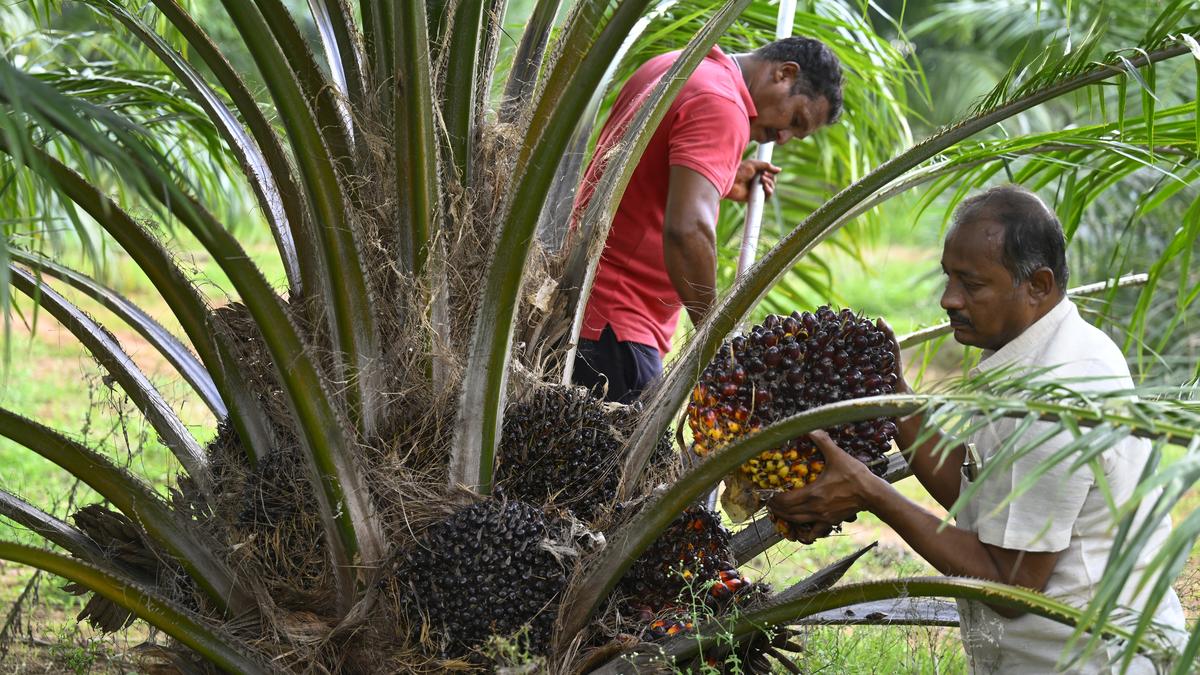
The crop that is raising farm incomes — and eyebrows in Telangana Premium
The Hindu
From a symbolic sapling to a sustainable plantation, Telangana's oil palm journey faces challenges and opportunities for economic transformation.
In Pedavegi, a non-descript dot on the map of West Godavari district in what was then undivided Andhra Pradesh, an act of symbolism took root, literally, way back in 1986. Then Chief Minister N.T. Rama Rao knelt on a patch of farmland and planted a palm sapling. At that point, it may have seemed like just another photo op. But that simple act would outgrow its moment in history, rooting itself into the soil, and the future, of two States.
Four decades later, that one sapling has morphed into a sweeping oil palm culture that now sustains thousands of farmers across Andhra Pradesh and Telangana.
What started in the lush delta districts of West and East Godavari soon crept into Krishna, before leaping across the newly-drawn State borders into Telangana. Khammam was the first to embrace it, followed by Adilabad and Nalgonda, where farmers looked westward for inspiration, and returns too.
Among the early adopters was Gutta Venkatarama Rao, a farmer from Malkaram village in Dammapeta mandal, now in Telangana’s Bhadradri Kothagudem district. He vividly remembers the early 1990s, not just for the gamble he took, but also for what it gave back.
“It was N.T. Rama Rao’s vision of promoting oil palm cultivation that lit the spark,” says the 69-year-old. “He wanted farmers to have a stable income and the country to become self-reliant in edible oil. That is what pushed me to plant oil palm in 1994.”
And that decision paid off. For over two decades, oil palm gave him what few crops could: predictability, prosperity and peace of mind. His success did not go unnoticed. Soon, other farmers in Dammapeta followed, turning the region into a hub for oil palm cultivation.
It wasn’t long before word spread beyond Dammapeta and Aswaraopeta, also in the same district. Farmers from across the State began travelling to these mandals to see the transformation firsthand. Among them was V. Veerya, a tribal farmer from Singaram village in Mahabubabad district.


Perundurai's industrial growth faces challenges of pollution, water scarcity, and healthcare, impacting residents ahead of the 2026 elections.

The Travancore Devaswom Board asserts that courts should respect community beliefs in its Supreme Court submission on Sabarimala's entry issue.

Karnataka cancels Deendayal Upadhyay event at KSOU due to protocol violations, citing inconsistency with university objectives.

Illegal pickle unit busted in Hyderabad, one arrested; unhygienic stock worth ₹3 lakh seized

Karnataka has entered a state of demographic transition where a large working-age population will no longer be enough to drive economic growth, and future gains will depend on how productively people are employed, the ‘State of Working India 2026’ report said.

Key demands in Sulur Assembly constituency include reviving the powerloom sector, addressing farmers' needs, and protecting River Noyyal.

Kodihalli urges Karnataka CM to allocate ₹10,000 crore revolving fund for seamless procurement of farm products under MSP scheme.

Kerala's political parties continue to marginalize women candidates, highlighting a troubling disconnect between gender demographics and representation.

The High Court of Karnataka on Tuesday ordered the issue of a notice to the State government on a PIL petition, which had complained about disturbances caused to people residing in the localities around the National Public School situated in Rajajinagar 5th block due to use of loudspeakers with high volume in the school and parking of school buses in residential areas.

China is extensively mapping ocean floors to enhance submarine warfare capabilities against the U.S. and allies across key oceans.

AIADMK's 2026 manifesto promises free rations, women's benefits, education reforms, and economic growth initiatives for Tamil Nadu.

The vehicle towing drive will soon resume in the city to ease traffic congestion. The Bengaluru Traffic Police (BTP), in coordination with the Greater Bengaluru Authority (GBA), is set to relaunch the vehicle towing drive across the city shortly to tackle traffic congestion and illegal parking.

Panic buying, not shortage, is leading to long queues at Hyderabad petrol pumps.