The chatter in Moscow’s Red Square Premium
The Hindu
Despite U.S. President Donald Trump’s overtures to Moscow, people there still feel that the American administration cannot be trusted.
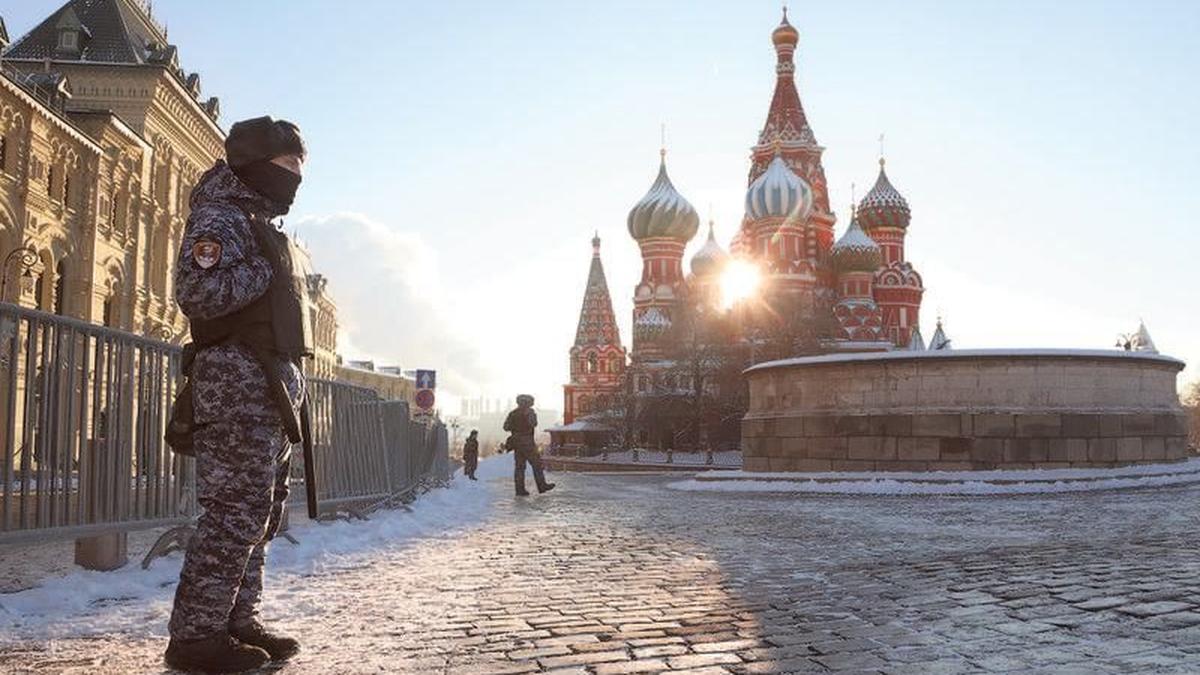
Crisp sub-zero winds envelop the Red Square, Moscow’s heart, as political activists, weekenders, and visitors from abroad pour through the twin-towered Resurrection gates, reconstructed in 1994. In the square, on one side is Soviet hero Vladimir Lenin’s memorial and the Kremlin, where governments have conducted business. On the other is the execution spot, where rebels were hanged during the Czarist period.
About a dozen people have gathered in the space, first constructed in the 14th century, for the festivities that precede the Victory Day parade on May 9 that commemorates the triumph of the Red Army over Nazi invaders in 1945, when World War II ended. This year will be the 80th anniversary, a reminder of the about 20 million Russian lives lost across four years.
Posters bearing ‘1945-2025’ hang from every street corner, welcoming visitors to the Red Square. The revellers head towards the heritage market located on one side of the stone-paved expanse that has been witness to Russian history, from the Tzars to the communists to the disintegration of the Union of Soviet Socialist Republics (USSR) in 1991. Until then, Ukraine had been one of 15 republics of the Soviet Union.
In the days running up to May 9, the market is dominated by supporters of President Vladimir Putin. They sing, wave tricolour white-blue-red flags, and distribute newspapers and pamphlets. These editorialise the news, declaring a definite victory in Russia’s ongoing war in Ukraine.
“Our citizens know that we are not fighting with Ukraine, but with the U.S., and for that we need to threaten Washington, not Sumy,” says an article in Natsional’ny Curs (The Nationalist Path), a news pamphlet that openly calls for keeping Russia’s nuclear arsenal ready. While the pamphlets and newspapers are in Russian, and that is the predominant language on the street, Moscow also has communities of Turks, Greeks, and Germans.
The enthusiastic support for Russia’s military campaign in Ukraine is infectious and most of Moscow — citizens and travellers alike — reflects this. Seema Kushwaha, an Indian student in her 20s, is in Moscow for a few months to study Russian, on an exchange programme from Agra. She says, “People back home worry about the situation here. But we don’t have any fear as Russia is very strong in security matters. The war is heading in the right direction for Russia.”
The over three-year-old war began with Putin amassing troops along Russia’s border with Ukraine and making demands against North Atlantic Treaty Organization (NATO) expansion, which were rejected. The Russian army then went in, in what Putin called a “special military operation”. On February 24, 2022, Putin announced the launch of missiles. Soon, Russia launched a full-fledged attack, bombing the capital Kyiv, and going to annex the eastern Ukrainian territories of the predominantly Russian-speaking Donetsk, Luhansk, Kherson, and Zaporizhzhia.


Russia claims control of Potapivka village in Ukraine's Sumy region amid ongoing military efforts to establish a buffer zone.

Iranian missile strikes on Israeli towns cause widespread damage and injuries, marking a significant escalation in the ongoing conflict.

As Gor makes first trip as U.S. Special envoy to South Asia, Delhi watches strategic signals closely
Sergio Gor's inaugural trip as U.S. Special Envoy to South Asia signals strategic U.S. engagement amid regional tensions.

Slovenians vote in a tight election between liberal and populist candidates, impacting the country's future domestic and foreign policies.

Netanyahu asserts U.S.-Israel alliance fights Iranian threats, emphasizing global security after missile strikes on Israeli and European targets.

Israeli settlers attack Palestinian villages in the West Bank, causing injuries and destruction amid ongoing settlement expansion.

Britain asserts no evidence of Iran planning missile strikes on Europe, despite Israeli claims of missile capabilities.

UNESCO reports over half of countries have banned phones in schools due to concerns about attention, cyberbullying, and social media impact.

Analysis reveals a U.S.-operated Patriot missile likely caused a pre-dawn explosion in Bahrain, injuring numerous civilians.

Sri Lanka raises fuel prices by 25% amid ongoing West Asia conflict, impacting petrol and diesel costs significantly.

Iran strikes near Israeli nuclear research center as Trump threatens attacks on Iranian power plants
Iran's missile strikes near Israel's nuclear site escalate tensions as Trump threatens retaliation against Iranian power plants.

Saudi Arabia intercepts one of three ballistic missiles targeting Riyadh amid ongoing regional tensions and threats from Iran.

Iran's death toll exceeds 1,500 amid escalating war, with heavy airstrikes and shifting U.S. and Israel strategies reported.