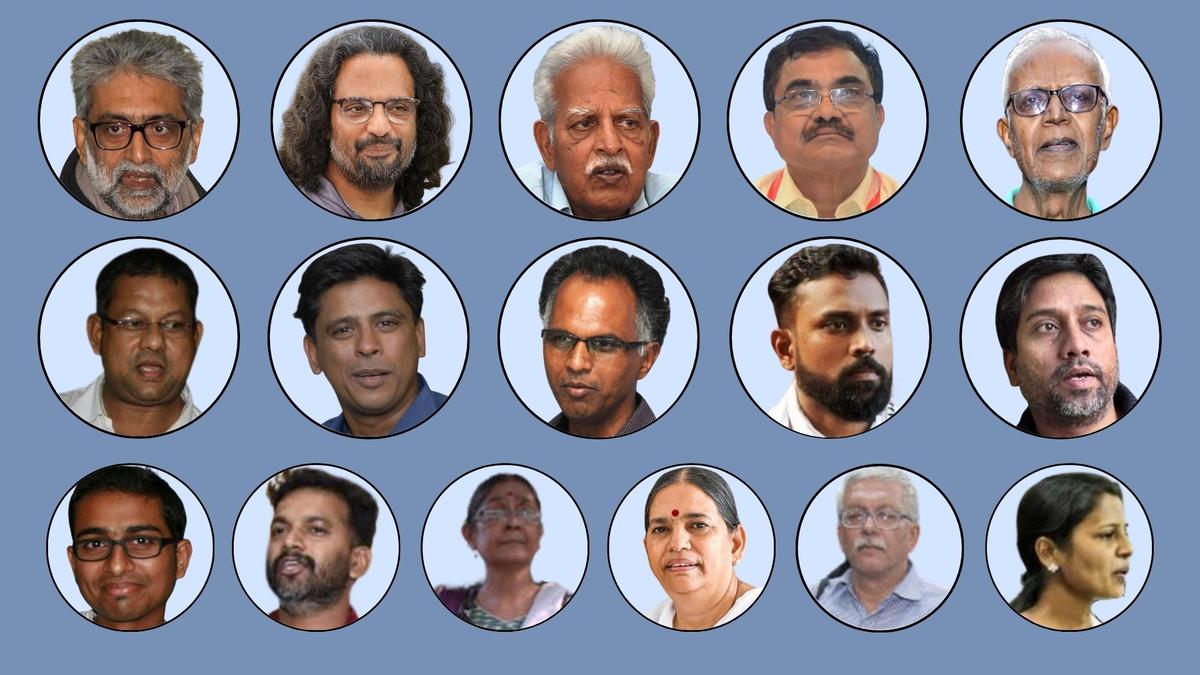
The cases and charges against the Bhima Koregaon 16 | Explained
The Hindu
Bhima Koregaon case: Legal status of the 16 activists, lawyers, scholars and artists arrested in the Elgar Parishad-Bhima Koregaon case in 2018.
On March 16, human rights activist Gautam Navlakha penned a letter, piecing together words of lament and surrendering to imminent arrest. Mr. Navlakha, is among the 16 human rights defenders who were arrested without trial in 2018 under the Unlawful Activities (Prevention) Act, 1967, for their alleged role in instigating caste violence at Bhima Koregaon. . In a letter published in The Caravan, he wrote he was “joining the ranks of thousands of others who are made to suffer for their convictions,” and dared to “hope to be freed” from “another conspiracy trial.”
Mr. Navlakha walked free after four years of incarceration on May 14. The Supreme Court granted bail to the 70-year-old, noting that charges are yet to be framed, and the trial would take “years and years and years for its completion.”
Six of Mr. Navlakha’s co-accused have been released on bail in the last six years: Sudha Bharadwaj, Anand Teltumbde, Vernon Gonsalves, Arun Ferreira, Varavara Rao and Shoma Sen. Activist Mahesh Raut secured bail in September last year but continues to remain in jail. Still behind bars are activists Rona Wilson and Sudhir Dhawale; lawyer Surendra Gadling; associate professor Hany Babu; activists and artists Sagar Gorkhe, Ramesh Gaichor and Jyoti Jagtap. Father Stan Swamy passed away while in detention in Mumbai’s Taloja Jail in July 2021, after being denied bail under medical grounds several times.
The Hindu traces the legal developments, taking you through the deferrals and detentions that have come to define the fate of the 16 incarcerated.
Mr. Navlakha was arrested on August 28, 2018, based on purported evidence of “involvement in inciting violence” during the Bhima Koregaon rally on December 31, 2017. The Pune police on the same day also arrested P. Varavara Rao, Sudha Bharadwaj, Arun Ferreira and Vernon Gonsalves. The Supreme Court directed that the accused be kept under house arrest; Justice D.Y. Chandrachud in his dissenting opinion cast doubt on “whether the Maharashtra police has...acted as fair and impartial investigating agency.” A local court granted the Maharashtra police’s appeal to transfer Mr. Navlakha to Pune, which was quashed later by the Delhi HC in October 2018. The Bombay HC in November ordered the police to refrain from taking coercive action against Mr. Navlakha. The activist, however, was subsequently imprisoned in the Taloja Jail in March 2020, after the SC refused anticipatory bail and directed him to surrender within three weeks before the National Investigation Agency (NIA).
Two years later, Mr. Navlakha was shifted from the Taloja Jail into house arrest on the grounds of ill health and poor prison facilities. Mr. Navalkha requested a mosquito net (required under his medical treatment), a plea rebuffed by the prison authorities.
The Bombay HC in December last year granted bail to Mr. Navlakha, observing there was no proof to back NIA’s claim that the activists had committed a terrorist act under the UAPA. The Court, however, stayed the implementation of the order for three weeks when NIA sought time to appeal against the bail order.


Explore Modakkurichi's agrarian challenges, development gaps, and tourism potential as it gears up for the upcoming elections.

The Govindapura police have successfully traced an 84-year-old man suffering from dementia who had gone missing last month, following a sustained 25-day search operation across the city.

First randomisation of EVMs and VVPATs held in Dindigul, Theni districts

Madras High Court permits Dayanidhi Maran to summon Union Telecom Secretary as witness in illegal telephone exchange case.

President of Mysuru District Consumer Disputes Redressal Commission A.K. Naveen Kumari has called upon consumers to check for quality certifications like ISI on products before purchasing them.

Students and women’s self-help groups in Madurai engage in vibrant voter awareness campaigns promoting 100% voting participation.

India pledges 60% non-fossil fuel power by 2035, targeting 47% emissions reduction per GDP unit and enhanced carbon sinks.

Supreme Court rules land acquisition compensation and interest must uphold constitutional guarantees, unaffected by financial burdens.

Election officials accept 23 nominations for Bagalkot bypolls, rejecting three, with polling scheduled for April 9.

Students and women’s self-help groups in Madurai engage in vibrant voter awareness campaigns promoting 100% voting participation.

Congress signals a "friendly fight" with allies in select Puducherry Assembly seats ahead of the April 9 elections.

Airstrike in western Anbar kills 7 Iraqi soldiers, injures 13, prompting condemnation for violating international laws on medical facilities.

Plaque unveiled in Bengaluru honors 11 victims of RCB stampede, emphasizing safety responsibility for future events.