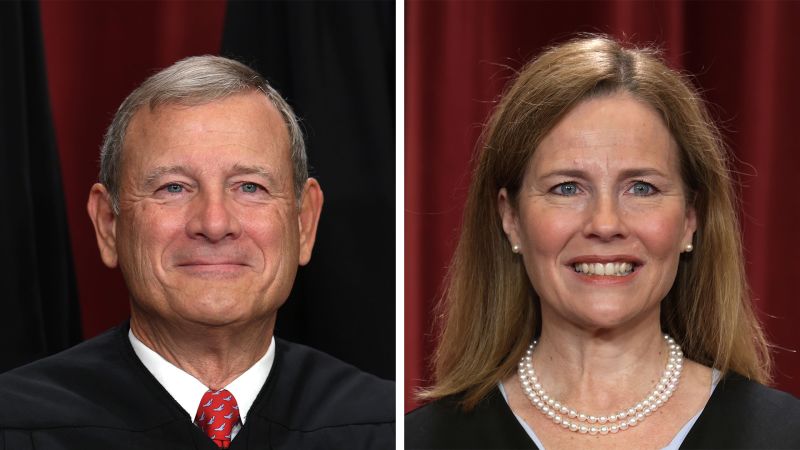
The behind-the-scenes power John Roberts wields to ensure his influence with justices
CNN
Chief Justice John Roberts often laments that he has limited clout as he deals with his eight Supreme Court colleagues.
Chief Justice John Roberts often laments that he has limited clout as he deals with his eight Supreme Court colleagues. “You can’t fire people if they don’t follow you. You can’t cut their pay,” he told a group of federal judges on Saturday, the day after the court released its final opinions of the term. “You have to be able to communicate what you think is important, and sometimes that means doing it eight different ways.” But Roberts, in fact, has several powerful levers, perhaps the most valuable being the power to assign opinions that speak for the court. When the chief is in the majority – as he was more than anyone this term – he chooses which justice will write the opinion. That’s important because the force of any Supreme Court decision exceeds its bottom-line vote. Its rationale sets a precedent for future cases. Even the rhetoric and tone can influence lower court judges. For the author of an opinion, the endeavor offers a chance to steer the law and can be a point of personal pride. Completing his 20th session on America’s highest court, Roberts has routinely kept the most important cases for himself, including those involving presidential powers. Still, he has wielded his assignment power strategically over the years, to influence and reward colleagues. In some situations, his assignments have appeared intended to cut against type or disprove ideological generalizations of the court.


Kentucky Gov. Andy Beshear, speaking in JD Vance’s home state of Ohio on Saturday, tore into the vice president, questioning his Appalachian roots and telling voters they “deserve better.”

President Donald Trump has said ICE agents will head to US airports tomorrow amid a partial government shutdown. Follow for live updates

Cuba is working to restore the electricity supply after another island-wide blackout left more than 10 million people without power.

President Donald Trump said Sunday border czar Tom Homan will be in charge of deploying Immigration and Customs Enforcement agents to airports on Monday, with Homan telling CNN the agents will help with security at entrances and exits to ease the Transportation Security Administration’s workload.

Donald Trump wants us to believe that a deal with Cuba is close at hand. After this past week, I am not so sure.

President Donald Trump has said ICE agents will head to US airports tomorrow amid a partial government shutdown. Follow for live updates

President Donald Trump said Sunday border czar Tom Homan will be in charge of deploying Immigration and Customs Enforcement agents to airports on Monday, with Homan telling CNN the agents will assist with security at entrances and exits to ease TSA workload amid a partial government shutdown.

Janet Mills and her allies are counting on a gender gap to narrow Platner’s wide lead ahead of the June 9 primary to decide who will face incumbent Republican Sen. Susan Collins. They are betting that the unfiltered style that has brought Platner widespread attention as someone who could help Democrats reach young men will backfire with women.

Why do people “pledge allegiance” to a “state” that is no longer a state? And what spurs someone to not just attack innocent people, but to then make a statement of loyalty while doing so?

A Supreme Court case examining state deadlines for election ballots sent in the mail is just the tip of the spear in President Donald Trump’s war on mail-in voting.

As a shrinking number of Transportation Security Administration agents work to keep hourslong security lines moving despite not being paid, President Donald Trump stepped into the fray Saturday, announcing he will send Immigration and Customs Enforcement officers to airports by Monday if Congress doesn’t agree to a plan to end the partial government shutdown.

Donald Trump wants us to believe that a deal with Cuba is close at hand. After this past week, I am not so sure.

The search for missing 84-year-old Nancy Guthrie, mother of “Today” show host Savannah Guthrie, has stretched into another anguished week, with mounting pressure on investigators and a family grappling with uncertainty.