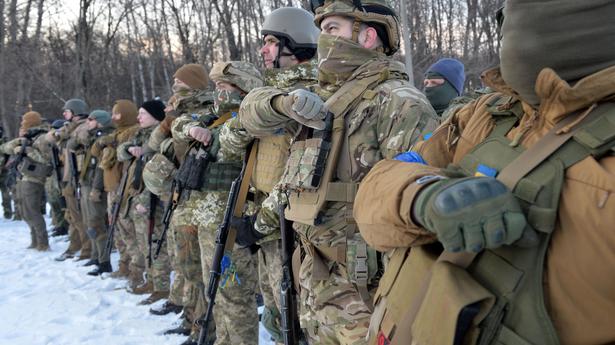
The Azov Battalion | The neo-Nazis of Ukraine
The Hindu
The far-right militia, once banned by the U.S., is part of Ukraine’s National Guard
When Russia annexed Crimea in February 2014, it faced no military resistance. Ukraine did not have an adequate number of combat-ready troops to mount a defence. Subsequently, when Russia-backed separatists took over government buildings in eastern Ukraine’s Donbas region as a prelude to full-fledged insurgency, the Ukrainian military again proved unable to quell the rebellion. It was against this background that the Azov Battalion was formed in May 2014.
The Azov began as a military infantry unit made up of civilian volunteers drawn from far-right, neo-Nazi groups that were active in Ukraine, such as the Patriot of Ukraine gang and the Social National Assembly (SNA). With its highly motivated band of fighters, the Azov unit recaptured the strategic port city of Mariupol from the separatists. Following this crucial military triumph — which had eluded the official forces of Kyiv — the Azov unit was integrated into the National Guard of Ukraine in November 2014.
In 2016, the Azov set up its political wing, the National Corps Party, under the leadership of Andriy Biletsky, an ultra-Nationalist who was a Member of Parliament from 2014 to 2019 and has said on record it is Ukraine’s mission to “lead the white races of the world in a final crusade… against Semite-led Untermenschen [inferior humans]”.
The military uniforms of the Azov feature Nazi insignia and its fighters have been photographed with tattoos of Nazi symbols such as the swastika. On the eve of the launch of National Corps, its members took out a Nazi-style raised-fist, torch-lit march through the streets of Kyiv. Members of the Azov militia also do street patrols where, in the name of enforcing what it calls ‘Ukrainian order’, they have been known to attack Roma and other ethnic minorities, and LBGT events. The Ukrainian National Guard has released videos of Azov fighters greasing bullets with pig fat, apparently for use against the Muslim Chechens fighting among the Russian forces.
Different human rights bodies, including the Office of the UN High Commissioner for Human Rights and Amnesty International, have accused Azov fighters, along with those form other volunteer battalions, of human rights violations, including torture, kidnappings, and extra-judicial executions. Over the years, the U.S. stance on the Azov has swung between proscription (driven by acknowledgement of its neo-Nazi politics) and sly collaboration (on the grounds of geopolitical pragmatism). In 2015, the U.S Congress passed a resolution stating that military aid for Ukraine cannot be used for funding, arming or training the Azov Battalion. But in 2016, the ban was rolled back, reportedly under Pentagon pressure. Since then, there have been unsuccessful efforts by Congress members — one of whom has described it as a “neo-Nazi paramilitary militia” — to designate the Azov as a ‘Foreign Terrorist Organisation’. For all that, Azov social media channels are rife with videos of militia members training with American-made weapons.
Similar contradictions were also on display, for instance, in the way Facebook has reacted to the Azov. In 2016, it designated the Azov battalion a “dangerous organisation”. In 2019, it placed the Azov in the same category as the Islamic State (IS) and banned it. But after the Russian invasion on February 24, Facebook reversed the ban, allowing expressions of praise for the Azov. Significantly, the Azov has always had a pan-Ukrainian dimension, with documented links to American white supremacist groups such as the Rise Above Movement (RAM). It has volunteer fighters from different parts of Europe. It regularly conducts military training camps for civilians, including children, and has tried to build a ‘cool’ sub-culture around nationalism, militarism and physical sports – its mixed martial arts tournaments are quite popular. Its spokespersons have reiterated their intent to eventually ‘take over’ Kyiv and have said Ukraine needs a dictator to set things right.
When Russian President Vladimir Putin announced a “special military operation” to carry out a “demilitarization” and “denazification” of Ukraine, he appeared to be referring to the neo-Nazi militias such as the Azov, who – with the blessings of the Ukrainian state – have been at the forefront of Kyiv’s military campaign against the Russia-backed separatist groups. Until the Russian invasion, many in the Ukrainian mainstream viewed the rise of the Azov with concern. After all, they were a law onto themselves and did not defer to the state — while their military units could operate independent of the Ukrainian chain of command, their street patrol units did not answer to the police, and their defiance of the law went unpunished. But the Russian invasion — belying its stated aim of denazification — may well end up laundering the Azov’s neo-Nazi baggage, as seen with Facebook’s U-turn, and strengthen the far-right forces, not just in Ukraine but beyond as well, which isn’t good news for Europe’s liberal democratic order.


Cuba begins restoring power after a nationwide grid collapse, affecting thousands amid an ongoing energy crisis and blackouts.

The Hindu LIVE updates on March 23 2026 on Iran-Israel war. Iran faces deadline of US President Donald Trump warning to open Strait of Hormuz

Brazil's Lula condemns renewed colonialism and U.S. interference in developing nations at a summit in Colombia.

Saudi Arabia expels Iranian military staff amid escalating tensions and ongoing missile attacks during the U.S.-Israeli war on Iran.

Russia claims control of Potapivka village in Ukraine's Sumy region amid ongoing military efforts to establish a buffer zone.

Iranian missile strikes on Israeli towns cause widespread damage and injuries, marking a significant escalation in the ongoing conflict.

As Gor makes first trip as U.S. Special envoy to South Asia, Delhi watches strategic signals closely
Sergio Gor's inaugural trip as U.S. Special Envoy to South Asia signals strategic U.S. engagement amid regional tensions.

Slovenians vote in a tight election between liberal and populist candidates, impacting the country's future domestic and foreign policies.

Netanyahu asserts U.S.-Israel alliance fights Iranian threats, emphasizing global security after missile strikes on Israeli and European targets.

Israeli settlers attack Palestinian villages in the West Bank, causing injuries and destruction amid ongoing settlement expansion.

Britain asserts no evidence of Iran planning missile strikes on Europe, despite Israeli claims of missile capabilities.

UNESCO reports over half of countries have banned phones in schools due to concerns about attention, cyberbullying, and social media impact.

Analysis reveals a U.S.-operated Patriot missile likely caused a pre-dawn explosion in Bahrain, injuring numerous civilians.