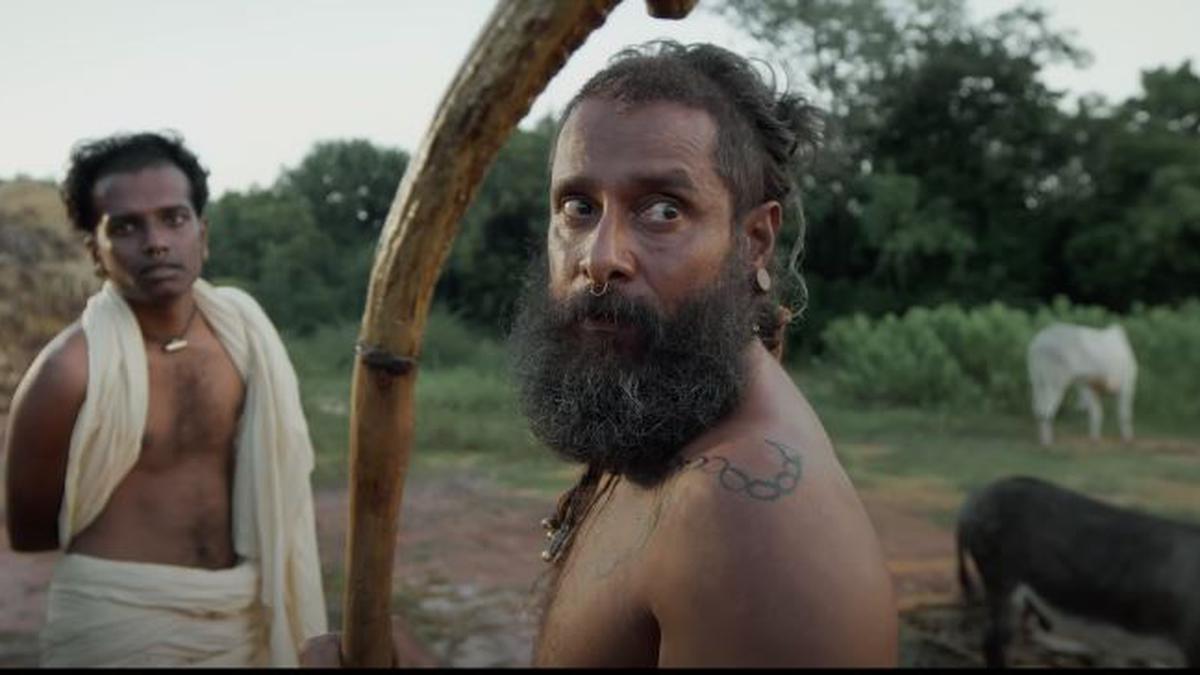
‘Thangalaan’ movie review: An ambitious Pa. Ranjith and regal Vikram aim for gold, but settle for less
The Hindu
The impressive performances and memorable sequences stand apart like golden nuggets in a muddled sieve in Vikram and Pa. Ranjith’s intriguing yet incoherent ‘Thangalaan’
In one of Thangalaan’s more memorable stretches, the titular hero, who was previously seen only draped in a loincloth, comes on horseback with a gun, wearing a shirt, trousers and even suspenders, to return the amount he owes a desirous landlord, and save his family from slavery. Apart from arguably being the best scene in the film and a probable hat-tip to Quentin Tarantino’s Django Unchained, Pa. Ranjith condenses the film’s core idea into a single sequence. Thangalaan has quite a few such momentous segments... fuelled by Ranjith’s unapologetically pertinent politics and fantastic performances. But whether they come together cohesively is a different question; the shimmer dims every now and then.
What sets apart filmmakers like Ranjith, especially against those trying to use the same medium to push diametrically opposite politics, is his command over the craft and use of tropes and metaphors as tools to drive home his angst against societal issues. If it was a wall in Madras, one’s identity in Kabali, land in Kaala, pride in Sarpatta Parambarai, a piece of a field in Dhammam (Victim) or a topic of conversation in Natchathiram Nagargiradhu, in Thangalaan, Ranjith takes his battle against oppression head-on.
In the Veppur village of North Arcot around 1850 CE, a clan of tribals, unable to manage the rapaciousness of a rich landlord, hastily send Thangalaan (Vikram) and a few more men with a British general Clement (Daniel Caltagirone) to find gold. Their forefathers had panned for gold during the rein of kings, and despite the prospect of venturing into a territory controlled by Aarathi the sorceress (Malavika Mohanan) who is willing to draw blood to secure the land’s possessions, the men stride forward in the hope of a better future. As expected, there’s more to it than meets the eye and it’s up to Thangalaan to save his folks and, of course, live up to his name as the son of gold.
On paper, Thangalaan might have come off as an endearing story of a man and his people standing up for themselves against all odds, and those who stood at the same place for generations. But stripped to its bare bones, it is a story of the search for one’s true identity. While the clan gets their answer only in the very last shot of the film, Ranjith and his fellow writers lace the film with enough fascinating characters trying to find their own identity.
Thangalaan is troubled by his dreams and wants to find a better living for his family; his wife, Gangamma (Parvathy Thiruvothu) is the family’s cornerstone; Pasupathy is a self-anointed Brahmin hoping that a piece of thread and “dietary restrictions” might get him a ticket to Vaikuntam; and then there’s the British general whose life depends on what he will find digging in the Indian soil. The search for their identities ends only when their search for the gold ends, and that’s easier said than done.
The biggest pillar of support for Thangalaan is Vikram and his able colleagues. The veteran actor gives his best every time and it’s no different here either; as the leader who endures inner turmoil but has to keep up a calm front, he aces his role with adept mannerisms and expressions. The rest of the cast, comparatively, have very little to do but experienced actors like Parvathy and Daniel pull off their roles excellently. A pleasant surprise on the acting front comes from Malavika as Aarathi and it’s indisputably her best role in Tamil. Shedding every inch of vanity, the lead and ensemble cast have undoubtedly given it their all to this enterprising project.
Behind the camera, it’s unsurprisingly Ranjith who stands apart and that’s both a compliment and a complaint. Yet another brilliant scene — that could only be mustered by someone like the filmmaker — is when the village women finally get their very own blouses. As an extension of the politics of clothing which he voiced out with Puyal in Kaala or with the titular character in Kabali, it makes for an endearing sequence accentuated by strong performances.


Actor-director Amol Palekar will receive META's Lifetime Achievement award for 2026 on March 25 in New Delhi.

India's artists unite against rising censorship, advocating for creative freedom and support for marginalized voices in the arts.

Written and directed by Kunal, the film also stars Sparsh Shrivastava and Vanshika Dhir

This year, Bharatnatyam artistes will present the Tyagaraja Aradhane as a dance performance

This year, Bharatnatyam artistes will present the Tyagaraja Aradhane as a dance performance

The actor, along with director Sushant Shah, speak about their upcoming series ‘Chiraiya’, Divya’s process of working on the dialect, Sushant’s approach to telling a story about women, and more

An independent video, ‘Feel the Spark’ by Raleigh Rajan with vocals by Ciera Dumas that celebrates Tamil literary giants, garnered 1.4 million views in less than 36 hours.

In ‘Jack Ryan: Ghost War’, John Krasinski is back as the savvy CIA analyst, diving headfirst into a high-stakes mission that unravels a deadly conspiracy and pits him against a rogue black-ops unit

Shriram Bharatiya Kala Kendra’s Shankarlal festival showcased rare ragas, radiant artistry, and inclusive performances, from Pt Madhup Mudgal’s serene morning ragas to Ramana Balachandran’s Saraswati veena.

Explore "Threads that Bind: The Kantha Project," an exhibition in Delhi reimagining kantha as a medium of repair and renewal.

Sean Penn skips the Oscars to meet Ukraine's Zelenskyy, who praises him as a "true friend" amid the war.

The teaser of Tamil star Suriya’s much-awaited film with director Venky Atluri, titled Vishwanath and Sons, was unveiled by the makers on Monday

A 'Golden' moment for a K-pop track at the Oscars.