Thamirabarani tragedy: When a march to champion the cause of Manjolai tea estate workers turned fatal Premium
The Hindu
Thamirabarani massacre: A tragic incident during a workers' protest in Manjolai tea estate, leading to 17 deaths.
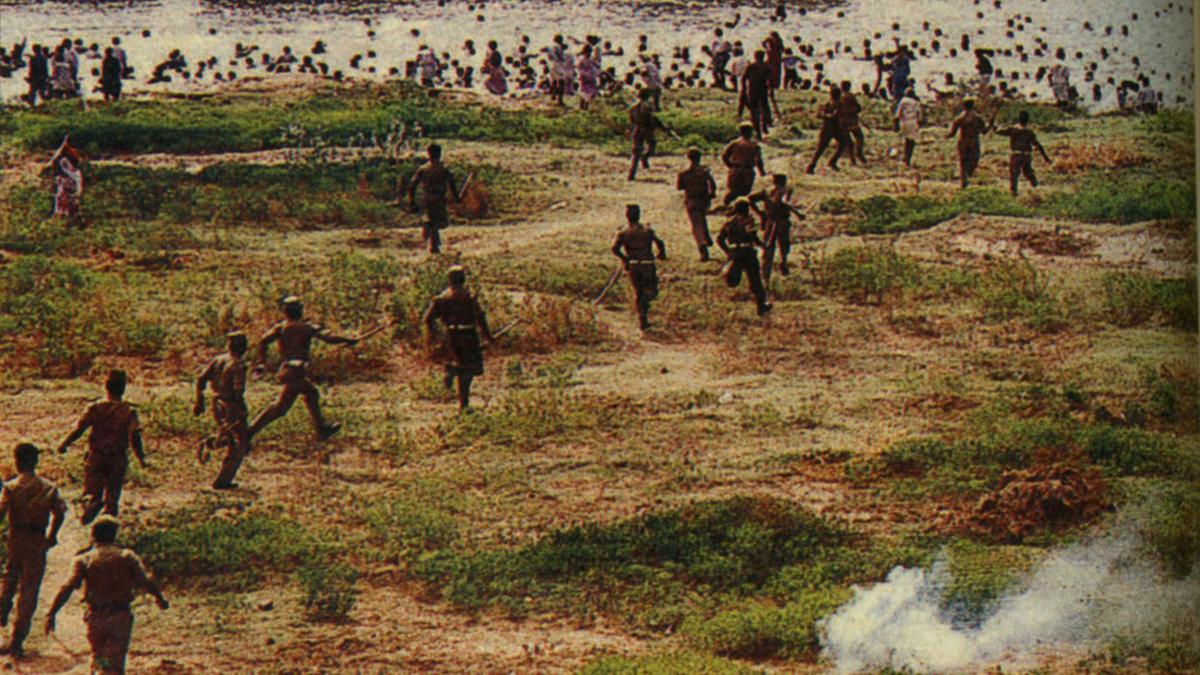
On July 23, a quarter century ago, what began as a peaceful procession championing the cause of the Manjolai tea estate workers in Tirunelveli district turned into a watery grave for 17 persons attempting to flee from the ‘lathi’ blows of the police. The victims, including two women and a two-year-old toddler, drowned in the Thamirabarani. This incident came to be called the Thamirabarani massacre.
The workers of the 8,374-acre estate, leased out to Bombay Burmah Trading Company, were waging a battle with the management for more pay and better amenities and working hours. They wanted the time they took to walk from the reporting point to the work spot, which could be four kilometres in some areas, to be included in the working hours.
Protesting against penalisation by the management, the workers staged an agitation in June 1999. It led to the detention of 652 persons, including 198 women. On July 23, the Opposition parties — the Tamil Maanila Congress (TMC), the Puthiya Thamizhagam (PT), the Communist Party of India (CPI), the Communist Party of India (Marxist), and the Thamizhaga Muslim Aikkiya Jamaath — took out a procession demanding the release of the workers, a solution to the year-long labour struggle, and take-over of the management by the Tamil Nadu government.
At least 3,000 plantation workers and party men took part in the procession, which was permitted by the police and led by Leader of the Opposition S. Balakrishnan, of the TMC, and MLAs K. Krishnasamy, of the PT, M. Appavu, J.M. Haroon, P. Velthurai, and R. Easwaran.
Balakrishnan and Dr. Krishnasamy, who were in an open jeep at the head of the procession, attempted to submit a petition to Tirunelveli Collector K. Dhanavel. The MLAs were stopped at the first gate of the Collectorate. Violence erupted when the police tried to stop them and the protesters threw stones. The police resorted to a ‘lathi’ charge and opened two rounds of fire in the air. Chaos reigned.
The Hindu initially reported that chased by the police, three persons, including a two-year-old boy (the son of a jailed plantation worker), drowned while crossing the river. In the next two days, 14 bodies were recovered from the riverbed.
“The panic-stricken men and women had no other option but to run towards the river. On seeing the police still pursuing them, they jumped into the water. The policemen did not withdraw even at this stage. Some of them jumped into the water and rained blows on the heads of the protesters with ‘lathis’. Those who jumped into the river were attacked by policemen from both the banks,” reported the Frontline. With the police on three sides, the only escape route open for the marchers was the river. They ran towards the river in the hope of crossing to safety. But they were followed by the police, reports said.


The government plans to amend the FCRA, introducing new regulations for NGO asset management and accountability for key functionaries.

The draft policy for “Responsible Digital Use Among Students”, released on Monday by the Department of Health and Family Welfare, has recommended that parents set structured routines with clear screen-time rules and prioritise privacy, safety, and open conversation with children on digital well-being.

Police Observer Sushant Kumar Saxena conducts surprise inspection at Shencottai police station, reviewing warrants and security arrangements ahead of elections.

Andhra Pradesh government to launch key projects in April, focusing on industrial growth and infrastructure development, says Nara Lokesh.

Lok Sabha refers the Corporate Laws (Amendment) Bill to a JPC amid opposition concerns over CSR provisions dilution.

SHG members in Kanniyakumari use snakes and ladders to raise election awareness and boost voter turnout.

Government accelerates consultations for early implementation of the Women’s Reservation Act to ensure women’s representation in 2029 elections.

CM A. Revanth Reddy distributes ₹1 crore insurance cheques to families of deceased Electricity department employees, enhancing financial security for workers.

The Bengaluru Traffic Police (BTP) registered 634 cases of drunk driving during a week-long special enforcement drive conducted across the city between March 16 and March 22.

GHMC intensifies action against property tax defaulters, seizing properties and offering a One Time Settlement scheme for payments.

CCB arrests three drug peddlers in Mangaluru, seizing ₹2.5 lakh worth of MDMA and other valuables.

TVK's 28 candidates in Puducherry include former BJP MLAs, a sitting Independent, and a retired police IG.

BRS submits notice on private member bill to Speaker