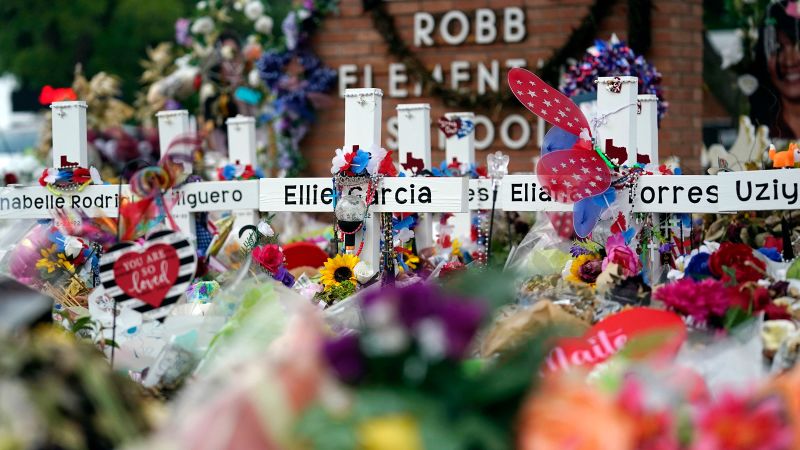
Text messages reveal police conversations following the Uvalde school shooting
CNN
More than two years after the deadly massacre at Robb Elementary School in Uvalde, Texas, the city released files related to the shooting on Saturday.
More than two years after the deadly massacre at Robb Elementary School in Uvalde, Texas, the city on Saturday released bodycam and dashcam videos, audio recordings of 911 calls and radio communication, documents and text messages related to the shooting. Most of the material released was previously reported by CNN. The files - some of which were redacted - were released only after CNN and more than a dozen other major news organizations filed a lawsuit to obtain public records related to the massacre. In one of the 911 calls, first reported by CNN in the months after the shooting, a 10-year-old girl trapped in a classroom tells the police dispatcher to “hurry” as there are “a lot of dead bodies.” The massacre at Robb Elementary School left 19 children and two teachers dead, making it one of the deadliest shootings at a K-12 school in the United States. Law enforcement was heavily criticized for their failed response to the May 2022 incident. While victims lay wounded, it took the 376 law enforcement officers on scene 77 minutes to confront and kill the gunman from the time he entered the school through an unlocked door. More than 90 Texas Department of Public Safety officers responded to the scene and were among the first to arrive. Among the hundreds of pages of text messages released Saturday, a series of messages show a group of officers expressing fear for their safety in the hours and days after the massacre, as community anger and national questions grew over why victims were left with the gunman for well over an hour. In the text messages, multiple officers ask for their photos to be removed from the department’s website after they felt like they were being blamed for the failed response.


ICE agents sent to airports as TSA callouts remain high; separately, two people have died after a plane collided with a fire truck at New York’s second biggest airport. Follow for live updates

Mike Pence used to dream of following two successful Donald Trump terms with his own turn in the White House.

An Air Canada plane was damaged after colliding with a vehicle on a runway at New York’s LaGuardia Airport Monday, according to video from the scene and air traffic control audio.

A statue of Christopher Columbus has been erected outside of an ornate federal office building on the White House grounds — the latest sign of the Trump administration’s efforts to reshape cultural and historical representations across the nation’s capital.

Kentucky Gov. Andy Beshear, speaking in JD Vance’s home state of Ohio on Saturday, tore into the vice president, questioning his Appalachian roots and telling voters they “deserve better.”

President Donald Trump has said ICE agents will head to US airports tomorrow amid a partial government shutdown. Follow for live updates

Cuba is working to restore the electricity supply after another island-wide blackout left more than 10 million people without power.

President Donald Trump said Sunday border czar Tom Homan will be in charge of deploying Immigration and Customs Enforcement agents to airports on Monday, with Homan telling CNN the agents will help with security at entrances and exits to ease the Transportation Security Administration’s workload.

Donald Trump wants us to believe that a deal with Cuba is close at hand. After this past week, I am not so sure.

President Donald Trump has said ICE agents will head to US airports tomorrow amid a partial government shutdown. Follow for live updates

President Donald Trump said Sunday border czar Tom Homan will be in charge of deploying Immigration and Customs Enforcement agents to airports on Monday, with Homan telling CNN the agents will assist with security at entrances and exits to ease TSA workload amid a partial government shutdown.

Janet Mills and her allies are counting on a gender gap to narrow Platner’s wide lead ahead of the June 9 primary to decide who will face incumbent Republican Sen. Susan Collins. They are betting that the unfiltered style that has brought Platner widespread attention as someone who could help Democrats reach young men will backfire with women.

Why do people “pledge allegiance” to a “state” that is no longer a state? And what spurs someone to not just attack innocent people, but to then make a statement of loyalty while doing so?