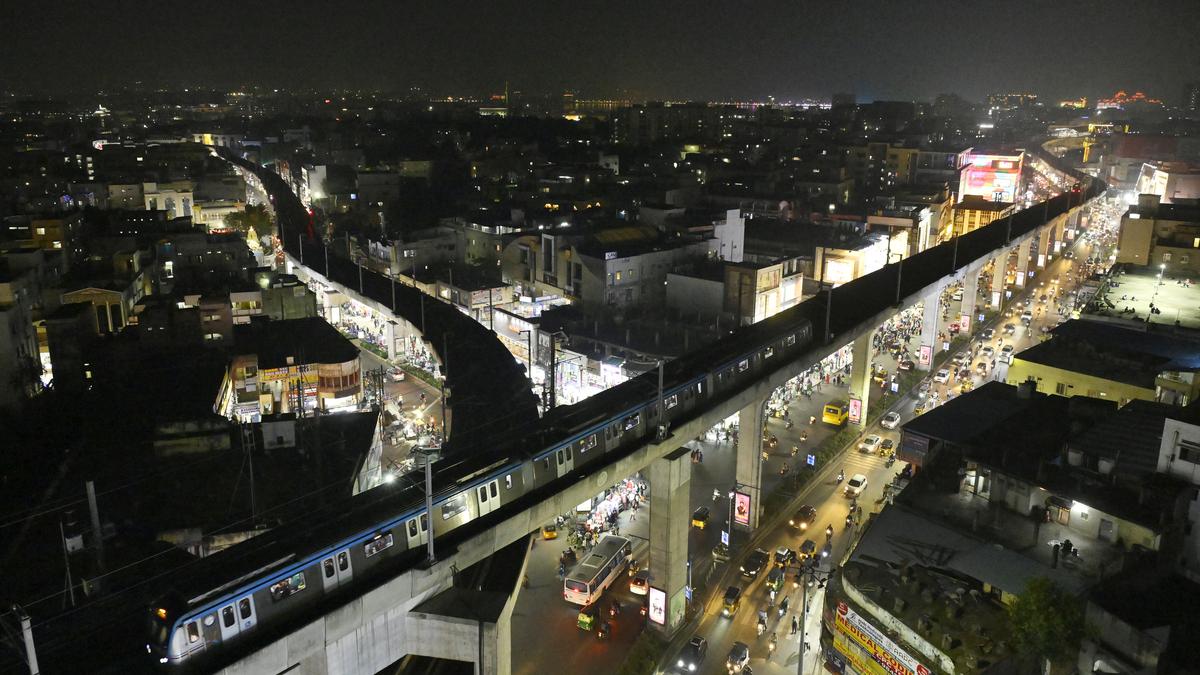
Telangana spotlight: 10 years on, Hyderabad metro rail phase 2 rolls into action
The Hindu
Hyderabad Metro Rail embarks on transformative phase two, promising seamless urban transit with new routes and financial model.
Later this month, the bustling streets of Hyderabad’s Old City will witness the rumble of excavators – not for routine roadworks, but to mark a transformative step in the city’s urban transit story.
The much-anticipated second phase of the Hyderabad Metro Rail (HMR) project is set to commence, starting with the demolition of approximately 400 properties along the 3.5 km stretch from Darulshifa to Shalibanda.
This marks the beginning of land acquisition for the long-stalled metro overhead line connecting Mahatma Gandhi Bus Station (MGBS) to the proposed Chandrayangutta junction station, a distance of 7.5km.
Following the demolition, the roads will undergo remarking while barricades will be set up to manage traffic and geo-technical studies will be taken up next month. These preliminary activities will pave the way for constructing the towering pillars and viaducts over which metro rail tracks will be laid.
This metro line is part of five new corridors proposed by the current Congress government in Telangana, spanning 76.4 km at an estimated cost of ₹24,269 crore. To be taken up as a joint venture between the State government and the Centre, the project includes a significant loan component of ₹11,653 crore (48%). The financial partnership will see the State contributing ₹7,313 crore (or 30%) and the Centre ₹4,230 crore (or 18%), with the latter also extending a sovereign guarantee.
It has been a long wait – 10 years, to be precise – but the wheels of Hyderabad’s metro rail expansion are finally turning again. This recommencement comes seven years after the HMR began its first phase of commercial operations across three corridors comprising 57 stations: the 29-km Red Line from Miyapur to L.B. Nagar, the 29-km Blue Line from Nagole to Raidurg, and the 11-km Green Line from Jubilee Bus Station to MGBS. These corridors opened in phases starting in November 2017, with the final stretch of JBS to MGBS being inaugurated in February 2020.
Driving this renewed momentum is Chief Minister A. Revanth Reddy, who has taken a hands-on approach to the metro’s revised blueprint. Under his leadership, Hyderabad Airport Metro Limited (HAML), the agency implementing the project, has been tasked with integrating the existing metro lines into a seamless circular loop. This involves connecting the terminal stations of Nagole and L.B. Nagar, and linking all the corridors to the proposed metro route extending to the Rajiv Gandhi International Airport (RGIA) in Shamshabad on the outskirts of Hyderabad.


Anuradha Jonnalagadda took over as in-charge Vice-Chancellor of the University of Hyderabad, focusing on continuity during the transition.

Telangana government awaits committee report on TGSRTC staff absorption, with decisions to be made at an appropriate time.

Telangana's revised pay scale implementation for employees will take timer. The tenure of Pay Revision Commission extended. Govt likely to take decision on reccomendation based on its report.

Vizianagaram's SP A.R. Damodar highlights 20 accident-prone areas and urges drivers to prioritize safety with helmets and seat belts.

Kerala HC stays disqualification of SNDP Yogam leaders, reversing a single judge's order regarding financial and regulatory compliance issues.

Karnataka announces daily supply of 10,000 LPG cylinders to hotels, easing the commercial shortage for the hospitality industry.

Malayalam superstar Mohanlal will be reuniting with filmmaker Priyadarshan, it was announced recently. It will mark the 100th film of Priyadarshan and is backed by Mohanlal’s longtime collaborator, Antony Perumbavoor

Gautham Vasudev Menon loses Madras High Court appeal, ordered to pay ₹4.25 crore to R.S. Infotainment with interest.

AIADMK faces its toughest challenge in 53 years as it prepares for the crucial 2026 T.N. Assembly elections.

Lakmé Fashion Week x FDCI 2026 in Mumbai: What worked and what didn’t

Telangana CM announces underpass beneath Begumpet Airport runway to alleviate traffic congestion in Hyderabad.

Congress leader Ramesh Chennithala claims an alliance between Pinarayi Vijayan, Modi, and Shah aims to undermine UDF in Kerala elections.

CCB arrests Bengaluru couple for running a fake government job scam, cheating over 100 victims out of crores.