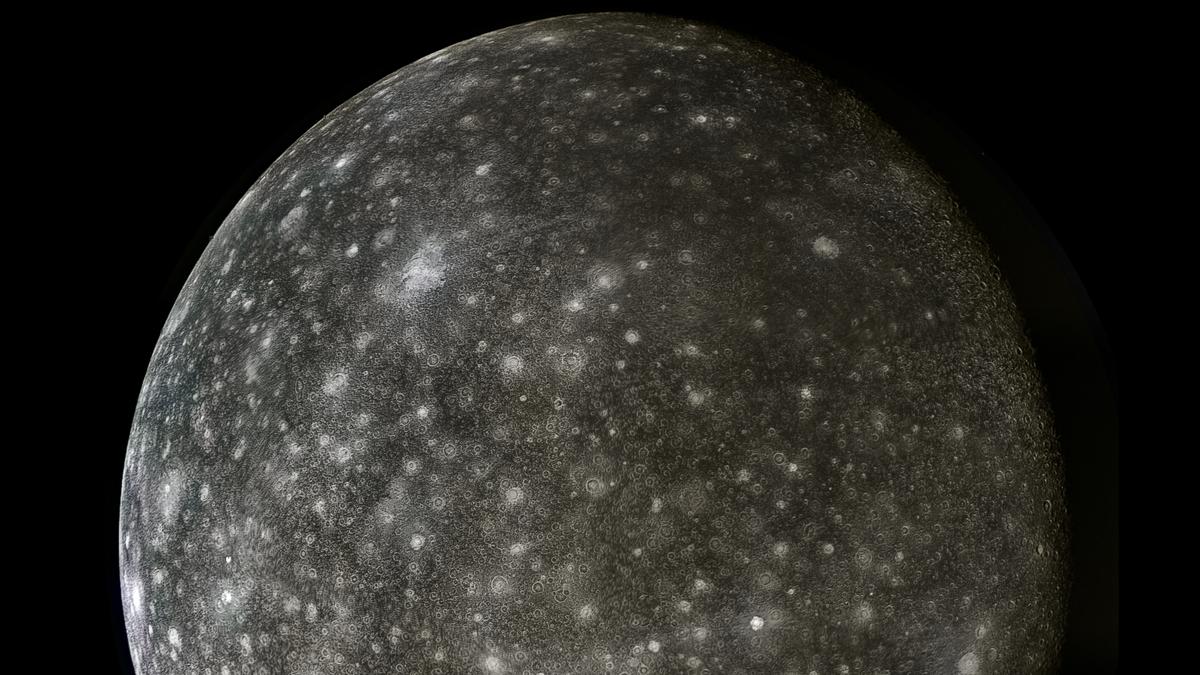
Team led by PRL Ahmedabad finds ozone on Jupiter’s moon Callisto Premium
The Hindu
Scientists discover ozone on Jupiter's moon Callisto, hinting at potential habitability and complex chemical processes on the icy celestial body.
An international team of scientists, including from India, has discovered strong evidence indicating the presence of ozone on Jupiter’s moon Callisto, shedding light on the complex chemical processes taking place on icy celestial bodies in the Solar System.
The study was published in the March 2024 issue of the journal Icarus. It outlines the researchers’ investigation into the chemical evolution of “SO2 astrochemical ice”, which is ice primarily composed of sulphur dioxide (SO2) in the presence of ultraviolet irradiation.
This shed light on the chemical processes and composition on the surface of Callisto. By analysing the data of the UV absorption spectra of the irradiated ice samples, the team was able to identify a distinct signature indicating the formation of ozone.
They corroborated their findings by comparing them with data from the Hubble Space Telescope to understand Callisto’s environment and the potential habitability of icy moons in the Solar System.
The earth has life not just because it found a way to originate here: it also had the resources to thrive, evolve, and diversify. These resources include sunlight containing the ‘right’ frequencies of radiation, water, a stable atmosphere providing a stable supply of the requisite gases and at the right temperature, and various compounds required for the life-forms’ biochemical processes.
This said, not all emissions from the Sun are good for organisms on the earth. Ultraviolet radiation in particular is harmful to many species (but also useful to some others). Two of its components, called ultraviolet-B and ultraviolet-C, of wavelengths 290-320 nanometres and 100-280 nanometres respectively, can damage DNA, trigger mutations, and increase the risk of skin cancer and cataracts in humans.
Ultraviolet light has also been known to inhibit plant growth and have detrimental effects on various organisms. This is why the ozone layer is a crucial part of the earth’s atmosphere: it completely absorbs ultraviolet-B and ultraviolet-C radiation.


Test your knowledge of the influential figures in physics who paved the way for Newton's groundbreaking discoveries.

Forget what Christmas is supposed to look like. In Chennai, it smells of the sea, plum cake and hot chocolate. Here are 12 ways the city keeps the season merry

Discover the science behind goosebumps, their causes, and their vestigial role in human biology.

Discover why yawning leads to watery eyes, exploring the role of facial muscles and lacrimal glands in tear production.

Countdown begins for ISRO's Bluebird Block-2 mission, launching a record-breaking communication satellite from Sriharikota on December 24, 2025.

Learn how astronauts are safeguarded from hazardous space debris through innovative engineering and international collaboration.

Explore the dual significance of Jantar Mantar as both a mathematical observatory and a designated protest site in Delhi.

Explore the roots of math anxiety in students and discover strategies to foster confidence and understanding in mathematics.

NASA loses contact with MAVEN, its Mars orbiter studying the planet's atmosphere, after a decade of successful operations.

ISRO's LVM3 will launch the BlueBird Block-2 satellite on December 24, providing global high-speed cellular broadband directly to smartphones.

Explore the SHANTI Act's implications for India's nuclear development, replacing outdated laws and targeting significant capacity growth.

ISRO successfully completed drogue parachute deployment tests for the Gaganyaan mission, advancing safety for human spaceflight.

Discover Ritwik Khanna's innovative repair shop Rkive in Mumbai, merging sustainability, creativity, and youthful urgency in fashion.