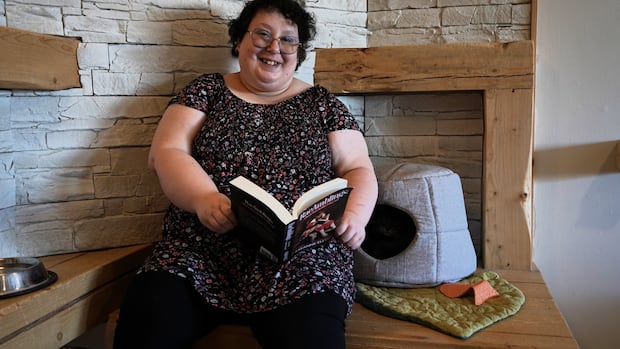
Talking to strangers online helped me feel less lonely. But I was sliding toward disaster
CBC
This First Person article is the experience of RaeAnne Ellert, who lives in Regina. For more information about CBC's First Person stories, please see the FAQ.
I was lying on my bed with my laptop one evening when a new friend request popped up on Skype. I didn’t know who it was, but I accepted out of curiosity and a love of meeting new people.
Let’s call this stranger Mark. He immediately sent me a message and we started chatting about life.
Maybe this unsolicited friend request should have rung an alarm bell in my mind.
When I was a kid, my mom and dad had rules around chat rooms, warning me about the dangers of talking to strangers. I did listen for the first little while, but when I was 13, I started sending emails to musicians, their partners and their management. I loved it when they responded, particularly since it was a struggle to connect with my peers in the real world.
What you should know about me is that I was born with a rare genetic mutation — so rare it doesn’t have a name and is only known as duplication 10p12.33p11.23.
My disability makes it hard for me to multitask and it takes me longer to do things. I have a short stature, poor dexterity and get overwhelmed easily. Like many neurodivergent kids, I was perceived as different, and I had a hard time making friends. I loved listening to tunes, but my peers said my taste was “old people music,” which left me feeling excluded.
At the time Mark sent me that friend request, I was in my 20s and living in a small town and had become socially isolated. My relationships with the musicians I’d corresponded with over the internet were a lifeline at that point. A musician named John from Toronto turned out to be a friend I really needed.
When I told John about the friend request on Skype, John immediately got back to me saying there were warning signs the stranger was a scammer and to block him right away.
“But he never asked for money,” I wrote.
Mark and I had only spoken for an hour at that point.
“That’s how they work. They will be very friendly to you, then ask you for money,” John said.
Trusting John, I promptly blocked the stranger and kept the lesson to myself. I was confused and embarrassed, but I was grateful that John had my best interests at heart.
I couldn’t see the irony in the moment, in the fact that like a scammer, I myself had spent years messaging people I didn’t know.


Lawyers for a man acquitted in a high-profile Toronto murder trial where a police officer was killed are holding a news conference Thursday to address a recent Ontario Provincial Police report that re-examines evidence from the trial.

Quebec provincial police arrested two men after a suspicious package grounded flights headed to Montreal's Pierre Elliott Trudeau International Airport on Wednesday.

A nurse in Winnipeg says Canada's immigration system is undercutting efforts to address a shortage of health-care workers, after his application for permanent residency was rejected based on a technicality.

This year's provincial budget is "essentially" the status quo for wildfire preparation and response, the finance minister says.

Parts of B.C.'s coast continues to see heavy rain as Environment and Climate Change Canada warns of a prolonged atmospheric river this week.

Alberta teachers say they face increasingly dangerous conditions at school, with the most common threat coming from their own students.

Cataract surgeries at Charlottetown’s outpatient clinic are expected to resume in April, after procedures scheduled for March were cancelled due to the clinic reaching its annual funding target earlier than expected.

Shannon Elgazzar can see planes taking off from Cairo International Airport from her balcony.

Yellowknife city council has voted in favour of signing an agreement with the federal government that's aimed at bringing piped water and sewer service to the city's airport.

While Canada's economy is far more reliant on exports to the U.S. than vice versa, Canadian negotiators have crucial ammunition in their efforts to land a trade deal that reduces or eliminates tariffs imposed by U.S. President Donald Trump.

Nova Scotia PC MLA Rick Burns says he and his wife are victims of blackmail after hackers accessed and shared videos and intimate images on his personal devices this week.

The Saint John Board of Police Commissioners and Chief Robert Bruce have lost a bid to permanently deny public access to all court documents related to conduct complaints nine officers filed against the chief.

With the looming October election, Quebec Finance Minister Eric Girard has delivered a modest budget as the province aims to withstand ongoing trade disruptions and mounting geopolitical pressure.