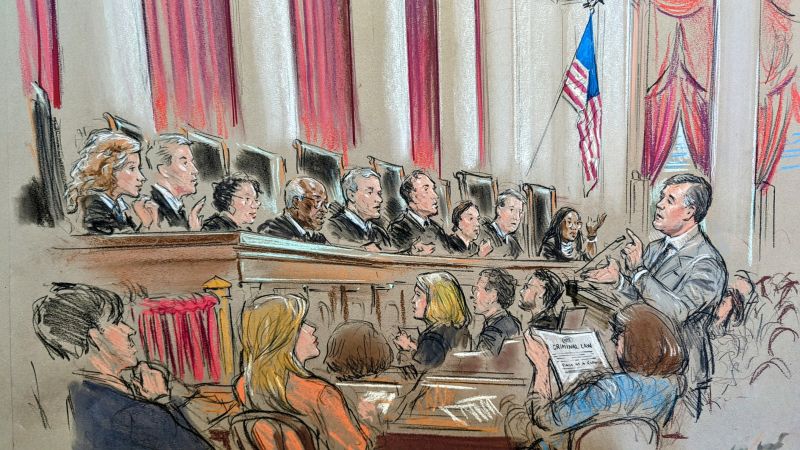
Takeaways from the Supreme Court’s arguments over obstruction charge used against January 6 rioters
CNN
The Supreme Court’s conservative majority indicated Tuesday that it may toss out a charge prosecutors have lodged against hundreds of people who took part in the January 6, 2021, riot on the US Capitol, a decision that could force the Justice Department to reopen some of those cases.
The Supreme Court’s conservative majority indicated Tuesday that it may toss out a charge prosecutors have lodged against hundreds of people who took part in the January 6, 2021, riot on the US Capitol, a decision that could force the Justice Department to reopen some of those cases. During over 90 minutes of arguments, most justices signaled concern with how the Justice Department is using the law enacted by Congress more than two decades ago in response to the Enron accounting scandal. Critics claimed the felony charge, which carries a prison sentence of up to 20 years, was intended to prevent evidence tampering – not an insurrection in support of a president who lost reelection. The court’s decision, expected by July, could have significant ramifications for some 350 people who were charged with “obstructing” an official proceeding for their part in the Capitol attack – including more than 100 people who have already been convicted and received prison sentences. The high court’s ruling could also affect the federal election subversion criminal case pending against former President Donald Trump, who was also charged with the obstruction crime. Here’s what to know about Tuesday’s oral arguments: The appeal was brought by a former Pennsylvania police officer, Joseph Fischer, who was charged with multiple crimes for pushing his way into the Capitol after attending Trump’s rally outside the White House on January 6. Fischer’s attorney told the justices that prosecutors overstepped by charging his client with what critics previously framed as an anti-shredding law.


As a shrinking number of Transportation Security Administration agents work to keep hourslong security lines moving despite not being paid, President Donald Trump stepped into the fray Saturday, announcing he will send Immigration and Customs Enforcement officers to airports by Monday if Congress doesn’t agree to a plan to end the partial government shutdown.

Donald Trump wants us to believe that a deal with Cuba is close at hand. After this past week, I am not so sure.

The search for missing 84-year-old Nancy Guthrie, mother of “Today” show host Savannah Guthrie, has stretched into another anguished week, with mounting pressure on investigators and a family grappling with uncertainty.

Cuba’s Ministry of Energy announced Saturday evening that entire island has suffered another electrical blackout, leaving more than 10 million people without power.

Iran’s attempt to strike a US-UK base over 2,000 miles (over 3,000 kilometers) off its coast has renewed questions about Tehran’s military capabilities and how far its missiles can reach.

For years, President Donald Trump has offered crass and insensitive comments about people who died – especially his foes. That reached a new level on Saturday.

Robert Mueller, the former FBI director who led the historic probe into alleged collusion between Donald Trump’s 2016 campaign and the Russian government, has died. He was 81.

Marlon Batres is not OK. The assistant principal says he is in constant fear for his students, staff and even himself after federal agents swarmed the streets.

To hear some prominent MAGA voices tell it, the marathon Senate debate over the “SAVE America Act” is an existential one for the Republican Party. But the urgency to pass the legislation is not felt by Americans more widely.

In the days after winning the Democratic nomination for Senate, Illinois Lt. Gov. Juliana Stratton spoke to the two women with whom she could make history next year.

This month, terrorist suspects in the alleged bomb-throwing in New York City and the synagogue attack in Michigan visited Phantom Fireworks stores shortly beforehand.

In near-daily briefings with top military officials at the White House, President Donald Trump has reviewed options that include sending American troops into Iran.

With his Atlantic City casinos in duress in the 1990s, Donald Trump saw a potential lifeline in sports betting and aggressively campaigned to legalize it in New Jersey. But when state powerbrokers shut him down, Trump vowed that he’d eventually find a way to win.