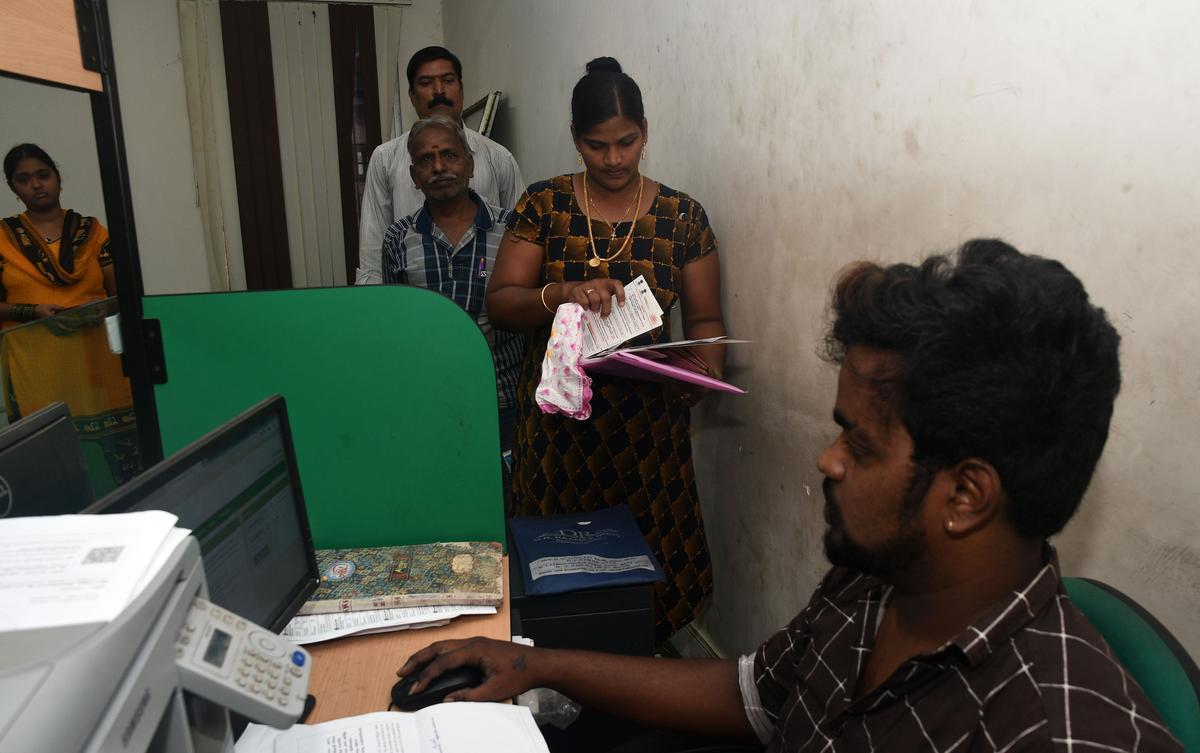
T.N.’s e-Sevai centres receive twice as many applications as online portal
The Hindu
Civil servants cite nominal charges fixed by them and swiftness in execution as reasons for people preferring to approach these centres
The Tamil Nadu e-Governance Agency (TNeGA) portal, meant to help people seeking e-Sevai services from their mobile phones or laptops anywhere / anytime, does not seem to have stopped many from visiting e-Sevai centres.
According to official data for four months, ending November, the number of people going to the e-Sevai centres, a large number of which are located at taluk offices, is more than twice that of applicants using the portal (https://www.tnesevai.tn.gov.in/citizen/).
Approximately, 30.96 lakh applications were received in the last four months for a host of certificates, such as community certificate and income certificate, which are all issued through the Revenue Department. Of these, 21.54 lakh were submitted at e-Sevai centres and 9.42 lakh through the portal.
A senior official says the purpose of setting up the portal is to ensure that people get their documents without going to the taluk offices. This has not been achieved as a majority are yet to change their mindset. Lack of awareness, according to a former Secretary of the Revenue Department, is a key issue. So, greater awareness has to be generated about the portal.
Civil servants, who have been observing the functioning of taluk offices and the e-Sevai centres, cite nominal charges fixed by them and swiftness in execution as reasons for people preferring to approach these centres. “Most applicants are not ‘tech savvy’. So, they need guidance to upload certain documents. The centres take care of these aspects. Accessibility of the e-Sevai centres is another factor,” says a former official, who has been keenly following the evolution of digital governance.
However, a document of the Information Technology and Digital Services Department offers a different perspective.
There has been a “steady increase” in the number of transactions on the citizen portal. From only 2% of the e-Sevai transactions being delivered in 2018, the figure shot up to more than 20% in 2021. The goal is to have 50% of the e-Sevai transactions through the citizen portal.


Anuradha Jonnalagadda took over as in-charge Vice-Chancellor of the University of Hyderabad, focusing on continuity during the transition.

Telangana government awaits committee report on TGSRTC staff absorption, with decisions to be made at an appropriate time.

Telangana's revised pay scale implementation for employees will take timer. The tenure of Pay Revision Commission extended. Govt likely to take decision on reccomendation based on its report.

Vizianagaram's SP A.R. Damodar highlights 20 accident-prone areas and urges drivers to prioritize safety with helmets and seat belts.

Kerala HC stays disqualification of SNDP Yogam leaders, reversing a single judge's order regarding financial and regulatory compliance issues.

Karnataka announces daily supply of 10,000 LPG cylinders to hotels, easing the commercial shortage for the hospitality industry.

Malayalam superstar Mohanlal will be reuniting with filmmaker Priyadarshan, it was announced recently. It will mark the 100th film of Priyadarshan and is backed by Mohanlal’s longtime collaborator, Antony Perumbavoor

Gautham Vasudev Menon loses Madras High Court appeal, ordered to pay ₹4.25 crore to R.S. Infotainment with interest.

AIADMK faces its toughest challenge in 53 years as it prepares for the crucial 2026 T.N. Assembly elections.

Lakmé Fashion Week x FDCI 2026 in Mumbai: What worked and what didn’t

Telangana CM announces underpass beneath Begumpet Airport runway to alleviate traffic congestion in Hyderabad.

Congress leader Ramesh Chennithala claims an alliance between Pinarayi Vijayan, Modi, and Shah aims to undermine UDF in Kerala elections.

CCB arrests Bengaluru couple for running a fake government job scam, cheating over 100 victims out of crores.